Download Savvycom’s comprehensive whitepaper to discover proven frameworks for deploying Operational AI in logistics from architecture design to production implementation and learn how leading enterprises achieve measurable business impact.
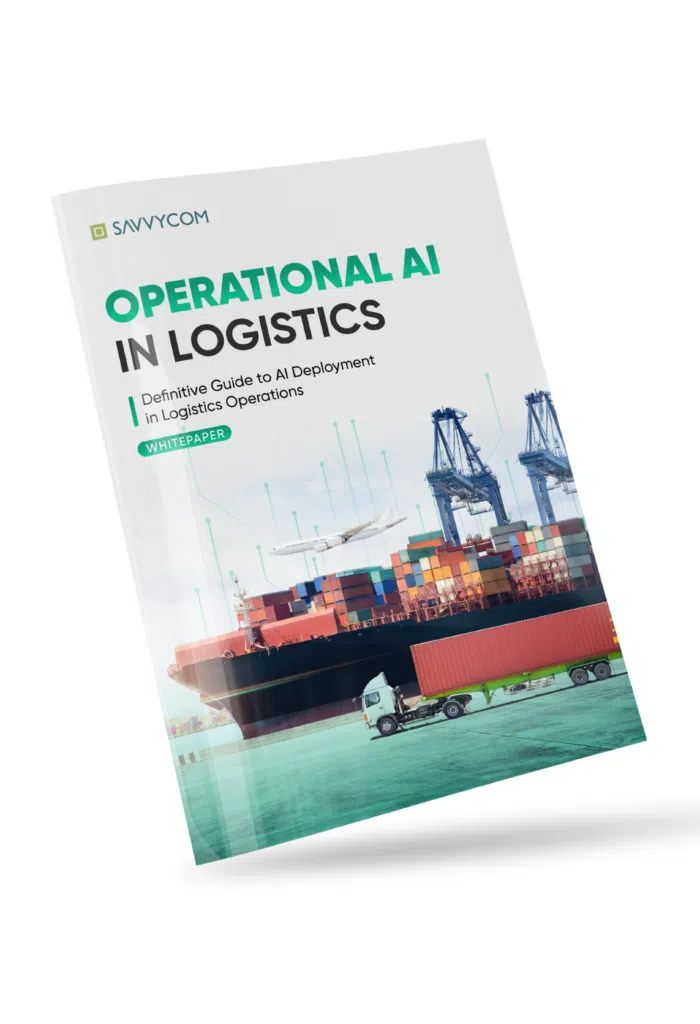
Download our FREE AI whitepaper
Operational AI in Logistics – Turning Visibility into Real-Time Execution
Whitepaper Summary
The Complete Operational AI Playbook for Modern Logistics
From architecture design to production deployment, everything you need to transform logistics operations with AI systems that actually scale.
Modern logistics operations face an execution gap: systems provide visibility into what’s happening, but operational decisions still rely on manual processes that can’t match the velocity modern supply chains demand. With thousands of routing decisions daily, hundreds of contracts under review, and equipment maintenance across distributed facilities, logistics enterprises need systems that act autonomously within defined parameters – not just report what happened.
This whitepaper provides a comprehensive technical and strategic framework for deploying Operational AI systems that close this execution gap. Written for C-level executives, technical teams, and project managers, it examines proven architectural patterns, real-world use cases, and systematic deployment approaches that reduce the failure rate plaguing AI initiatives industry-wide.
What’s Inside This Whitepaper
- Foundational concepts: Why Operational AI differs from traditional analytics, the operational execution gap in modern logistics, and three fundamental capabilities AI enables processing complexity at scale, real-time operational decisions, and learning from outcomes.
- Reference architecture: A four-layer technical framework covering data ingestion from enterprise systems, AI processing through NLP and computer vision, decision logic with confidence thresholds, and action execution across TMS/WMS platforms.
- Decision support vs automation: Framework for determining which AI outputs drive automated actions versus human review, risk-based governance aligned with NIST AI RMF and EU AI Act, and confidence scoring methodologies.
- Real-world case study: Savvycom’s contract intelligence deployment for a global logistics provider – technical architecture, implementation approach, measurable results (70% efficiency, 85% accuracy, 3x volume capacity), and 18-month ROI achievement.
- Deployment decision framework: Three-question structure including Should we deploy AI? (qualifying and disqualifying criteria); Are we ready? (assessment across data, processes, team, budget); How do we implement? (build vs buy decision matrix across platforms, solutions, and custom development).
- Readiness assessment: Evaluation framework covering data infrastructure maturity (availability, quality, volume), process standardization level, team AI literacy and technical capability, and realistic budget/ROI expectations (12-24 month typical timelines).
- Practical guidance: Phased deployment roadmaps, pilot-to-production transition criteria, change management alongside technical implementation, and success metrics aligned with operational KPIs rather than just model accuracy.
Key Insights
6 Data-driven Insights From Logistics Enterprises That Achieved
Measurable Impact And What They Did Differently
Operational AI transforms logistics through three capabilities:
◦ Processingcomplexity at scale (NLP extracts contract terms, computer vision monitors yards).
◦ Enabling real-time decisions (route optimization updates continuously).
◦ Learning from outcomes (models improve accuracy over time).
Contract intelligence deployments achieve:
◦ 70% efficiency improvements.
◦ 85% risk scoring accuracy.
◦ Enabling legal teams to handle 3x contract volume without additional headcount.
Reference architecture operates across four layers:
◦ Data ingestion from TMS/WMS/ERP.
◦ AI processing (NLP/computer vision/ML models).
◦ Decision logic with confidence scoring and human-in-the-loop.
◦ Action execution across operational systems.
Successful AI deployment requires 12-24 months to measurable ROI, with systematic investment across data infrastructure (6-12 months foundation building), process standardization, and team capability development – not just technology purchase.
Operational AI applies most effectively to high-frequency decisions (thousands daily), volatile inputs requiring continuous recalculation, speed-critical operations (sub-30-second response), and scenarios with available historical training data .
Organizations achieving deployment success share characteristics: executive sponsorship beyond IT, realistic ROI timelines (not “AI magic”), data infrastructure investment before model development, and systematic change management alongside technical implementation technology alone doesn’t deliver value.
VIEW OUR COMPLETE AI CAPABILITIES
Savvycom has officially launched Savvycom AI – a knowledge hub to showcase our end-to-end AI services, ready-to-use solutions, and real-world success stories from enterprise deployments. Explore how we transform AI strategy into measurable impact through practical implementation and industry-proven experience.
Additional Data Snippets
The 4 Data Points Every AI Investment Decision Needs
01
Four proven use cases deliver measurable ROI
◦ Contract intelligence: 70% efficiency gain, 85% accuracy
◦ Yard management: <30-second slot assignment, 20% capacity increase
◦ Route optimization: 15-20% fuel savings, real-time traffic response
◦ Predictive maintenance: 30-50% downtime reduction, weeks-ahead failure alerts
02
Implementation investment ranges
◦ Platform adoption: $50K–$150K initial, fastest deployment (3-6 months)
◦ Solution integration: $150K–$500K, balanced customization (6-12 months)
◦ Custom development: $500K–$2M+, strategic differentiation (12-24 months)
◦ Hybrid approach: Platforms for commodity, custom for competitive advantage
03
Readiness assessment dimensions
◦ Data infrastructure: Real-time TMS/WMS/ERP access, quality >95%, volume >10K transactions/month
◦ Process standardization: Documented SOPs, <20% exception rate, clear escalation paths
◦ Team capability: AI literacy, technical deployment skills, executive sponsorship
◦ Budget/ROI: $2M investment → $30-35M annual savings at scale (McKinsey benchmark)
04
Security and compliance requirements
◦ Data privacy: GDPR/CCPA compliance, AES-256 encryption, geographic data residency
◦ Access control: RBAC, MFA mandatory, OAuth 2.0/JWT, principle of least privilege
◦ Audit trails: Immutable logs, 7-year retention, decision transparency via SHAP/LIME
◦ Standards: ISO 27001, SOC 2 Type II, NIST AI RMF alignment, EU AI Act readiness
Our AI Portfolio
Discover The Real AI-Driven Success Stories
Many businesses have chosen Savvycom to help them design & build & deliver innovative AI services. Here are just a few examples of our Case Studies.







Let’s Talk About Your AI Journey
Recent News
Our Latest Insights









Direct PDF Access (for archive & crawling): https://savvycomsoftware.com/wp-content/uploads/2026/04/SVC_whitepaper-2026_Operational-AI-in-Logistics.pdf