Consumer
Wallet Apps
Registration, balances, top-up, transfer, bill payment and card linking, built for web and mobile with identity checks that run in the flow rather than behind it.
Savvycom builds and scales wallet platforms for banks, telecom operators, retail groups and fintech firms: onboarding, payments, merchant acceptance and settlement, connected to the systems that already hold the balance.
Book 1:1 Consultation



Every figure below comes from a published Savvycom case study you can open and check. Where the client works in another part of financial services, it is named under the number.
Customer onboarding
Processing with AI agents
Records migrated
Fintech Company in Vietnam
Each type of wallet has different licence needs, costs and launch times. Choosing the right one first saves months of rework.
Money is spent only inside your own brand: top-ups, store credit, loyalty and refunds. No licence to acquire, so it is the fastest route to a live wallet.
Money moves out to other merchants, banks and people. Licensing, settlement and fraud controls set the launch date here, not the app build.
The wallet holds balances for sellers or partners and pays them out on a schedule you control, with the fee and commission rules applied automatically.
A wallet added to a banking, retail, telecom or mobility app you already have, reusing the accounts and identity that exist, so customers do not register twice.
Custody, exchange and reporting for digital assets and collectibles, built to the controls an institution has to evidence rather than to a consumer application standard.
A wallet designed around how your business actually earns: your fee structure, your customer groups, your partners. Chosen when no ready-made product carries the rules you need.
Users decide in their first few minutes whether to keep a wallet. These are the basics they expect to work from day one.
Transfers between customers, businesses and accounts, with the same status visible to both sides of the payment.
Payment at merchants and transfers out to banks and partners, including across borders where the licence allows it.
Every movement listed with its reference, so the customer and your support team are reading the same record.
Balance available at any moment, with statements a customer can download and an accountant will accept.
Routine questions answered automatically around the clock, passed to a person when the case needs one.
Spending grouped and shown back to the customer, which is also what makes the wallet worth opening between payments.
Customer data and credentials recoverable after a lost or changed device, without opening the account again from scratch.
Encryption, device binding, transaction limits and fraud detection applied to every transaction, not only at sign-up.
These are the baseline. What takes longer to build is everything underneath them: the ledger, the reconciliation, the limits engine and the partner connections that make each feature correct rather than merely present.
Customers only see the mobile app, but every wallet also needs a merchant portal and an admin console. Planning all three from the start avoids surprise costs later.
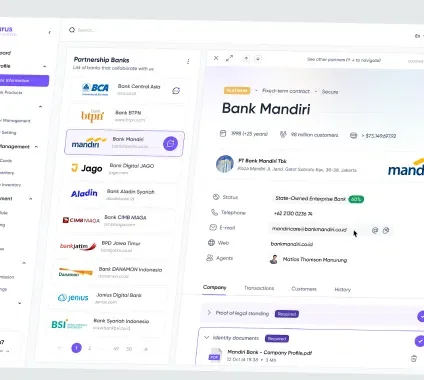
Your own team's view of the wallet, and the first thing an auditor asks to see.
The side that decides whether a merchant keeps accepting after the first month.
The part everyone budgets for, and the only one customers ever judge you on.
We add AI to the parts of a wallet business that cost the most time and money: customer onboarding, reconciliation, customer support and back-office operations. Figures below are typical results from Savvycom AI solutions, and your free assessment confirms what applies to your wallet.
AI reads the ID document, matches the selfie and checks liveness in one flow. Your staff only review the cases the AI flags, cutting manual verification time by up to 90% and getting new users to their first payment faster.
AI reads partner files, bank statements and merchant documents and flags mismatches automatically. Finance teams typically spend 70 to 80% less time typing in data, and month-end closes sooner.
An AI assistant answers questions about failed top-ups or missing refunds using the customer’s own transaction history, day and night. Typical result: 20 to 40% fewer repetitive requests, with complex cases passed to a person.
AI agents handle routine operations work such as checking exceptions, preparing reports and routing approvals, with a person signing off each step. In a Savvycom FX operations project in South Korea, processing became 60% faster.
Four areas cover what an e-wallet business needs built, connected or automated. Each card shows what we deliver and the result it is built for.
Registration, balances, top-up, transfer, bill payment and card linking, built for web and mobile with identity checks that run in the flow rather than behind it.
The side of the wallet merchants see: sign-up, payment acceptance, settlement on a schedule, fees that match the statement and a portal that answers their questions without a call.
Connecting the wallet to the core banking system, payment partners and the accounting ledger, and moving customers and balances off a platform that has stopped keeping up.
AI placed on the steps that cost the most after launch: verification at sign-up, daily reconciliation, customer service and the operations queue behind disputes.
What Savvycom already holds today, and what we confirm in writing for your project. Nothing on this list is claimed without a document behind it.
Certified, awarded or standard on every Savvycom engagement.
Assessed against your licence and your market, then written into the statement of work.
If a specific control matters to your compliance team, raise it in the free assessment. Savvycom will tell you whether it can be evidenced today, what it would take to get there and what it adds to the timeline, rather than answering yes on a web page.
Tell us about the wallet you are planning, or the one already live that costs more than it returns. You get a scope, a timeline and a cost estimate before you commit any budget.
Book 1:1 Consultation
Real projects Savvycom has delivered, each with a case study you can open and read in full.


Choosing an e-wallet partner comes down to three things: do they understand regulated payments, can they put AI to work on live transactions, and will they stay accountable after launch.
Savvycom was named one of Vietnam’s Top 10 FinTech Companies. Read the news →
No sales pressure and no commitment until you have a clear plan and price in hand.
A Savvycom consultant contacts you to understand your goals and agree a time to talk.
We sign a non-disclosure agreement on request, so you can share plans and systems safely.
A solution architect looks at your idea or live wallet, your systems and your market rules with your team.
A written estimate you can take to your board, with no obligation to continue.

When comparing Savvycom with big enterprises in Vietnam in terms of product quality and business communication, Savvycom is providing a very high standard compared to other firms in the market.


They were responsive to our communications along the project and delivered high-quality work on time and within budget. Savvycom team has been very reliable with their delivery promises.


Savvycom has gone above and beyond the traditional engagement of vendors. And we really can’t even tell the distinction between where Savvycom begins and Jio ends. It’s been a wonderful experience!


Yes, and that is the usual starting point. The wallet is built as its own product and connected to the core system, the card or payment partners and the accounting ledger through their interfaces. The balance stays where your auditors expect it. Replacement is proposed only where the existing system blocks the volume or the product you are planning.
Scope and timeline are set after a free two-week assessment, not before it. A closed-loop wallet that spends only inside your own brand moves fastest because no licence is involved. An open wallet that sends money out depends on licensing and partner approval, which usually sets the launch date rather than the build.
The cost depends on the type of wallet, how many systems it must connect to (core banking, card processors, identity checks), the number of apps involved (customer, merchant, admin) and the compliance requirements in your market. We do not quote before those are known. The free assessment ends with a written scope, timeline and cost estimate you can take to your budget holder, and you can stop there with no further commitment.
No. The licence is held by you or by a licensed partner, because the regulator licenses the business that holds customer money, not the software vendor. Savvycom builds to the requirements that licence carries, maps them during the assessment and tests them before release, and works alongside your legal and compliance advisers.
A single source of truth for the balance and an automated reconciliation that runs against partner files every day. Each transaction carries one identifier across the wallet, the core and the partner, so a mismatch is raised by the system with the records attached rather than found by a person reading spreadsheets at month end.
Yes. An embedded wallet reuses the accounts, identity and sign-in your app already has, so the customer does not register twice. The wallet, balances and payment flows are added as a module inside the existing product, which is typically faster to launch than a separate app that has to be marketed on its own.
Fraud controls are designed in three layers: identity checks at sign-up with document verification and liveness detection, rules and limits applied to each transaction, and monitoring that flags patterns after the fact. The controls that apply to your market and your licence are agreed during the assessment and tested before launch.
Ownership is set out in the contract before work starts, covering source code, documentation, deployment scripts and the data produced during the engagement. Confirm the exact terms in your statement of work. Savvycom also supports handover to your own team, with documentation captured as the work moves rather than written afterwards.
Ownership of each failure path is agreed in writing before the build starts. Every transaction carries one identifier across the wallet, the core system and the payment partner, so a failure can be traced to the exact step that caused it. The support model, including who is on call outside business hours, is part of the contract.
Where data is stored, how long it is kept and who can access it are decided before the build and written into the contract. Balances stay in the system of record you choose. Savvycom delivers under ISO/IEC 27001 certified processes, signs an NDA before details are shared, and does not use customer data to train AI models.
Yes. The process starts with a free assessment, followed by a smaller proof phase measured against goals you agree in advance. You only fund the full build once the results hold up, and stopping after the proof phase is a planned option, not a failure.

Our dedicated consultants will contact you within 24 hours. NDA available upon request.
Download Our Company Profile Now!
We can onboard IT staff in just 2 weeks!
Boost productivity while saving time.
Contact Us
Our dedicated consultants will contact you within 24 hours. NDA available upon request.