Healthcare Software Development: A Complete Guide for Buyers and Decision-Makers (2026)
Healthcare today does not run on doctors alone. It runs on software, and the gap between organizations that build the right systems and those that do not is widening every year.
The global digital health market reached $177.77 billion in 2026. Behind that number is a simple operational reality: hospitals, clinics, and health networks that once managed patient records on paper or disconnected systems are now under pressure to integrate, automate, and follow a regulatory environment that changes faster than most IT roadmaps.
This guide covers what healthcare software development is, which types of organizations are actually building, what the development process looks like, what it costs, where budgets blow out, and what to look for in a development partner.
1. What is healthcare software development, and why does it differ from general software engineering?
Healthcare software development is the engineering and delivery of digital tools used by providers, patients, administrators, and payers to manage clinical, operational, and financial workflows with three fundamental differences from general software: regulated data, higher clinical stakes, and unusually complex system integration.
Healthcare software development is the engineering and delivery of digital tools used by healthcare providers, patients, administrators, and payers to manage clinical, operational, and financial workflows.
It differs from general software development in three important ways. First, the data is regulated. Any system that touches protected health information (PHI), patient records, diagnostic data, or billing data operates under HIPAA in the US and equivalent frameworks elsewhere: GDPR in Europe, PDPA in Thailand and Singapore, APPI in Japan, and PIPA in South Korea. Compliance is not a feature added at the end of a project. It is an architectural requirement baked into every layer from day one.
Second, the stakes are higher. A bug in a consumer app is an inconvenience. A bug in a medication management system or a diagnostic tool can harm a patient. Healthcare software that touches clinical decision-making carries quality assurance and validation obligations that most other software categories do not.
Third, integration complexity is unusually high. Healthcare organizations run on dozens of interconnected systems: EHRs, lab platforms, pharmacy systems, insurance clearinghouses, and wearables, most of which use different data standards and were built in different decades. Any new system typically needs to exchange data with several of these, which means HL7 and FHIR integration work is almost always in scope.
2. Types of healthcare software organizations are building in 2026
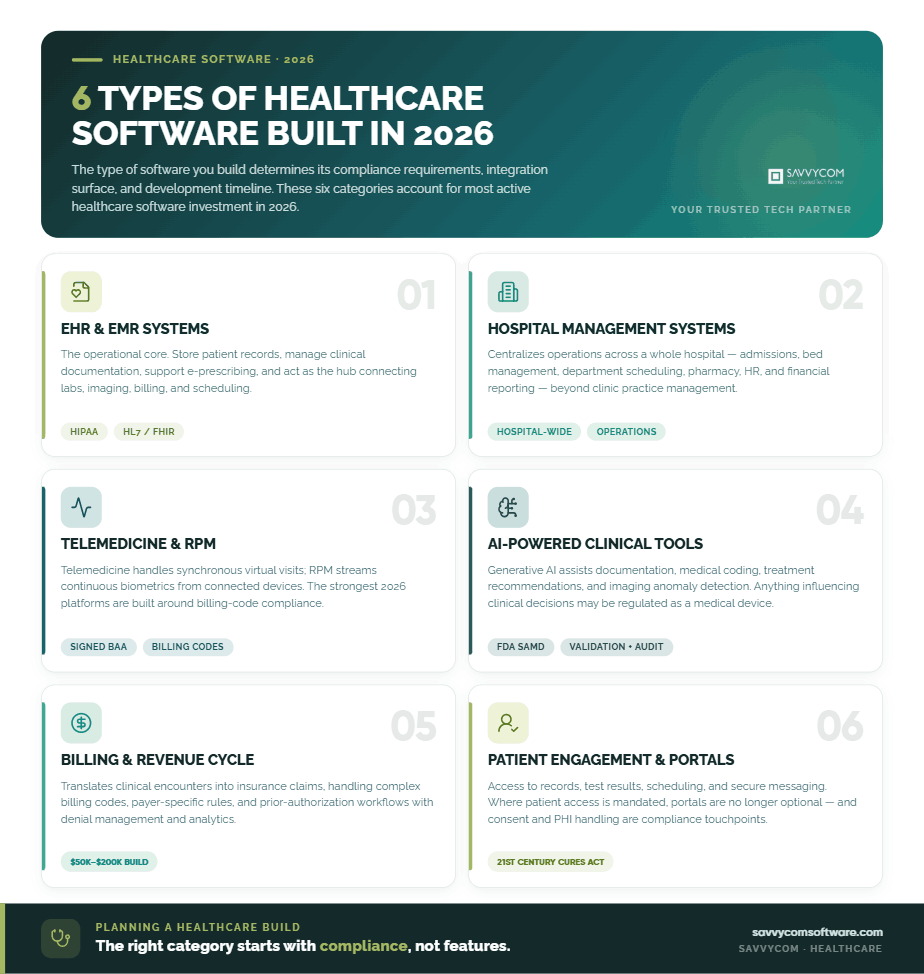
Six categories account for the majority of active healthcare software investment in 2026, each with distinct compliance requirements, integration surface, and development timelines: The specific type of software determines the compliance requirements, integration surface, and development timeline for any given project. Six categories account for the majority of active investment in healthcare software development in 2026.
Electronic Health Records (EHR) and EMR systems
EHR systems are the operational core of most healthcare organizations. If you are deciding between the two record systems, see the difference between EHR and EMR explained. They store patient records, manage clinical documentation, support e-prescribing, and serve as the integration hub connecting lab results, imaging, billing, and scheduling. EHR platforms must follow HIPAA and support HL7/FHIR integrations. Custom EHR development makes sense for large networks with requirements that off-the-shelf systems cannot meet. For most providers, extending or integrating an existing platform is more cost-effective.
Hospital Management Systems (HMS)
Unlike clinic-focused practice management software, an HMS centralizes operations across an entire hospital, including admissions, bed management, department scheduling, pharmacy, HR, and financial reporting.
Telemedicine and remote patient monitoring (RPM)
Telemedicine handles synchronous virtual consultations. RPM is architecturally distinct; it manages continuous biometric streams from connected devices, extending clinical oversight between visits rather than replacing one. Both require a signed Business Associate Agreement (BAA) with every vendor before PHI touches their infrastructure. In 2026, the most deployable RPM platforms are built around billing code compliance, not just device connectivity. For scope, feature sets, and cost breakdowns by platform type, see the guide on telemedicine app development.
AI-powered clinical tools
Generative AI models now assist with clinical documentation, automate medical coding, generate treatment recommendations, and flag anomalies in imaging data. Any system that supports or influences clinical decision-making may be regulated as a medical device under the FDA’s Software as a Medical Device (SaMD) framework, adding validation and audit requirements beyond standard HIPAA obligations. Teams evaluating AI clinical tools can explore Savvycom’s AI solutions for healthcare, which include document AI, vision AI, and enterprise AI agents. For a benefit-by-benefit view of what these systems deliver in production, from diagnostic sensitivity gains to a 50 to 70% drop in manual data entry, see the guide on the benefits of AI in healthcare.
Medical billing and revenue cycle management (RCM)
Medical billing software translates clinical encounters into insurance claims. It must handle complex billing codes, payer-specific rules, and prior authorization workflows. Costs range from $50,000 for a basic single-specialty system to $200,000 for a multi-specialty platform with denial management and revenue cycle analytics.
Patient engagement and portal systems
Patient portals provide access to records, test results, scheduling, and secure messaging. In markets where patient-facing access is mandated by the US 21st Century Cures Act, for example, portals are no longer optional for providers above a certain size. Portal design is also a compliance touchpoint: consent workflows and PHI handling must meet the same standards as clinical systems.
3. How does healthcare software development actually work?
Healthcare software follows the same broad phases as any project: discovery, design, build, test, and deploy, but each phase carries compliance and safety requirements that do not exist in most other industries.
Healthcare software follows the same broad phases as any project, but each phase carries compliance and safety requirements that do not exist in most other industries. Teams that treat compliance as a final-stage review consistently discover these issues when a health system’s IT security team rejects their deployment.
Phase 1: Discovery and compliance mapping
Discovery involves stakeholder interviews with clinicians, administrators, and end users to map current workflows and pain points and, simultaneously, compliance mapping. Which regulatory frameworks apply? Does the system qualify as a SaMD? Which third-party vendors will touch PHI? Poor requirements gathering is the single largest cause of budget overruns in healthcare software projects. Every dollar spent on discovery saves $5–$10 in rework.
Phase 2: Architecture and compliance-first design
Cloud provider selection means compliance partner selection. AWS, Azure, and GCP all offer HIPAA-eligible tiers, but the BAA negotiation and service configuration determine actual coverage. Data residency requirements in Japan, South Korea, and Southeast Asia may restrict where data can be processed, which affects architecture before any code is written. AES-256 encryption at rest, TLS 1.2+ in transit, RBAC, and audit logging are architecture requirements, not configurable options.
Phase 3: UX design for clinical environments
Clinical UX operates under constraints that consumer product design does not. A physician using a system between consultations has different needs from a nurse on a mobile device during rounds or a patient at home. Role-based interfaces, WCAG 2.1 accessibility for patient-facing screens, and cognitive load considerations matter here more than almost anywhere else. A poorly designed clinical interface is a patient safety issue.
Phase 4: Development, integration, and QA
Integration work is consistently the most underestimated component. FHIR R4 is the standard for new integrations, but legacy systems often run on HL7 v2 or proprietary APIs requiring custom interface engineering. Healthcare software must pass functional, performance, security, and compliance testing before release. For AI-enabled systems, QA extends to data pipeline integrity, model bias testing, and clinical validation. Cutting QA in healthcare is one of the most expensive decisions in the project, as bugs surfacing in a regulated production system require formal incident response and, in some cases, re
regulatory reporting.
Phase 5: Deployment and maintenance
Budget 15–20% of the build cost per year for maintenance. This covers OS updates, security audits, compliance updates as regulations change, and secure cloud infrastructure. A system compliant at launch may need architecture updates within 12–24 months as interoperability mandates evolve.
4. What does healthcare software development cost in 2026?
Healthcare software costs range from $40,000 for a basic patient-facing tool to over $1,500,000 for a custom EHR platform, with compliance and integration overhead compounding significantly as scope grows.
Healthcare software costs vary more than most categories because compliance and integration overhead compound with scope. Costs range from $40,000 for a basic patient-facing tool to over $425,000 for a complex clinical platform with multiple EHR integrations.
| Software type | Cost range | Timeline | Main cost drivers |
| Patient portal/engagement app | $40,000–$80,000 | 3–5 months | EHR integration depth, accessibility requirements |
| Medical billing / RCM system | $50,000–$200,000 | 4–8 months | Billing rule complexity, payer integrations |
| Telemedicine platform | $100,000–$300,000 | 5–9 months | Video infrastructure, EHR sync, BAA compliance |
| Remote patient monitoring | $80,000–$150,000 | 4–7 months | Device integrations, real-time data pipelines |
| Hospital Management System | $150,000–$500,000 | 8–18 months | Department scope, legacy system integrations |
| Custom EHR platform | $200,000–$1,500,000+ | 12–24 months | Interoperability scope, SaMD classification |
| AI-powered clinical tool | $150,000–$300,000+ | 6–12 months | Model development, clinical validation, and SaMD risk |
The HIPAA compliance premium adds 15–25% to any project touching PHI. This covers encryption implementation ($5,000–$15,000), audit trail infrastructure, BAA management, and penetration testing ($15,000–$100,000). The average healthcare data breach cost $9.77 million in 2024, the 14th consecutive year healthcare topped all industries for breach costs. Against that number, compliance investment looks different.
5. The hidden costs that blow healthcare IT budgets
Most healthcare IT budget overruns do not come from the build itself, they come from three categories of cost that were not scoped properly at the start.
Most healthcare software project overruns do not come from the build itself; they come from what was not scoped properly at the start. Three categories consistently explain the gap between the initial estimate and the final invoice.
Integration scope
HL7 FHIR R4 integration with existing systems costs $50,000–$300,000, depending on interface volume. That range reflects how much complexity varies with the number of legacy systems in scope and the quality of their documentation. Buyers typically scope the new system they want to build and treat integration as a line item, not a primary cost driver. It almost always is.
Rework
Rework caused by poor requirements gathering costs 3–5 times the original build cost in healthcare projects. 45% of large healthcare IT projects run over budget, and 56% deliver less value than projected (McKinsey). The root cause in most cases is requirements that were incomplete or not validated before development began. A discovery engagement that costs $24,000–$36,000 on a $300,000 project consistently prevents overruns that dwarf that investment.
Ongoing compliance
Post-launch is not the end of costs. A mature HIPAA compliance program runs $30,000–$120,000 per year, covering audits, policy updates, employee training, and incident response readiness. Regulatory environments change, HIPAA guidance updates, CMS interoperability mandates evolve, and new state-level privacy laws come into force on rolling timelines. Budget 15–20% of the build cost annually to keep a healthcare system compliant and maintained.
6. Which compliance standards apply to healthcare software?
The compliance frameworks that apply depend on where your patients are located, where data is processed, and whether your software influences clinical decisions.
The regulatory landscape depends on where your patients are, where data is processed, and whether your software influences clinical decisions. A development partner operating across markets needs to be fluent in multiple frameworks simultaneously.
| Framework | Applies to | What it requires |
| HIPAA | US any system touching PHI | Encryption (AES-256 at rest, TLS 1.2+ in transit), RBAC, audit trails, BAA with all vendors, breach notification to HHS and patients |
| HITECH | US extends HIPAA | Strengthened enforcement, higher breach penalties, extends HIPAA obligations to business associates and their subcontractors |
| GDPR | EU patients / EU data processing | Consent management, data subject rights (access, deletion, portability), 72-hour breach notification to the supervisory authority |
| PDPA | Thailand, Singapore | Consent requirements, purpose limitation, and cross-border transfer restrictions for patient data |
| APPI / PIPA | Japan / South Korea | Sensitive data classification for health data, data subject rights, cross-border transfer controls, and localisation requirements |
| HL7 FHIR R4 | Any system exchanging clinical data | Interoperability standards are effectively mandatory for new healthcare integrations in most regulated markets |
| FDA SaMD | AI / clinical decision tools (US) | Software as a Medical Device classification adds design controls, validation documentation, and post-market surveillance |
A telemedicine platform serving patients in the US, Japan, and Singapore, a common scenario for enterprise health networks operates under HIPAA, APPI, and PDPA simultaneously, with different consent workflows, breach notification timelines, and data residency constraints for each market. Compliance architecture needs to be designed for these applications from the start, not retrofitted after launch.
7. Integration challenges in healthcare software projects
Integration is where most healthcare software projects encounter their most unexpected friction and the most underestimated cost.
Integration is where most healthcare software projects run into the most unexpected friction. Understanding the landscape before scoping a project is one of the highest-value investments a technical lead can make. For connector patterns, data mapping, and go-live risks in detail, see the EHR integration guide.
- Legacy system fragmentation: Most health networks run a mix of systems built across three or more decades. HL7 v2 message formats, proprietary APIs, and SOAP-based web services are still in active use alongside modern REST/FHIR endpoints. Any new system typically needs to speak multiple dialects.
- FHIR adoption gaps: FHIR R4 is the standard for new integrations, but not all existing systems expose FHIR-compliant APIs. Custom middleware parsing HL7 v2 feeds and translating them into FHIR resources adds both cost and ongoing maintenance obligation.
- BAA complexity at scale: As healthcare organizations adopt more software tools and cloud providers, the number of Business Associate Agreements multiplies. Each vendor that touches PHI needs a signed BAA before data flows. Enterprise health networks commonly manage dozens of active BAAs, each with different expiry dates, breach notification obligations, and security requirements.
- Data residency and cross-border compliance: APPI (Japan), PIPA (South Korea), and PDPA (Singapore/Thailand) each restrict how patient data is transferred across borders. A multi-market deployment that handles data in a single cloud region may violate local residency requirements. This must be resolved at the architecture stage, not deployment.
67% of healthcare providers plan increased software spending in 2026, with interoperability mandates and cybersecurity needs as the primary drivers. Building on FHIR R4 from day one is significantly cheaper than retrofitting an existing system to meet interoperability requirements after it is live.
8. Key technology trends shaping healthcare software in 2026
Four technology shifts are reshaping what healthcare software needs to do in 2026, and each has direct implications for architecture decisions made today.
Understanding where the market is moving helps buyers make architectural decisions that will not require expensive rework in 24 months.
- Generative AI in clinical workflows: AI has moved from analytics dashboards to operational tools embedded in clinical workflows, clinical documentation assistance, automated medical coding, diagnostic image analysis, and personalized treatment recommendations. Teams building AI clinical tools in 2026 need to design for SaMD regulatory compliance and clinical validation from the start, not after the model is trained.
- Internet of Medical Things (IoMT) and remote patient monitoring: The proliferation of connected medical devices, continuous glucose monitors, cardiac monitors, and wearable vital sign sensors is creating demand for platforms that can ingest, process, and act on real-time biometric data streams at scale. Architecture decisions around real-time data pipelines, device certification, and alert management define whether an RPM platform works in production or just in demos. Ingesting device streams only pays off when the analytics layer underneath can actually use them; the guide on big data in healthcare covers what that infrastructure requires.
- Cloud migration and modernization: Health systems are migrating applications and data to cloud infrastructure to improve scalability, reduce on-premise maintenance burden, and enable real-time data access across distributed teams. HIPAA-eligible cloud tiers from AWS, Azure, and GCP have matured significantly, but shared-responsibility clarity and security configuration remain the primary compliance risks.
- Interoperability mandates: Regulatory pressure for health data interoperability is increasing in the US (ONC/CMS FHIR mandates), Europe (European Health Data Space), and several APAC markets. Organizations that have not started FHIR R4 migration planning are accumulating technical debt that will become a compliance deadline, not just an efficiency gap.
9. How do you choose a healthcare software development partner?
Most healthcare IT project failures trace to three sources: teams without domain experience, inadequate discovery, and integration scope that was not properly estimated.
Most healthcare IT project failures trace to three sources: teams without domain experience who underestimate compliance complexity, inadequate discovery that surfaces gaps too late, and integration scope that was not properly estimated. When evaluating partners, look for these signals.
- Healthcare domain experience, not just software delivery track record. Ask specifically about HIPAA-compliant architecture design, HL7/FHIR integration work, and clinical workflow mapping. A team that has not delivered a healthcare project before will learn on your timeline and budget.
- Live production deployments, not demo portfolios. Request references for systems in active clinical use. Ask how they handled a compliance issue mid-project, how they managed a regulatory-driven scope change, and what their post-launch incident response process looks like.
- Structured discovery before any development contract. Partners who quote before scoping will renegotiate later. The right partner runs a discovery engagement that defines requirements, maps compliance obligations, and produces a realistic budget before committing to a timeline or fixed price.
- Security-first architecture as standard practice. Encryption by default, RBAC, audit trail infrastructure, and incident response planning should be standard deliverables, not optional line items.
- Relevant certifications and verifiable compliance credentials. ISO 27001, ISO 9001, HIPAA compliance documentation, and GDPR readiness are signals that quality and security processes are systematic.
10. Frequently asked questions
What is the minimum viable budget for a healthcare software project?
A single-function MVP with limited integrations starts around $40,000–$80,000. Any system touching multiple clinical workflows, EHR integration, or AI features should be budgeted above $150,000. Enterprise platforms with multiple compliance frameworks and legacy system integration commonly run $500,000–$1,500,000.
Do I need HIPAA compliance if I am building outside the US?
Not directly, but equivalent frameworks apply in every major market. GDPR governs health data for EU patients. PDPA applies in Singapore and Thailand. APPI governs Japan. PIPA applies in South Korea. Each carries different consent requirements, breach-notification timelines, and data-residency constraints. Savvycom builds to local compliance requirements across all of these markets as a standard deliverable.
Should I build custom software or buy an existing healthcare platform?
Custom development is justified when workflow requirements are specific enough that off-the-shelf options require significant workarounds, when you need deep integration with existing proprietary systems, when you are building a product to sell externally, or when available commercial platforms do not meet compliance requirements in your market. For standard use cases, basic scheduling, billing, and patient communication extending an existing platform through APIs is typically more cost-effective.
What makes healthcare software development different from general software development?
Three factors: regulated data (PHI), clinical safety obligations, and integration complexity. HIPAA and equivalent frameworks add 15–25% to development costs and require architecture decisions that standard software projects never encounter. Healthcare software that influences clinical decisions must pass higher QA standards because failures carry patient safety risk. And integration with existing healthcare systems is almost always in scope and consistently more complex than initial estimates suggest.
Looking for a Trusted Tech Partner That Delivers Your Measurable Values?
Savvycom’s healthcare IT team has shipped EHR integrations, HMS deployments, and AI clinical tools across the US, Japan, South Korea, and Southeast Asia, built to local compliance standards from day one.
Start with a free 2-week assessment → Healthcare IT Solutions