Core Banking Modernization: Strategies, Risks, and Roadmap
Core banking modernization is the process of replacing or re-architecting a bank’s central system of record, the platform that processes accounts, transactions, loans, and deposits, with technology that can meet the demands of real-time payments, open banking APIs, and digital product delivery at scale.
For most banks operating today, the core banking system was built in the 1980s or 1990s on COBOL, mainframe infrastructure, and batch-processing logic. It was designed for overnight settlement cycles, branch-based distribution, and product catalogues that changed annually. None of those assumptions hold in 2026.
The decision to modernize the core is not primarily a technology decision. It is a business decision about whether the bank’s current system architecture can support the products, partnerships, and cost structure the business needs to compete over the next decade. This guide covers the four principal modernization strategies, the risk profile of each, how to build a phased roadmap, and what the program typically costs and takes. For a full breakdown of what banking and fintech development costs at the component level, see Fintech App Development Cost: What to Budget and Why.
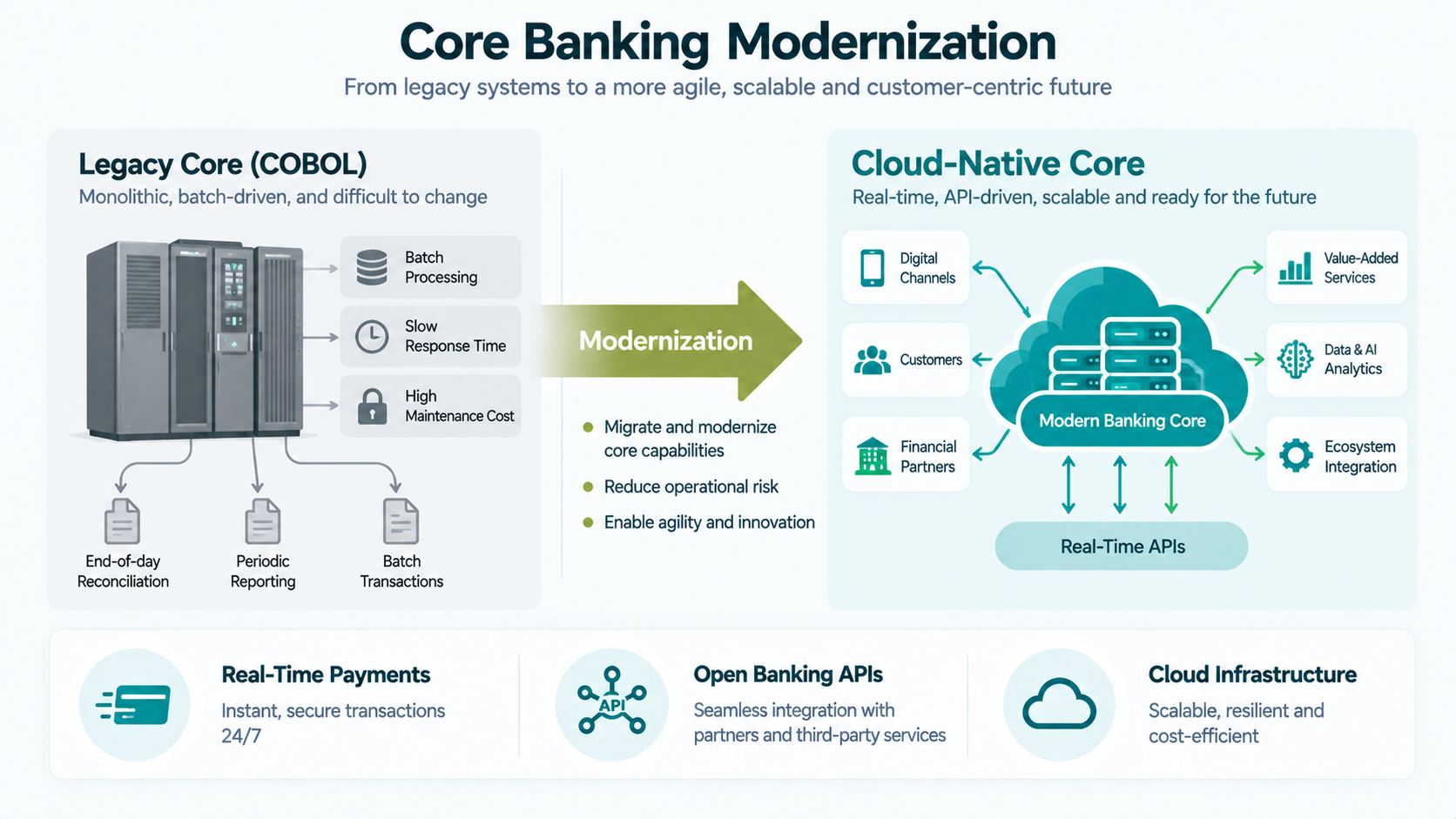
Core banking modernization replaces batch-processing legacy systems with real-time, API-first infrastructure that can support instant payments and open banking at scale.
1. What is core banking modernization?
Core banking modernization is the replacement, re-architecture, or progressive decomposition of a bank’s legacy core banking system (CBS) to enable real-time processing, API-based integration, cloud deployment, and faster product development cycles.
A core banking system manages the fundamental banking record: account balances, transaction history, interest calculations, customer data, and product definitions. Everything else in a bank’s technology stack (mobile apps, payment rails, CRM, risk systems, and reporting) integrates with the core. When the core cannot support real-time data exchange, the entire digital product layer is constrained by it.
The three capabilities that legacy cores most commonly cannot deliver:
Real-time ledger updates
Legacy batch-processing cores update balances on overnight cycles. Instant payment schemes (including Thailand PromptPay, India UPI, Singapore PayNow, and Vietnam NAPAS 247) require real-time balance confirmation at the moment of transaction. Most legacy cores cannot provide this without a real-time layer bolted on top, which adds latency and reconciliation complexity.
API-first product delivery
Open banking regulations in the UK (PSD2), Australia (CDR), Singapore (MAS guidelines), and increasingly across ASEAN require banks to expose product and account data via standardized APIs. COBOL-based cores were not designed to serve external API consumers. Integration middleware can bridge the gap, but each middleware layer adds a failure surface and operational overhead.
Cloud-native infrastructure
Legacy cores typically run on on-premises mainframes or mid-range servers. Cloud migration requires either containerizing existing workloads (lift-and-shift) or re-architecting the application logic for cloud-native deployment. Banks that have completed this transition report infrastructure cost reductions of 30 to 40% and significantly faster provisioning for new products and markets.
2. Why are banks modernizing core banking systems now?
Three converging forces have made core banking modernization a board-level priority in 2024 to 2026: the commercial threat from digital challengers, regulatory mandates for real-time payment participation, and the rising cost of maintaining aging infrastructure that is increasingly difficult to staff.
McKinsey’s research on banking technology transformation identifies legacy core replacement as one of the highest-value infrastructure investments available to traditional banks, with transformations that reach full implementation delivering 15 to 25% reductions in total cost of operations and enabling revenue from digital product lines that the legacy core could not support. The same analysis notes that banks that delay modernization beyond 2028 risk a widening technology gap with challengers that will be difficult to close through incremental improvement.
The staffing dimension is underappreciated in most modernization discussions. The COBOL developer population is aging out of the workforce. Institutional knowledge of how specific legacy configurations work often resides with a small number of people who are near retirement. Banks that have not begun knowledge transfer and modernization planning face an operational continuity risk that is separate from competitive positioning.
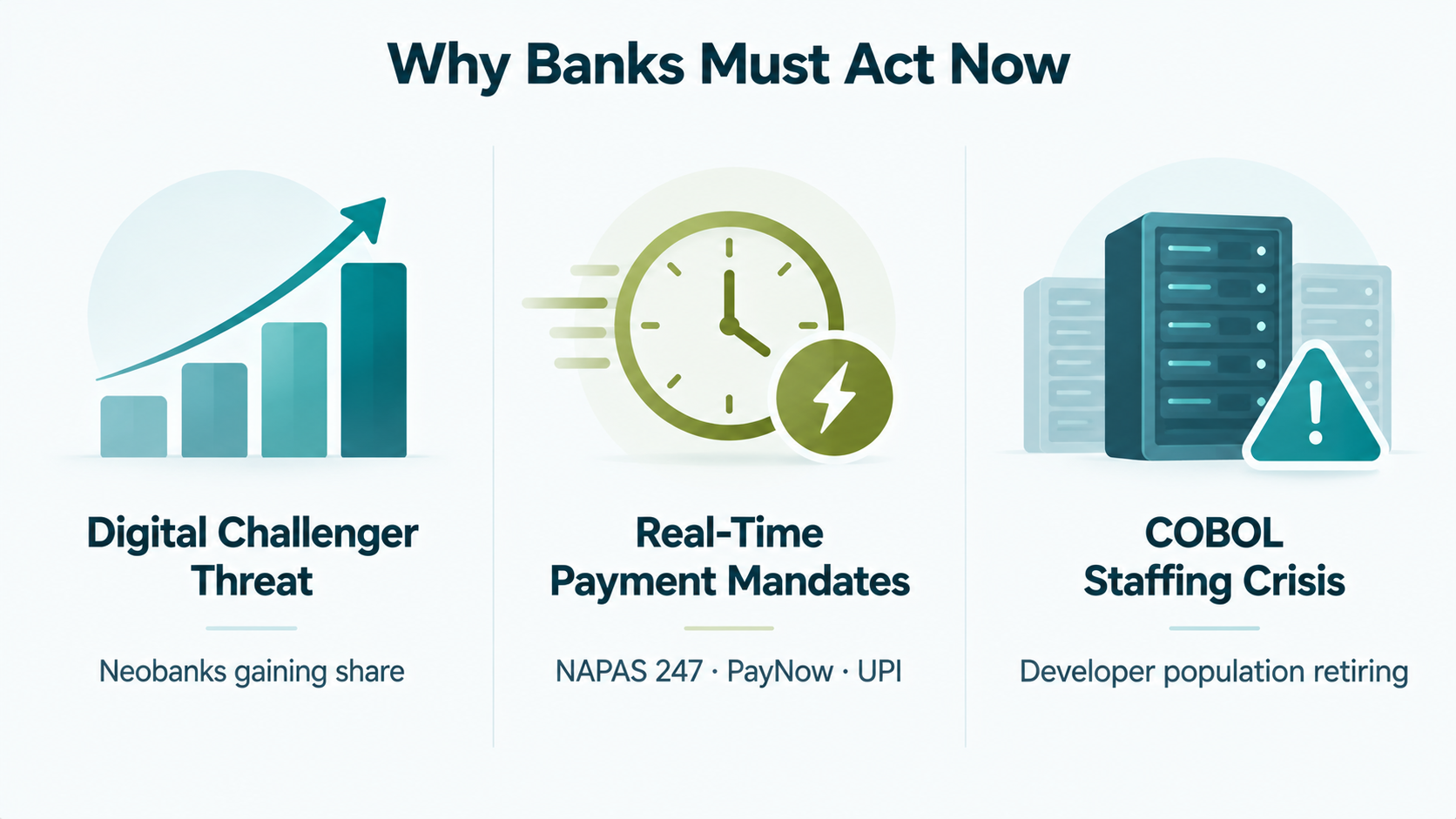
Three converging pressures are forcing the modernization agenda: challenger bank competition, regulatory mandates for instant payment participation, and the COBOL staffing crisis.
3. What are the main core banking modernization strategies?
There are four approaches in active use. The right choice depends on the bank’s risk appetite, technology starting point, budget cycle, and how quickly it needs specific capabilities.
| Factor | Lift-and-shift | Strangler fig | Greenfield | Composable banking |
| What it is | Move the existing core to cloud infrastructure with minimal code change. | Gradually replace modules while legacy runs in parallel. | Build a net-new core on a modern stack; decommission legacy post-cutover. | Assemble best-of-breed components (BaaS APIs, microservices) on a unified platform. |
| Timeline | 6 – 18 months | 2 – 5 years | 2 – 4 years | 12 – 30 months per domain |
| Risk level | Low–medium | Medium | High | Medium |
| Best for | Cost reduction; infrastructure modernization without product change | Large retail banks that cannot afford a big-bang cutover | Challenger banks, new market entrants, and banks with regulatory mandates to rebuild | Banks targeting specific product verticals (e.g., embedded finance, BNPL) |
| Main constraint | Delivers infrastructure efficiency but not product agility | Requires sustained governance over years; dual-running cost is significant | Highest upfront investment; parallel operation risk during cutover window | Vendor lock-in risk if API contracts are not standardized; integration complexity |
The strangler fig pattern (gradual module replacement while legacy runs in parallel) is the most common approach for established retail banks because it avoids a single high-risk cutover event. A new payment processing module is built on modern infrastructure and gradually takes traffic from the legacy equivalent. Over years, the legacy system is hollowed out domain by domain until it can be decommissioned. The main risk is governance: dual-running two systems for years requires sustained leadership commitment and clear decommissioning milestones. Without those, banks end up with neither a modern core nor a decommissioned legacy.
The composable banking model, assembled from vendor components (Thought Machine, Mambu, and Temenos Transact), is gaining traction for product-specific deployments. A bank launching a new BNPL product or embedded finance service can build on a composable platform for that vertical rather than waiting for a full core replacement. This approach creates new integration complexity but delivers specific product capabilities quickly.
4. What are the real risks of core banking modernization?
Core banking transformation carries risks in four categories: technical integration failure, data migration errors, program governance breakdown, and parallel-run cost overrun. Each of these has ended programs; understanding them is part of making the investment case.
Integration complexity
A core banking system connects to hundreds of downstream and upstream systems: payment rails, risk systems, reporting databases, front-end applications, and third-party data providers. Each integration point must be rebuilt or adapted when the core changes. The integration catalogue is typically larger than expected at the start of the programme, and undocumented dependencies in legacy systems surface during the project rather than the planning phase.
Data migration
Moving decades of account and transaction history to a new data model is one of the highest-risk activities in the program. Data quality issues in the legacy system (inconsistent formats, missing fields, undocumented product codes) become migration failures. Multiple dry-run migrations before the cutover window are standard practice; underinvesting in migration testing is the most common cause of cutover delay.
Governance erosion
Multi-year transformations outlast the executives who sponsored them, the program managers who designed them, and sometimes the technology decisions that underpinned them. Programs that lack a clear executive owner, defined success metrics, and a credible decommissioning schedule tend to drift into indefinite parallel operation at permanent dual-run cost.
Regulatory timing
Banks operate under continuous regulatory change. A modernization program running over three years will encounter new compliance requirements mid-flight. The architecture needs to be able to absorb regulatory changes without derailing the modernization schedule, which requires regulatory change management to be built into program governance from the start.
The McKinsey and BCG literature on large-scale banking transformations consistently identifies program governance, not technology selection, as the primary determinant of whether a core banking modernization delivers its intended outcome within its intended budget.
5. How do you build a core banking modernization roadmap?
A phased roadmap structures modernization into three stages: assessment and architecture, domain-by-domain migration, and legacy decommissioning. Each stage has defined entry and exit criteria so the program can be paused, descoped, or accelerated based on business performance.
Phase 1: Assessment and architecture design (months 1 to 6)
The assessment phase maps the existing system landscape: core banking platform version and configuration, downstream integrations and their data contracts, data volumes and quality profile, regulatory compliance dependencies, and vendor support status. This phase produces the target architecture document, the integration catalogue with dependency mapping, the data migration strategy and risk assessment, and the vendor selection shortlist if the modernization involves a platform replacement. Organizations that skip or rush this phase consistently underestimate scope and encounter integration failures in later phases.
Phase 2: Domain migration (months 6 to 36+)
Migration proceeds domain by domain: typically payments first (highest regulatory pressure, clearest API standards), then deposits and accounts, then lending, then less-critical back-office functions. Each domain follows the same pattern: build the new module on modern infrastructure, create an integration layer that allows both old and new systems to operate in parallel, migrate traffic progressively from legacy to new, validate data consistency across both systems, and then decommission the legacy module. The parallel operation window for each domain should be minimized; six months per domain is common, and twelve months is an extended risk.
Phase 3: Legacy decommissioning (months 24 to 48+)
Decommissioning is the stage most programs underinvest in during planning and underperform on during execution. Once new modules are live, legacy maintenance costs often drop enough that the business pressure to formally decommission weakens. A credible decommissioning plan names a specific date by which legacy infrastructure will be switched off, assigns ownership for that outcome, and includes the hardware, software license, and data archiving costs of the decommission itself.
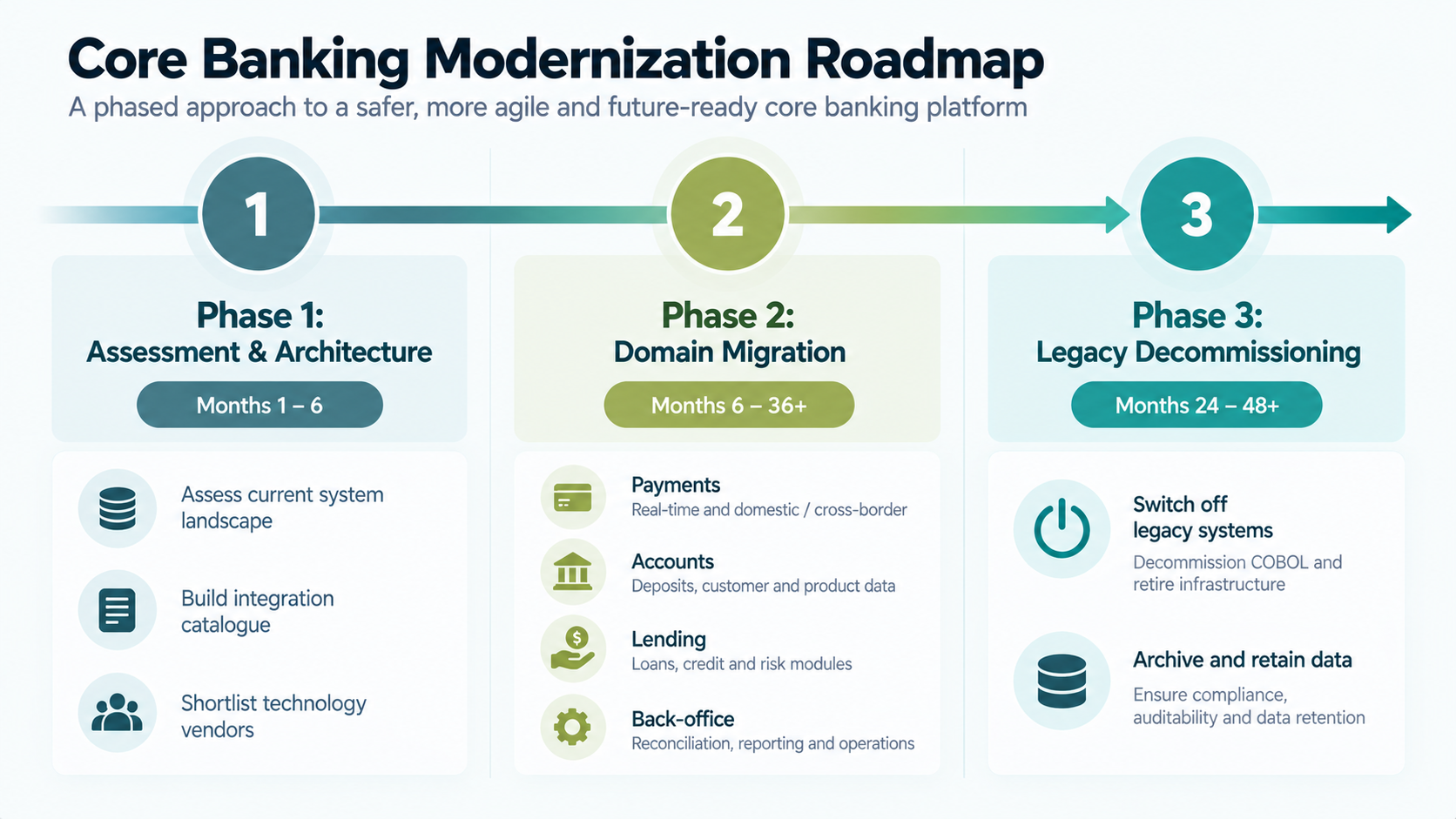
A phased roadmap with defined exit criteria at each stage gives program sponsors the control points needed to pause, accelerate, or descope without losing momentum.
6. How long does core banking modernization take, and what does it cost?
A mid-tier bank’s core banking modernization typically takes three to five years to reach full legacy decommissioning and costs between USD 20M and USD 150M depending on the bank’s size, geography, strategy, and number of integration points. The wide range reflects real program variation, not estimation uncertainty.
The cost variables with the most impact:
| Cost variable | What drives it |
| Strategy choice | A lift-and-shift infrastructure migration costs a fraction of a greenfield rebuild. A strangler fig program running over five years accumulates significant dual-run infrastructure and staffing costs that are often underbudgeted at initiation. |
| Integration scope | Each downstream system requires adapter development, testing, and validation. Banks with 200+ integrations face an integration program that can dwarf the core platform work in both time and cost. |
| Data volume and quality | Banks with 20+ years of transaction history and multiple legacy product configurations face more complex migration work. Data quality remediation before migration is an investment that directly reduces cutover risk. |
| Regulatory environment | APAC markets vary significantly in their requirements for system change notifications to regulators (MAS in Singapore, SBV in Vietnam, and OJK in Indonesia). Regulatory approval timelines are often not within the program’s control and should be mapped into the roadmap as dependencies rather than assumptions. |
McKinsey’s analysis of banking transformations in Asia-Pacific notes that programs with strong executive sponsorship, a dedicated transformation office, and a clear vendor strategy complete within their original timeline at twice the rate of programs that lack these conditions. The investment in governance infrastructure at the start of the program has a measurable impact on the outcome.
7. Which partners can support core banking modernization?
Core banking modernization requires a partner that can operate across the full program: architecture strategy, legacy system analysis, new platform implementation, integration engineering, data migration, and post-launch support. The categories of engagement are system integrators, platform vendors, and specialist engineering partners. The right choice depends on bank size, budget, and how much of the engineering the bank wants to own internally.
Savvycom Software
Vietnam · South Korea · Japan · Singapore ISO 27001 · ISO 9001 HIPAA-compliant
End-to-end core banking transformation partner covering architecture design, legacy integration, microservices build, and post-launch support. Experience across Vietnam, South Korea, Japan, and Singapore banking clients. Production deployments include an FX Operations platform for a South Korea-based financial firm processing high-volume real-time foreign exchange transactions with sub-second settlement confirmation, and EHR integrations and clinical AI tools across the US, Japan, and Southeast Asia. Engagements of this type require the same integration architecture, data consistency controls, and regulatory compliance plumbing that core banking modernization programs demand.
Best for: Mid-tier and regional banks in APAC seeking a hands-on engineering partner that understands local regulatory environments and can deliver both strategy and code. In-house team model; NDA-safe client references available.
Accenture / Infosys / Wipro
Global SI Temenos · Finacle · FIS
Global SI capacity with proven Temenos, Finacle, and FIS implementation practices and change management at scale. Higher day-rate cost; program timelines often extend. Less suited to agile delivery models.
Best for: Tier-1 banks with transformation budgets above USD 50M and established vendor relationships.
Thought Machine / Mambu / Temenos Transact
Platform vendors Cloud-native SaaS / PaaS
Pre-built cloud-native core banking platforms with configurable product catalogues and API-first architecture. Platform license cost adds to total; implementation still requires a system integrator; migration tooling varies by vendor.
Best for: Banks that want a composable or greenfield approach on a proven vendor platform rather than custom development.
In-house engineering team
Full IP ownership
Full ownership of IP; no vendor dependency; direct accountability for timelines and quality. Requires senior fintech engineering talent that is scarce in most APAC markets; opportunity cost of diverting core product team.
Best for: Banks with mature internal engineering capability and a long-term product roadmap that justifies the build investment.
For APAC banks, the choice between a global SI and a specialist regional engineering partner often comes down to program size and regulatory familiarity. Global SIs bring scale and established platform practices but come with high day-rate costs and program management overhead calibrated for Tier-1 bank budgets. Specialist partners like Savvycom offer direct engineering capacity with APAC banking regulatory experience and an in-house team model that is more cost-efficient for mid-market transformations.