Transportation Management Software Development: Architecture, Features, and Cost
Transportation management software (TMS) is the operational layer that tells freight how to move: which carrier, which route, which consolidation, at what cost, and whether it arrived on time.
Most logistics teams reach a TMS decision from one of two directions. They are running shipments through spreadsheets and carrier portals and need to consolidate. Or they have an off-the-shelf TMS that does not connect cleanly to their WMS, ERP, or carrier network, and every integration is a manual workaround. The question at that point is not whether to invest in TMS. The question is whether to buy a configured SaaS platform or build a system tailored to how their network actually operates.
This guide covers what TMS software does, how it integrates with ERP, where SAP fits in the picture, what a custom TMS costs to develop, and what the architecture looks like for a system built to scale. For the full context on logistics software decisions, see Logistics Software Development: A Complete Guide.
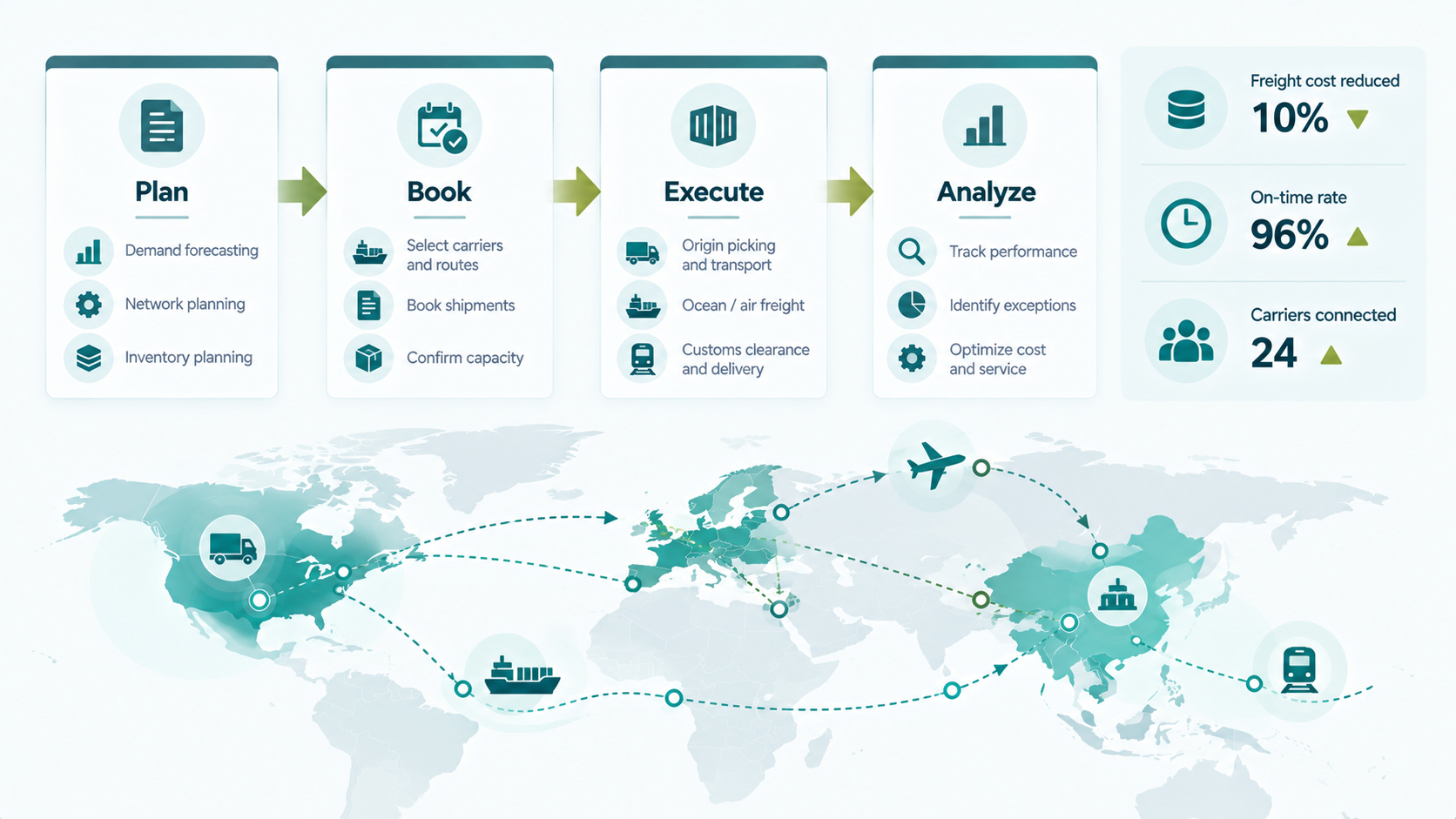
TMS software is the operational layer connecting freight planning, carrier selection, execution, and analytics across a logistics network
1. What is TMS software used for?
Transportation management software manages the planning, execution, and optimization of physical goods movement: carrier selection, route optimization, freight booking, shipment tracking, and freight audit and payment.
The core functions that define a TMS in production:
- Shipment planning: Consolidating orders into loads, selecting optimal routes, and comparing carrier rates in real time. A TMS connected to a live rate engine eliminates the manual carrier quote process that adds 2-4 hours to high-volume shipping operations.
- Carrier management: Maintaining carrier profiles, contract rates, performance scorecards, and compliance documentation in a single system. Multi-carrier environments with 20+ carriers become unmanageable without this layer.
- Execution and tracking: Booking shipments, generating BOLs and customs documentation, and providing real-time visibility from pickup through delivery. EDI 214 and API-based track-and-trace are the standard data feeds.
- Freight audit and payment: Matching carrier invoices against contracted rates, flagging discrepancies, and approving payment. Freight audits typically identify 2-5% in billing errors in high-volume operations.
- Analytics and reporting: Lane performance, carrier on-time rates, cost per unit shipped, and emissions tracking (increasingly required for Scope 3 reporting under ESG frameworks).
A McKinsey analysis of logistics digitization found that companies with integrated TMS platforms reduced freight spend by 8-12% within 18 months of deployment, primarily through carrier rate optimization and load consolidation. The performance gap between digitized and non-digitized freight operations has widened since 2022 as carrier market conditions have become more volatile.
2. What is the relationship between TMS and ERP?
TMS and ERP are complementary systems that operate at different layers: ERP manages financial and order data; TMS manages physical movement execution. They must exchange data in both directions for either system to work accurately.
The integration pattern that matters in practice:
What ERP provides to TMS
Sales orders, purchase orders, customer addresses, inventory locations, and product master data flow from ERP into TMS. Without this feed, a TMS is planning shipments against incomplete data. SAP S/4HANA, Oracle Fusion, and Microsoft Dynamics 365 are the most common ERP systems in enterprise logistics environments, and all three have standard connectors to major TMS platforms, though configuration depth varies significantly.
What TMS provides to ERP
Actual freight costs, carrier invoices, delivery confirmations, and shipment status flow back to ERP for financial reconciliation. This two-way exchange is where most integration projects stall: the data model in a SaaS TMS rarely matches the custom fields and cost centre structures in a heavily configured ERP instance. Custom TMS development solves this by building the data model around the ERP structure from the start rather than mapping between mismatched schemas post-deployment.
Integration architecture options
Three patterns are in common use:
- Direct API integration: Real-time, lower latency, higher implementation cost. Best for high-frequency order flows where delay creates downstream problems.
- Middleware via iPaaS: Platforms such as MuleSoft or Azure Integration Services deploy faster and add an abstraction layer that simplifies future connector changes.
- EDI batch exchange: Legacy-compatible, higher latency, and lower maintenance cost for stable carrier relationships. Still widely used for core carrier connections.
Most enterprise deployments use a combination: API for ERP and WMS connections and EDI for legacy carrier relationships.
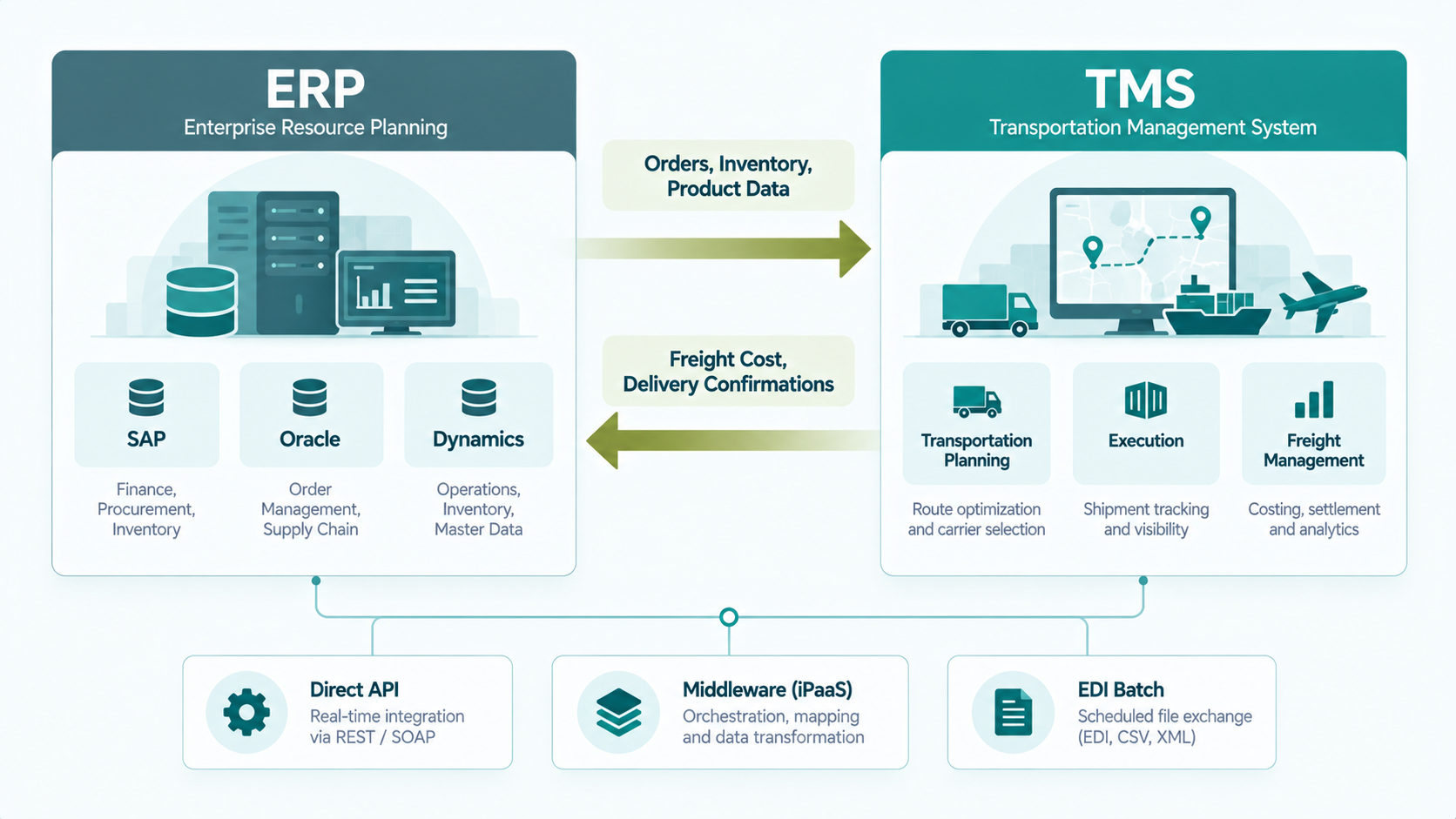
TMS and ERP systems exchange data in both directions: ERP feeds orders and inventory to TMS; TMS returns freight costs and delivery confirmations to ERP
3. Is SAP a TMS system?
SAP offers TMS functionality through SAP Transportation Management (SAP TM), a dedicated module within the SAP supply chain portfolio, but SAP itself is an ERP platform, not a TMS. The distinction matters for procurement decisions.
SAP TM is a full-featured transportation management module covering freight order management, carrier tendering, route optimization, and settlement. It integrates natively with SAP S/4HANA and the broader SAP supply chain suite (SAP EWM, SAP IBP). For organizations already operating on SAP S/4HANA with significant freight volume and the SAP implementation resources to configure it, SAP TM eliminates a category of integration risk.
The limitations that drive organizations toward third-party or custom TMS:
- Implementation cost: SAP TM licensing and implementation cost is high. A mid-market SAP TM deployment typically runs $500,000 to $2M+ including configuration, integration, and training.
- Ecosystem dependency: SAP TM requires SAP ecosystem expertise to configure and maintain. Organizations without an SAP Centre of Excellence or a managed SAP partner face ongoing dependency on expensive consultants for routine changes.
- Carrier connectivity: SAP TM’s carrier connectivity relies on the SAP Business Network for Logistics (formerly Ariba). Connecting carriers outside the network requires additional EDI setup, which can take months per carrier.
The practical decision: SAP TM is the default choice for large enterprises already standardized on SAP S/4HANA that need tight native integration and have the implementation budget. Third-party SaaS TMS platforms (Oracle TMS, MercuryGate, and BluJay) and custom-built TMS are more common for mid-market logistics operations, 3PLs with complex multi-client requirements, and companies with carrier networks that fall outside SAP’s standard connectivity.
4. When should you buy a TMS platform versus build a custom system?
Off-the-shelf TMS platforms cover standard freight management requirements in 80-90% of cases. Custom development is warranted when the remaining 10-20% represents the operations that differentiate your business.
The leading SaaS TMS platforms in 2026 include Oracle Transportation Management, MercuryGate, Project44, Transplace (now Uber Freight), and BluJay (now E2open). All are mature products with broad carrier networks and established ERP connectors, and they are the right starting point for most organizations.
| Factor | SaaS TMS platform | Custom TMS development |
| Time to launch | 3-6 months (configuration) | 6-18 months (full build) |
| Upfront cost | $50K-$500K implementation | $150K-$600K+ development |
| Ongoing cost | Annual license: $30K-$300K+ | Maintenance: $20K-$80K/year |
| ERP integration | Standard connectors; custom mapping often needed | Built to match ERP data model exactly |
| Best for | Standard freight flows; established carrier network; limited IT resources | Complex multi-modal, proprietary carrier networks, 3PL multi-client, and regulatory specifics |
Custom TMS development becomes the clearer choice in three situations: when the business model depends on carrier relationships or pricing models that a SaaS platform cannot represent accurately; when multi-client 3PL operations require data isolation and white-labelling that licensed platforms do not support without significant customization; and when the organization operates across jurisdictions with customs and regulatory requirements that standard platforms treat as exceptions rather than core features.
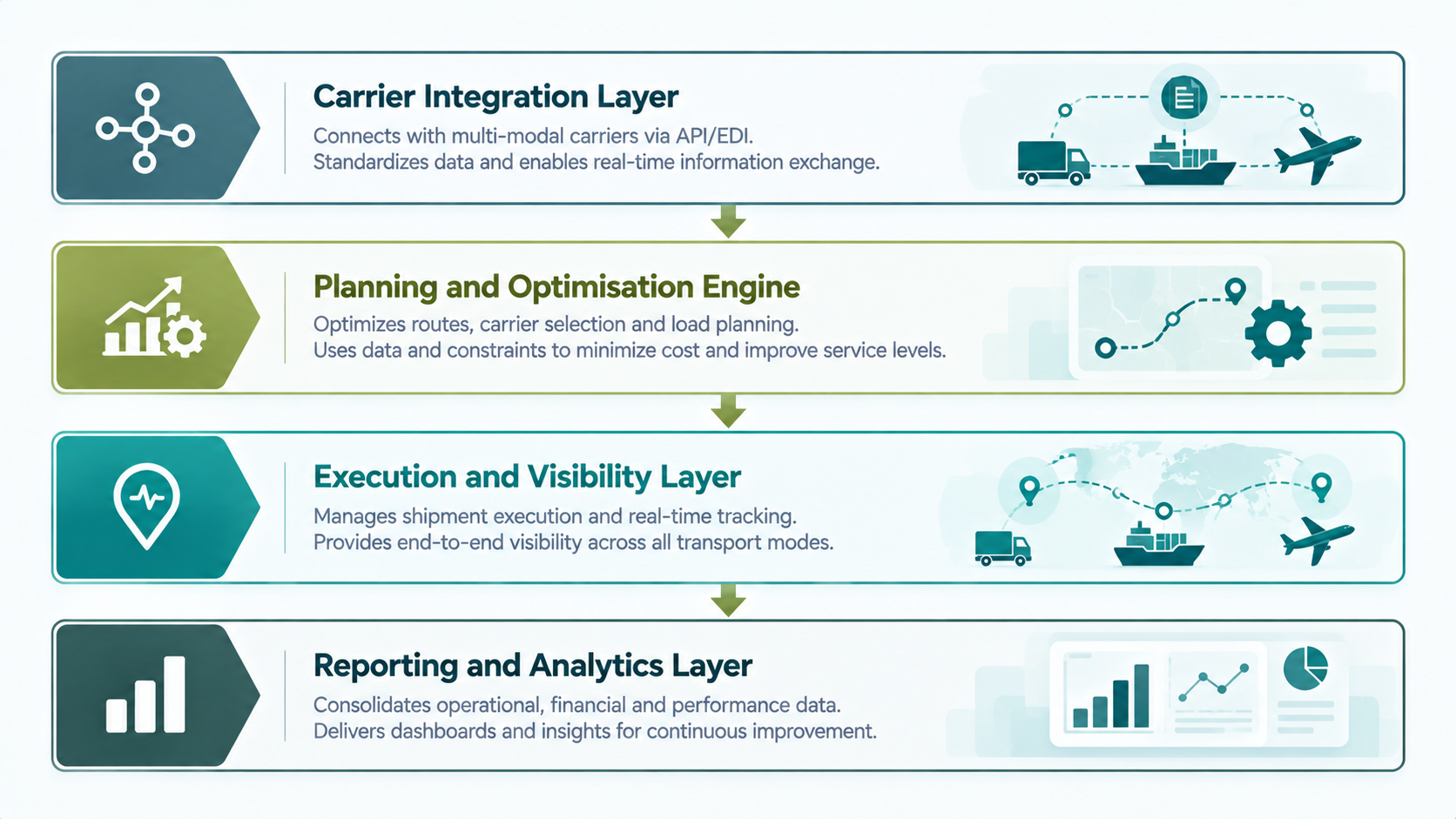
A production-grade custom TMS is built on four layers, with carrier integration and the optimization engine accounting for the majority of development complexity
5. What does a custom TMS architecture look like?
A production-grade custom TMS is built on four layers: a carrier integration layer, a planning and optimization engine, an execution and visibility layer, and a reporting and analytics layer. The complexity in development is concentrated in the first two.
Carrier integration layer
This layer handles all inbound and outbound data exchange with carriers: rate requests and confirmations, booking, status updates, and invoice ingestion. The technical challenge is carrier heterogeneity: enterprise carrier networks typically span EDI (X12 204/214/210 for US domestic, EDIFACT for international), REST APIs, SOAP web services, and proprietary portals. A well-built carrier integration layer normalizes all of these into a single internal schema. Building and maintaining this layer is where custom TMS projects most commonly underestimate cost and timeline.
Planning and optimization engine
The optimization engine evaluates carrier options against route constraints, service levels, and cost targets to produce a shipment plan. Basic implementations use rule-based selection: if weight exceeds X, use LTL carrier Y with contract rate Z. Advanced implementations use constraint-based optimization algorithms that factor in real-time capacity, multi-stop consolidation, and carbon efficiency targets. The choice of optimization approach has a significant impact on development cost and on the freight savings the system can actually generate.
Execution and visibility layer
Once a shipment plan is confirmed, the execution layer generates documentation (BOL, packing list, customs declarations), books with the carrier, and initiates real-time tracking. Track-and-trace in 2026 typically combines carrier EDI status messages, GPS telemetry from in-cab devices, and ocean/air carrier milestone APIs. Aggregating these into a single event stream per shipment requires a message broker (Apache Kafka or Azure Event Hubs are common choices) and a normalization pipeline that maps carrier-specific status codes to a unified status model.
Reporting and analytics layer
Freight cost per lane, carrier on-time performance, tender acceptance rates, and carbon per tonne-kilometer are the standard reporting dimensions. Modern TMS implementations push this data to a data warehouse (Snowflake, BigQuery, or Databricks) for cross-functional reporting rather than keeping analytics within the TMS application. This architecture avoids the performance problems that arise when transactional and analytical queries share a database.
6. What does TMS development cost?
Custom TMS development typically ranges from $150,000 for a focused single-mode system to $600,000 or more for a multi-modal enterprise platform with full carrier integration, an optimization engine, and analytics. Ongoing maintenance runs 15-20% of development cost annually.
The cost variables with the biggest impact:
Carrier integration scope
Each EDI trading partner requires setup, testing, and certification. A carrier network of 20+ partners adds $50,000-$150,000 in integration work alone, before any application development begins.
Optimization engine complexity
Rule-based rate selection is straightforward to implement. Constraint-based optimization with multi-stop consolidation and real-time capacity is a 3-6 month engineering effort in its own right, with ongoing model tuning required after launch.
Regulatory scope
US domestic freight has different documentation requirements than cross-border (CBP, CBSA), ocean (ISF, AMS), or air (IATA DGR). Each jurisdiction adds compliance architecture, validation rules, and documentation templates.
ERP integration depth
A standard API connection to SAP or Oracle takes 4-8 weeks. A deeply customized ERP instance with non-standard cost center structures and approval workflows can take 3-4 months, and this timeline frequently drives the overall project schedule.
Savvycom has delivered TMS integrations and logistics AI systems for clients, including LX Pantos, where an AI-assisted contract review system processes 1,000+ logistics contracts monthly at 95% clause extraction accuracy. For requirements scoping and architecture review before a build or platform decision, speak with the logistics engineering team.
7. Frequently asked questions
Looking for a Trusted Tech Partner That Delivers Your Measurable Values?
Savvycom’s logistics engineering team has built carrier integration layers, AI-assisted contract review systems, and ERP-TMS integrations for clients across Asia-Pacific, Japan, and the US. Start with a scoping conversation to map your requirements before choosing between platform and custom build.