
Digital Transformation Best Practices: What Works in 2026
The digital transformation best practices that hold up in delivery are easy to state. Fix one costly manual process first, measure it against a number you already track, build into the tools people use, put controls inside the workflow, and share ownership between IT and the business. The rest of this guide shows how, with real project results.
Most advice on this topic stays at the level of “get executive buy-in” and “build a culture of change.” It is not wrong, but it is hard to act on. This guide goes one level down. It uses Gartner and McKinsey survey data to show where programs fail, then ties each practice to results from four AI-enabled projects Savvycom delivered in construction, logistics, and financial services. If you need the basics first, start with what digital transformation means for an enterprise.
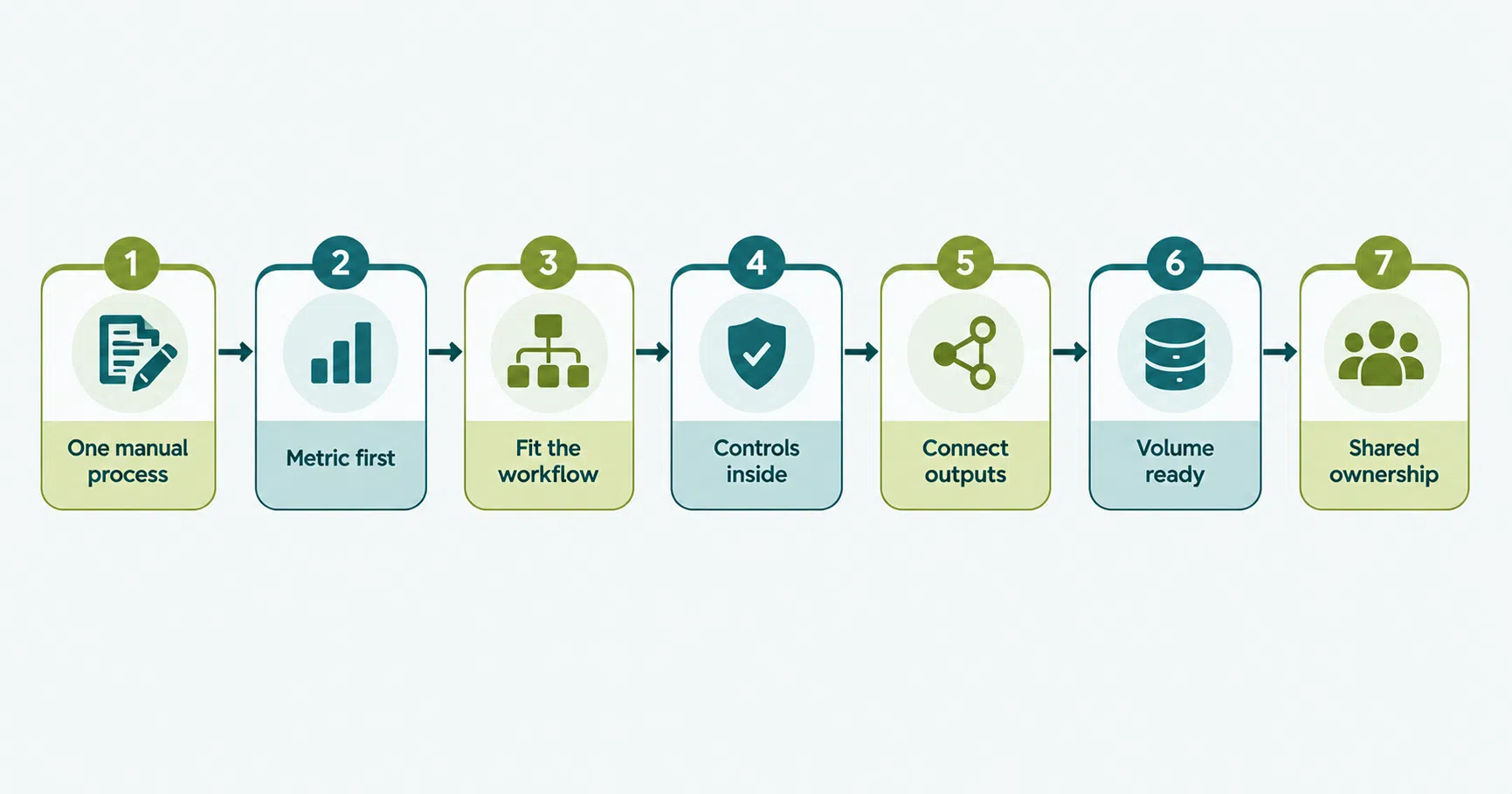
Seven practices that separate programs that deliver from programs that stall from first process to shared ownership.
1. What Are the Best Practices for Digital Transformation?
Seven practices separate programs that deliver from programs that stall: start with one costly manual process, choose the metric before you build, fit the workflow people already use, build controls into that workflow, connect outputs to downstream systems, design for next year’s volume, and share ownership between IT and the business.
None of these depends on a specific technology. They are decisions about scope, measurement, and ownership, and they look the same whether a project uses computer vision, language models, or workflow automation. The table pairs each practice with the mistake it usually replaces.
| Practice | Common mistake it replaces |
| Start with one costly manual process | Launching a company-wide program with no single place to prove value |
| Choose the metric before you build | Reporting activity (features shipped) instead of operational results |
| Fit the workflow people already use | Introducing a new tool and hoping people switch |
| Build controls into the workflow | Adding review steps after the system is live |
| Connect outputs to downstream systems | Producing data that someone re-enters by hand |
| Design for next year’s volume | Proving the idea on a sample that cannot scale |
| Share ownership between IT and the business | Leaving the program to the technology team alone |
2. Why Do Digital Transformations Miss Their Targets?
Most programs treat technology as the project and ownership as an afterthought. Gartner’s 2025 CIO and Technology Executive Survey found that only 48% of digital initiatives meet or exceed their business outcome targets, while a small group of leaders it calls the Digital Vanguard reaches 71%. The gap comes from how the work is owned, not which technology is chosen.
Gartner surveyed 3,186 CIOs and technology executives in 88 countries in October 2024. In the top group, business leaders co-own digital delivery with the CIO end-to-end rather than only sponsoring projects. That detail matters more than any tool choice, and it is the basis for the last practice in this guide.
McKinsey’s survey of 1,733 executives points the same way. Respondents who tied a few themes to measurable business outcomes were 1.7 times more likely to beat profit expectations, and those who adopted agile practices were nearly twice as likely. Both studies say the same thing: results follow how work is prioritized and owned.
3. Seven Best Practices That Hold Up in Delivery
Each practice below is paired with a delivered project so you can see it in scope, timeline, and results. Together they cover the decisions that most often decide whether a transformation reaches production: where to start, what to measure, how to fit users, how to control risk, how to connect systems, how to scale, and who owns the outcome.
1. Start with one costly manual process
Pick a process where people copy data by hand at volume, because the cost is visible and the result is easy to verify. A large Japanese construction corporation started this way, digitizing scanned blueprints so material tables could be extracted automatically instead of typed in by staff in a five-month project.
The solution combined computer vision to detect structural and material elements with OCR to read quantities and specifications. The client reported a 20% reduction in operational costs, a 65% improvement in process automation, a 35% increase in overall productivity, and fewer manual data entry errors. The scope was narrow: blueprints in, structured material data out.
2. Choose the metric before you build
Choose a metric the operation already feels, such as search time, review time, processing time, or error rate. A global logistics provider’s yard management project used this kind of measure: container search and retrieval time fell by 60%, and accuracy in container placement and movement tracking reached 95%.
The yards handle 400 to 500 container movements a day, with more than 500 containers stored at each site. AI cameras read container IDs, trailer IDs, and truck license plates at entry and exit, and a 2D digital map shows each container’s position in real time. The nine-month project also raised overall operational productivity by 35% to 40%. Before approving scope, write the metric, its current value, the target, and the owner on one line.
3. Fit the workflow people already use
Adoption fails when a new tool asks people to leave the one they already use. A South Korea-based financial services company got FX rate checks, settlement rules, and trade execution inside Mattermost, its existing team channel, so staff worked in natural language without learning a new system. The five-agent assistant took three months.
The reported results were a 60% reduction in FX processing time and a 40% improvement in operational efficiency. Gartner’s data supports the same instinct: it found that top-performing CIOs make technology easy for non-IT staff to use, which is a design requirement, not a training plan.
4. Build controls into the workflow
Controls that depend on people remembering a step fail on the busiest day, so put them in the path itself. In the same FX project, quote ID locking, role-based permissions, admin-only settlement settings, and automatic transaction logging were part of the workflow, which made the fast route and the compliant route the same route.
Execution ran through confirm or reject steps and admin approval controls, and the audit trail was created without extra effort from users. The principle applies outside finance. Whatever your regulator or internal audit team asks for, decide where the control lives before you build, not after the first review.
5. Connect outputs to the systems that act on them
A digitized output that sits in a folder changes nothing. The construction project delivered extracted material data through APIs to downstream systems for estimation and procurement, so the data fed decisions directly instead of waiting for someone to re-enter it. Name the consuming system and the interface in the first phase, not the last.
Ask two questions at scoping: who or what uses this output, and in what format? If the answer is “a person will copy it into another system,” the project has moved the manual step, not removed it.
6. Design for next year’s volume
Pilots that work on a sample often break at production volume, so design for the volume you expect to reach. A South Korean logistics company’s contract review platform was built on Google Cloud, using Vertex AI and BigQuery, and now processes more than 1,000 contracts a month after a three-month project.
The platform cut contract review time by 50% and reached 95% accuracy in identifying critical clauses and risks. Growing contract volume was one of the stated problems, so scalability was a requirement of the design from the start rather than a later upgrade.
7. Share ownership between IT and the business
Technology teams cannot own a transformation alone. Gartner found that business leaders in its top-performing group co-own digital delivery with the CIO, meet with the CIO about four times as often as other executives, and assign 35% of their staff to technology work, against 21% for other leaders.
In practice, name one business owner and one technical owner for each initiative, give the business owner budget and time, and review progress together on a fixed rhythm. McKinsey’s survey also linked appointing an owner for each initiative and holding individuals accountable to better outcomes.
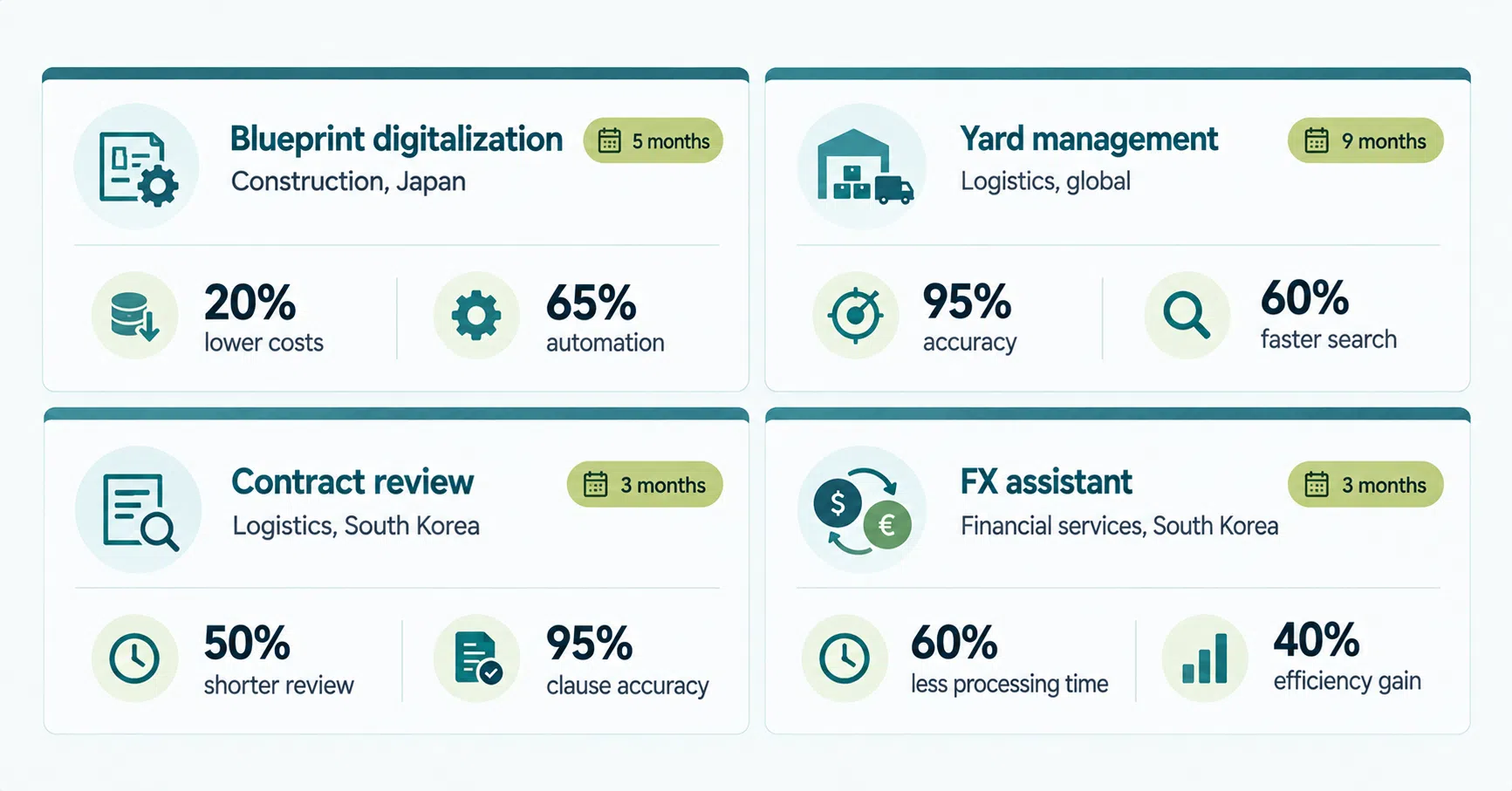
Four delivered projects from five months to nine each measured by an operational result, not a technology milestone.
4. How Do These Practices Show Up in Delivered Projects?
Across four delivered projects, timelines ran from three to nine months, and every project reported results as operational measures such as time saved, accuracy, or productivity rather than technology milestones. These are client-reported results from specific projects; starting points, volumes, and scope differ in every organization, so treat the figures as reference points, not forecasts.
| Project | Domain and region | Duration | Reported results |
| Blueprint digitalization | Construction, Japan | 5 months | 20% lower operational costs; 65% better process automation; 35% higher productivity |
| Yard management system | Logistics, global operator | 9 months | 95% placement and tracking accuracy; 60% faster container search; 35-40% higher productivity |
| Contract review platform | Logistics, South Korea | 3 months | 50% shorter review time; 95% accuracy on critical clauses; 1,000+ contracts a month |
| FX multi-agent assistant | Financial services, South Korea | 3 months | 60% lower FX processing time; 40% better operational efficiency; improved audit trail |
5. How Do You Choose a Digital Transformation Partner Using These Practices?
Ask each candidate to show the practices above in their own past work: a named process and a before-and-after number, the systems the output connected to, and who owned the project on the client side. A partner who can only describe technology has not yet shown you delivery.
Six questions turn the practices into a screening checklist:
- Process and numbers. What was the process, and what was the measurement before and after?
- Scope and timeline. How long did the first release take, and what was in it?
- Integration. Which existing tools and systems did the output connect to?
- Controls. What approvals and access rules sit inside the workflow?
- Volume. What volume does it handle today, and what happens at twice that?
- Ownership. Who on the client side owned the result, and how often did they review progress?
Treat vague answers as information. A partner with delivered work should be able to answer all six without leaving the conversation to look for slides.
6. Frequently Asked Questions
Scoping a first transformation project? Savvycom’s team can walk through scope and timeline using delivered projects as reference points.


