Digital Transformation ROI: How to Build a Business Case (2026)
The honest starting point for a digital transformation ROI conversation is that most programs do not deliver the returns they project. BCG research across more than 850 companies found that only about 35% of digital transformations meet their value targets. McKinsey’s 2025 State of AI survey found that only 5.5% of organizations report greater than 5% EBIT impact attributable to AI. And a 2026 analysis found that only about 6% of organizations qualify as AI high performers with significant financial returns.
These numbers are not arguments against transformation investment. They are arguments for building the business case correctly before committing the investment, measuring from the right baseline, and structuring the program around the factors that separate the 35% that succeed from the 65% that do not.
This guide covers the ROI reality of digital transformation in 2026, how to build a business case that holds up under scrutiny, which workstreams generate the most consistent returns, and what the measurement framework should look like. For the strategy and execution layers, see the guides on digital transformation strategy and digital transformation cost.
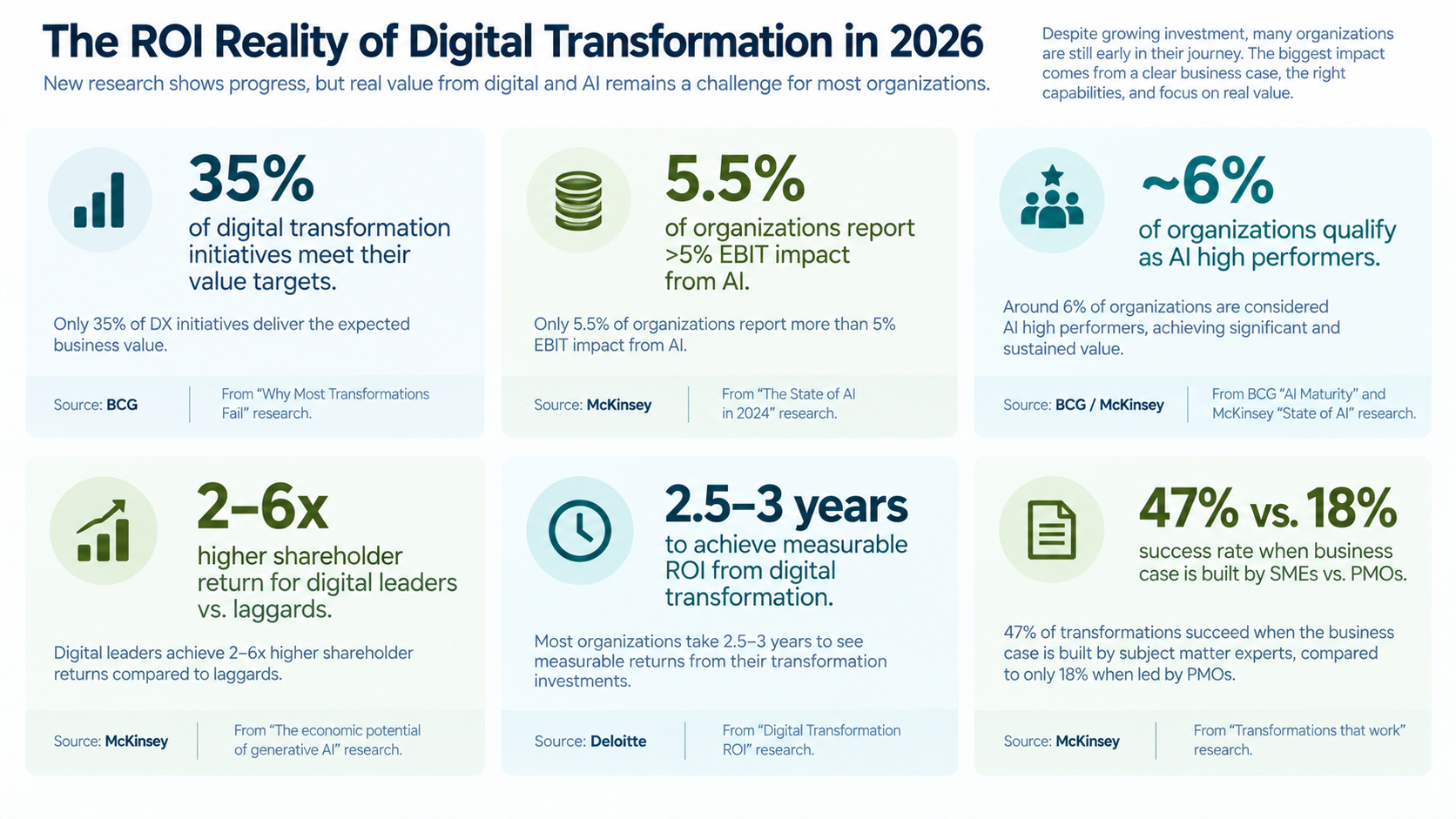
The ROI reality of digital transformation: six key research findings from BCG, McKinsey, and Deloitte
1. The ROI reality of digital transformation in 2026
The data on digital transformation ROI is consistent and uncomfortable: most programs underdeliver against their business case. But the data also shows that programs with specific structural characteristics consistently outperform, and those characteristics are identifiable in advance.
McKinsey research found that organizations with strong digital and AI skills earn two to six times higher shareholder returns than those that fall behind, across every sector studied. That return premium is real. But it accrues to the organizations that execute transformation as an operating-model change, not as a technology deployment program.
The Deloitte finding that the average enterprise digital transformation takes 2.5 to 3 years to show measurable ROI is important context for business case construction. Organizations that evaluate transformation ROI at 12 months and declare failure are measuring at the wrong point. Organizations that design their business case with a 30-month horizon and define leading indicators for the first 12 months are measuring correctly.
| Research finding | Source | Date | Implication for business case |
| Only 35% of DX programs meet value targets (850+ companies) | BCG | 2021 (updated 2026) | Build the case from the success patterns, not the average |
| Only 5.5% of orgs report >5% EBIT from AI | McKinsey State of AI Survey | June-July 2025 | AI ROI requires redesigning work, not just deploying tools |
| ~6% of orgs qualify as AI high performers | BCG/McKinsey composite | 2026 | High performance defined by specific structural factors |
| 2-6x shareholder return premium for strong digital/AI organizations | McKinsey | 2026 | ROI is real at program completion; interim metrics matter |
| 2.5 to 3 years to measurable ROI (average enterprise) | Deloitte | 2025 | Business case must define leading indicators for years 1 and 2 |
| 47% success when SMEs build business case vs 18% by PMOs | McKinsey | 2018 (consistently cited) | Who builds the business case materially affects achievability |
2. ROI by transformation workstream: where returns are most consistent?
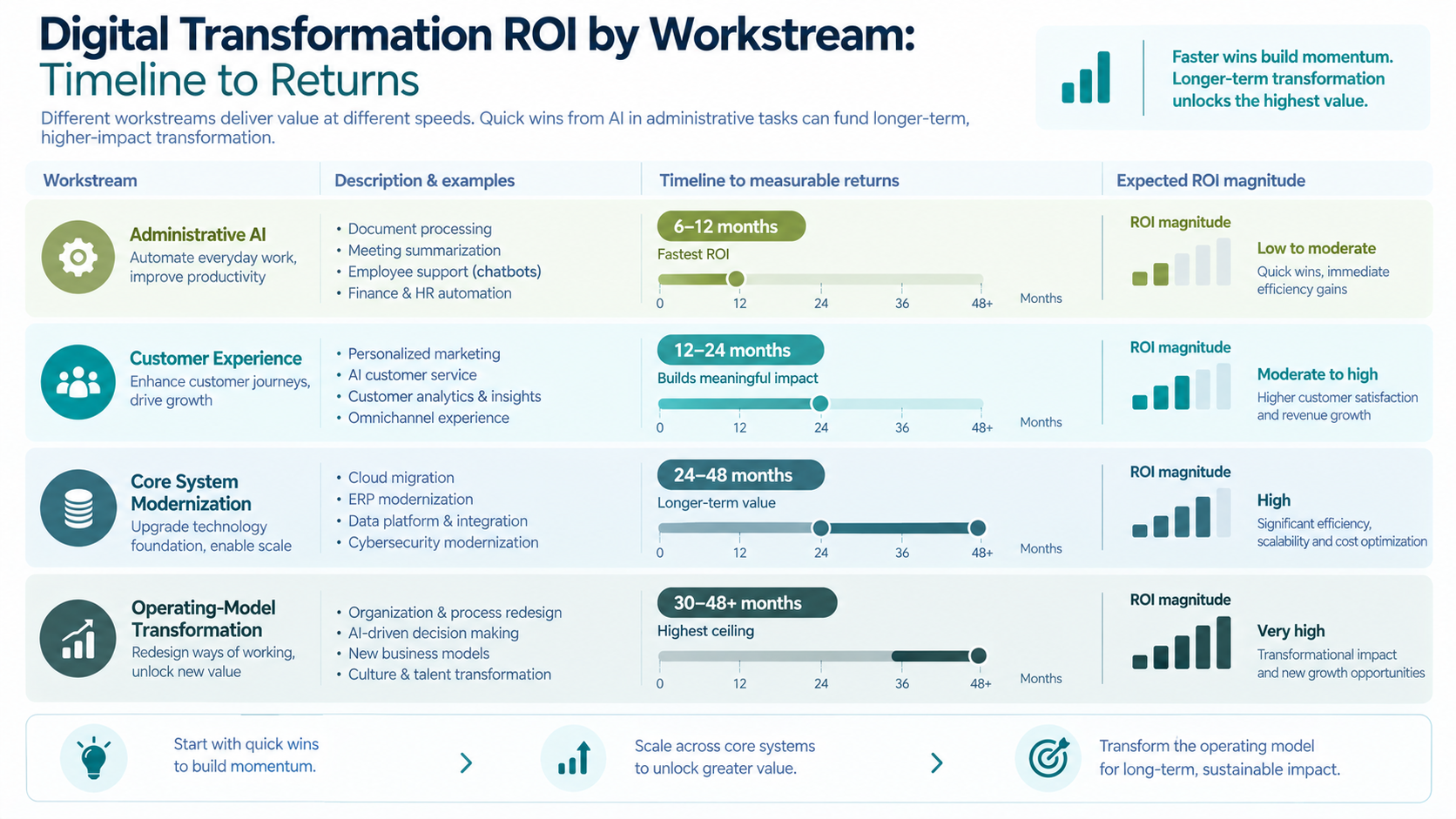
ROI timeline by transformation workstream: administrative AI delivers fastest, operating-model delivers highest
ROI is not evenly distributed across transformation workstreams. Administrative and operational AI generates the most consistent near-term returns because the inputs and outputs are well-defined and measurable. Operating-model transformation generates larger long-term returns but takes longer to materialize and is harder to attribute.
Administrative and operational AI (fastest ROI)
Revenue cycle AI, prior authorization automation, document intelligence, ambient scribing, and claims processing automation generate measurable returns within 6 to 12 months. The inputs and outputs are clearly defined: processing time before and after, error rates, labor hours per unit, and denial rates. McKinsey IDC research documents an average return of $3.70 per $1 invested in generative AI across Fortune 500 enterprise deployments, with the highest-returning applications concentrated in structured process automation.
Customer experience and digital channels (medium-term ROI)
Digital channel investment (mobile apps, customer portals, self-service platforms) generates revenue and cost outcomes over 12 to 24 months. Customer acquisition cost reduction, churn reduction, and revenue per customer improvement are the primary metrics, but they are multi-causal and harder to attribute cleanly. Organizations that set baseline measurements before launch and track cohort-level metrics consistently demonstrate ROI; those that rely on general revenue trends find attribution contested.
Core system modernization (longest ROI horizon)
Cloud migration, ERP modernization, and core platform replacement generate ROI over 24 to 48 months and primarily through cost reduction (hosting, licensing, maintenance) and speed advantages (faster deployment, easier integration). The strongest business cases for core modernization quantify the cost of not modernizing: the maintenance overhead, the integration constraints, and the competitive speed disadvantage of the current architecture.
Operating-model transformation (highest but longest-horizon ROI)
The highest-returning transformations in BCG and McKinsey research are those that redesign how work gets done, not just which technology is used. Companies that redesigned core processes alongside AI deployment reported significantly higher returns than those that deployed AI on top of unchanged processes. BCG found that the most decisive CEOs, those who rolled AI agents out across whole workflows rather than keeping them in small pilots, were about twice as likely to achieve significant returns.
3. How to build a digital transformation business case
A credible transformation business case quantifies three things: the cost of the current state (the problem the investment solves), the expected financial impact of the transformed state (what changes and how it is measured), and the program cost and risk profile. Most failed business cases are weak on the first or the measurement plan for the second.
Quantify the current state cost
The current state cost is the business case foundation. It is not a narrative about being “behind” or “inefficient.” It is a number: the current cost of processing a claim is $X per unit, the error rate is Y%, the processing time is Z days. McKinsey’s finding that business cases built by subject-matter experts succeed 47% of the time versus 18% for those built by PMOs reflects this: SMEs can quantify current-state cost accurately; PMOs often cannot.
Define the financial impact in measurable terms
The business case must state specifically what changes and how it will be measured. Not “improve operational efficiency” but “reduce processing time per claim from 4.2 days to 1.1 days, which at current volume reduces labor cost by $X annually.” Not “improve customer experience” but “reduce churn rate by 2 percentage points, which at current revenue per customer represents $Y in retained annual revenue.” Every projected benefit should have a measurement plan that specifies the baseline, the method, and the timeline.
Model the program cost accurately
Technology is 30 to 45% of total program cost. Change management, training, integration, data infrastructure, and first-year operations account for the rest. Business cases that project technology cost only and discover the other costs mid-programme are the ones that appear to overrun. A realistic program cost model includes all six workstream categories, a 20 to 30% contingency, and staged cost release tied to phase-gate milestones rather than committed upfront.
| Business case component | What to include | Common error |
| Current state cost | Cost per unit, error rates, processing times, maintenance burden | Using narrative (“inefficient”) rather than quantified metrics |
| Financial impact (revenue) | Revenue uplift, churn reduction, market expansion, pricing power | Attribution is contested; use conservative estimates and cohort measurement |
| Financial impact (cost) | Labor cost reduction, processing cost per unit, maintenance savings | Failing to account for change management; using gross, not net |
| Program cost | Technology (30-45%), consulting (20-30%), change management (15-25%), integration, data | Technology-only costing; missing integration and change management |
| Risk and sensitivity | Success probability by workstream; partial delivery scenario; stage-gate conditions | Binary success/failure modelling; no downside scenario |
| Timeline and leading indicators | Milestones by phase; leading indicators for 12-24 months; full ROI horizon | 30-month ROI presented as 12-month; no leading indicators defined |
4. What separates digital transformations that deliver ROI from those that do not?
The research on transformation success is consistent across BCG, McKinsey, and Deloitte: the differentiators are not technology choices but program design choices.
CEO and leadership commitment
BCG found that the most decisive CEOs, those who committed to rolling AI across whole workflows, achieved significantly higher returns than cautious ones. Transformation programs where the technology decision is made below C-suite, without C-suite accountability for outcomes, consistently underperform.
Integrated strategy
BCG research found that having an integrated strategy with clear goals, connecting technology investment to business outcome targets, shifts success probability from roughly 30% to 80%. Programs with technology strategy separate from business strategy produce systems that work technically and fail operationally.
Redesigning work, not just deploying tools
McKinsey consistently identifies redesigning how work gets done as the strongest predictor of AI ROI. Organizations that deploy AI on top of unchanged processes see limited impact; those that redesign the process to operate with AI see structural efficiency gains.
Measurement framework defined before deployment
Only 33% of organizations that have deployed AI at pilot scale have successfully scaled to production per McKinsey’s 2025 State of AI. The organizations achieving the highest ROI defined measurement frameworks, baselines, and success criteria before deployment, not after.
5. Measuring digital transformation ROI: a practical framework
Transformation ROI measurement requires a three-layer framework: leading indicators in year 1, financial impact in years 1 to 2, and strategic positioning metrics in year 3 and beyond.
| LAYER 1: LEADING INDICATORS | |||
| Timeline | Months 1 to 12 | ||
| Purpose | Signal whether the program is on track to deliver financial returns | ||
| Metrics | Adoption rate of new systems | Processing time per unit | Error rates, cycle time reductions |
| Decision rule | Adopted + improving at month 6 → likely financial returns at month 18. Not adopted at month 6 → unlikely to recover. | ||
| LAYER 2: FINANCIAL IMPACT | |||
| Timeline | Months 12 to 30 | ||
| Purpose | Quantify cost and revenue impact with attribution to transformation investment | ||
| Metrics | Labor cost per unit | Revenue per customer, CAC | Denial rates, processing cost |
| Decision rule | Use cohort measurement (exposed vs not exposed) for attribution. General revenue trends are not defensible as transformation ROI evidence. | ||
| LAYER 3: STRATEGIC POSITIONING | |||
| Timeline | Year 3 and beyond | ||
| Purpose | Capture the structural competitive advantage where the 2-6x return premium materializes | ||
| Metrics | Market share trajectory | Customer retention vs industry | Speed to market, shareholder return |
| Decision rule | Lagging and multi-causal. Organizations that abandon ROI measurement at year 1 miss the full return the investment generates. | ||
6. A transformation ROI case study: FX operations automation
The financial services deployment below illustrates how the business case components above translate into production outcomes, and specifically how the ROI was structured and measured.
A financial services enterprise in South Korea was running FX operations on manual, disconnected processes. The current-state cost was quantifiable: processing time per transaction, operational headcount, and error rate in settlement documentation. These metrics became the baseline against which the transformation ROI was measured.
The transformation program (Savvycom, three-month build): a five-agent AI platform on GPT-4o and LangGraph, coordinating agents across user management, FX rate handling, settlement, exchange, and transaction processing. The compliance architecture was the first design decision, mapping every decision boundary against South Korean financial data regulations before model development began.
Against the pre-deployment manual baseline, processing time dropped 60% and operational efficiency improved 40% over the three-month build and deployment period. These are the leading indicators. The financial impact, translated through labor cost, error reduction, and increased transaction capacity without headcount growth, constituted the business case ROI that justified the investment. The measurement framework was defined before build, making the attribution clean.
The transferable lesson: the ROI was achievable because the business case was built from quantified current-state cost, the measurement plan was defined before deployment, and the program was scoped to a bounded use case with clean data and a defined decision boundary before scaling to broader automation.
7. When is digital transformation ROI achievable, and when is it not?
Transformation ROI is most reliably achievable when the use case is specific and bounded, the data to support it is clean and available, the process being transformed is measurable before and after, and leadership is committed to redesigning how work gets done alongside deploying technology. It is least reliably achievable when the scope is broad and vague, data quality is poor, measurement is deferred to after deployment, and technology is deployed on top of unchanged processes.
For organizations constructing a business case: start with the highest-ROI, clearest-measurement use case, define the baseline and measurement method before any work begins, build the program cost to include change management and integration (not technology alone), model the ROI horizon at 30 months with leading indicators at 6 and 12 months, and stage the investment with release conditions that protect the organization from committing the full budget before the program has proved it can deliver.
8. Frequently asked questions
Savvycom works with enterprise clients to structure transformation programs designed for measurable ROI from the start, with discovery phases that define baselines, measurement frameworks, and staged investment before any fixed-price commitment.
Related reading:
Digital Transformation Strategy: How to Build One
Digital Transformation Cost: 2026 Breakdown
AI Digital Transformation Use Cases
Digital Transformation Solutions