Supply Chain Visibility Software: What It Is and How to Build It
Most supply chain leaders can see their first-tier suppliers. McKinsey’s 2025 survey of 100 supply chain leaders found that 95% have visibility into at least tier-one supplier risks, but only 42% of them extend that visibility to tier two or beyond. Software is how that gap closes, and the right type depends on where your blind spot sits. This guide sits inside our wider guide to logistics software development.
Quick answer
Supply chain visibility software collects data from carriers, warehouses, yards, sensors, and supplier systems, then shows it in one real-time view with alerts. The main types are control towers, tracking platforms, warehouse and yard systems, and ERP or supply chain suites. Start with the blind spot that costs you most, then pick the type that covers it.
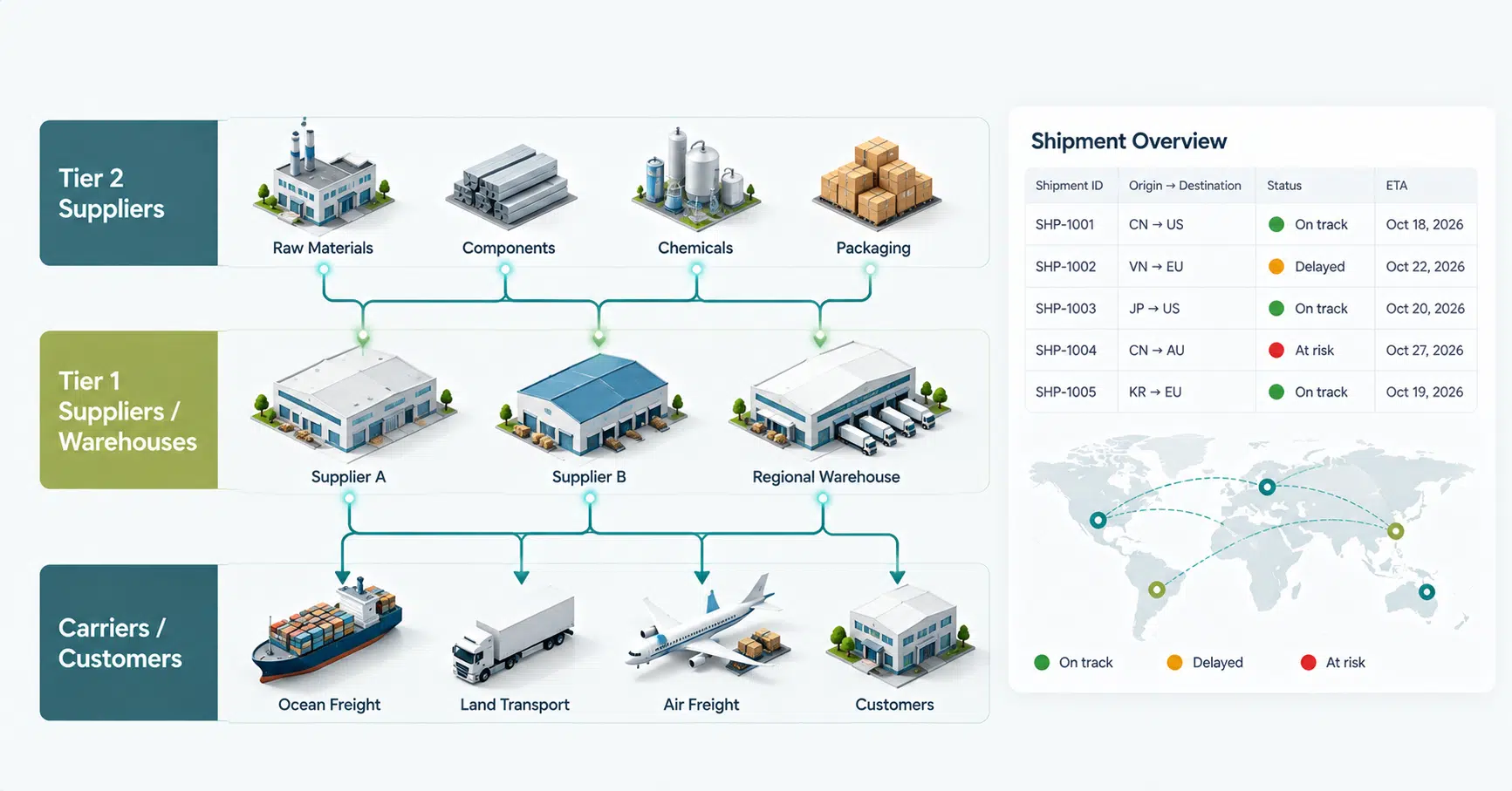
Real-time visibility across carriers, warehouses, and supplier tiers one view for the entire chain
1. What Is Supply Chain Visibility?
Supply chain visibility is the ability to see where goods, inventory, and orders are and what state they are in across suppliers, warehouses, carriers, and customers, close to real time. Software provides it by pulling data from separate systems and devices into one view, so teams can act on a delay before the customer feels it.
Visibility is not the same as a dashboard. A dashboard shows data that already exists in one system. Visibility software connects the systems that do not talk to each other, then keeps the picture current. This guide covers the data and systems underneath the screen.
2. What Software Is Used for Supply Chain Visibility?
Five types of software provide supply chain visibility: control towers and visibility platforms, transportation systems with tracking, warehouse and yard systems, sensor and IoT tracking, and ERP or supply chain suites. Most companies use several, because each one sees a different part of the chain, and none sees all of it.
| Type | What it shows | Best for | Main limit |
| Control tower or visibility platform | Shipments, orders, and exceptions across partners in one view | Many carriers and suppliers | Depends on partner data quality and integrations |
| Transportation system with tracking | Shipment status and ETAs for loads you book | Transport-heavy operations | Sees movement, not what happens inside sites |
| Warehouse and yard systems | Inventory and container or trailer location inside a site | High-volume sites and yards | Sees one site at a time |
| Sensor and IoT tracking | Location, temperature, and condition of assets or goods | Cold chain and high-value cargo | Hardware cost and coverage gaps |
| ERP or supply chain suite | Plans, orders, and inventory records | One system of record | Often updates in batches, not in real time |
The table is our reading of common practice, not a vendor comparison.
Sensor and identification technology is spreading. The 2025 MHI Annual Industry Report, produced with Deloitte, projects 88% adoption of sensors and automatic identification and 77% adoption of IoT within five years. These are forecasts, not current usage.
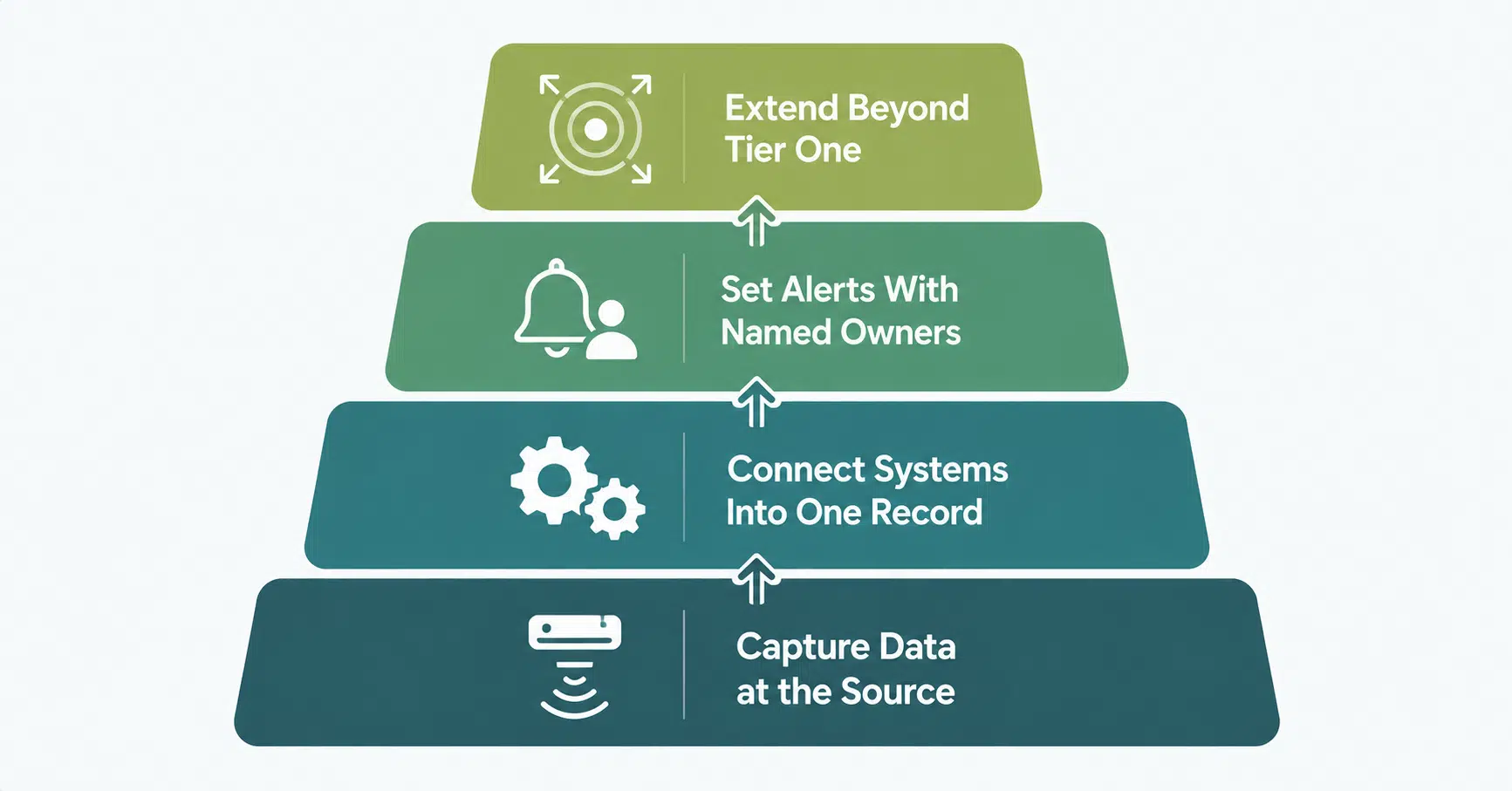
Build visibility in four layers; each one depends on the layer below it.
3. How Do You Improve Visibility in a Supply Chain?
Improve visibility in layers: capture data at the source, connect systems into one record, set alerts with named owners, and extend the view beyond your first tier of partners. Each layer depends on the one before it, so a dashboard built on incomplete data only shows the gaps faster.
Capture Data at the Source
Visibility starts with data created automatically at the point of work, such as scanners, GPS devices, sensors, and cameras, rather than keyed in later. Manual entry creates the delays and inconsistencies that visibility software is meant to remove, so each manual step you replace removes a place where the record can drift from reality.
Connect Systems Into One Record
Most visibility projects spend more effort on integration than on screens. Warehouse, transport, ERP, and partner systems use different formats, so the software must translate and match them into one record of each shipment or container. Without that shared record, every team keeps its own version of where things are.
Set Alerts With Named Owners
A view nobody acts on is only a report. Define which events matter, such as a missed pickup, a dwell time threshold, or a temperature breach, and assign each alert to a person or team. Visibility pays off when an exception reaches someone who can fix it while there is still time.
Extend Beyond Tier One
The hardest gap is beyond your direct partners. McKinsey found that 58% of surveyed companies have mapped their tier-two suppliers, but fewer than half of those maintain regular direct contact with them. Tier-two visibility rose 22 percentage points in the latest survey, reversing several years of decline.
4. What Does Visibility Look Like Inside a Yard?
Inside a yard, visibility means knowing where every container is and what state it is in without relying on paper records. Savvycom built an AI yard management system for a global logistics provider whose yards handle 400 to 500 container movements per day, using cameras and computer vision to track containers across the yard in real time.
The client had limited real-time visibility, manual records that caused inconsistencies, and internal movements that were never recorded. The system recognizes container IDs, trailer IDs, and truck license plates at entry and exit, tracks containers across the yard, and shows each container’s position and status on a live 2D map. Dashboards support instant search and dwell time monitoring.
The client reported 95% accuracy in container placement and movement tracking, a 60% reduction in container search and retrieval time, and a 35% to 40% increase in operational productivity. The figures describe this client’s yards and a manual starting point, so treat them as a reference, not a forecast.
5. What Slows Visibility Projects Down?
Visibility projects slow down when data sits in separate systems, partners cannot share data in a usable form, alerts have no owner, and leadership does not treat multi-tier visibility as a priority. These are organizational as much as technical problems, which is why software alone rarely closes the gap.
- Data in silos. Each system holds part of the picture, and nobody owns the combined record.
- Partners without data access. A tier-two supplier may have no system that can send data in a usable format.
- Alerts without owners. Exceptions appear on a screen, and nobody is responsible for acting on them.
- Shifting investment. McKinsey found the share of companies planning major investments in digital supply chain systems fell from 47% to 25% in the past year.
A practical way to start is a pilot on one lane, one site, or one supplier tier, with two or three measures such as search time, dwell time, or on-time delivery. Expand once the data and the alert process work.