What Is AI Development? A Complete Guide for Businesses (2026)
88% of companies now use AI in at least one business function. But only 6% report that AI contributes more than 5% to their bottom line (McKinsey, State of AI 2025). That gap between adoption and actual business impact is where most AI investments go to die.
The problem isn’t the technology. It’s how companies approach AI development: building without clear business objectives, underestimating integration complexity, or choosing vendors based on demos rather than production track records.
This guide is not an introduction to machine learning. It’s a practical resource for CTOs, CDOs, and business owners making real decisions about AI investment in 2026. We cover what AI development actually involves, which types of AI systems match which industries, what the build process looks like from discovery to production, what it realistically costs, and what compliance frameworks apply. Every section draws on production deployment data, not research abstractions.
1. What is AI development, and why does it matter for your business?
AI development is the process of building, deploying, and maintaining custom AI systems that integrate into your business operations to automate decisions, reduce manual costs, and create competitive advantages that off-the-shelf tools cannot deliver.
There’s an important distinction most discussions skip. Using AI tools (ChatGPT for drafting emails, Copilot for code completion) is not the same as building AI systems integrated into your business workflows. The first is productivity enhancement for individuals. The second is operational transformation for the organization.
Off-the-shelf AI tools work well for generic tasks. But when your workflows are specific to your industry, when your data is proprietary, or when regulatory compliance requires explainability and audit trails, generic tools fall short. A bank processing loan applications needs AI trained on its own risk models and compliant with its specific regulatory framework. A logistics company optimizing route planning needs AI that understands its fleet constraints, warehouse network, and seasonal demand patterns.
Custom AI development becomes justified when three conditions overlap: the workflow is specific enough that generic tools can’t handle it, the data involved is proprietary or sensitive, and the decision being automated has direct financial or operational impact. When all three are true, the return on a custom build consistently outperforms the workaround cost of adapting generic SaaS.
Think of it this way. Buying a SaaS AI tool is renting a general-purpose capability. Building a custom AI system is constructing a competitive asset that improves with your data over time. The question isn’t whether AI matters for your business. It’s whether you’re consuming AI or building AI, and at what point the distinction starts costing you money.
2. Why are businesses rushing to adopt AI, and what happens if you don’t?
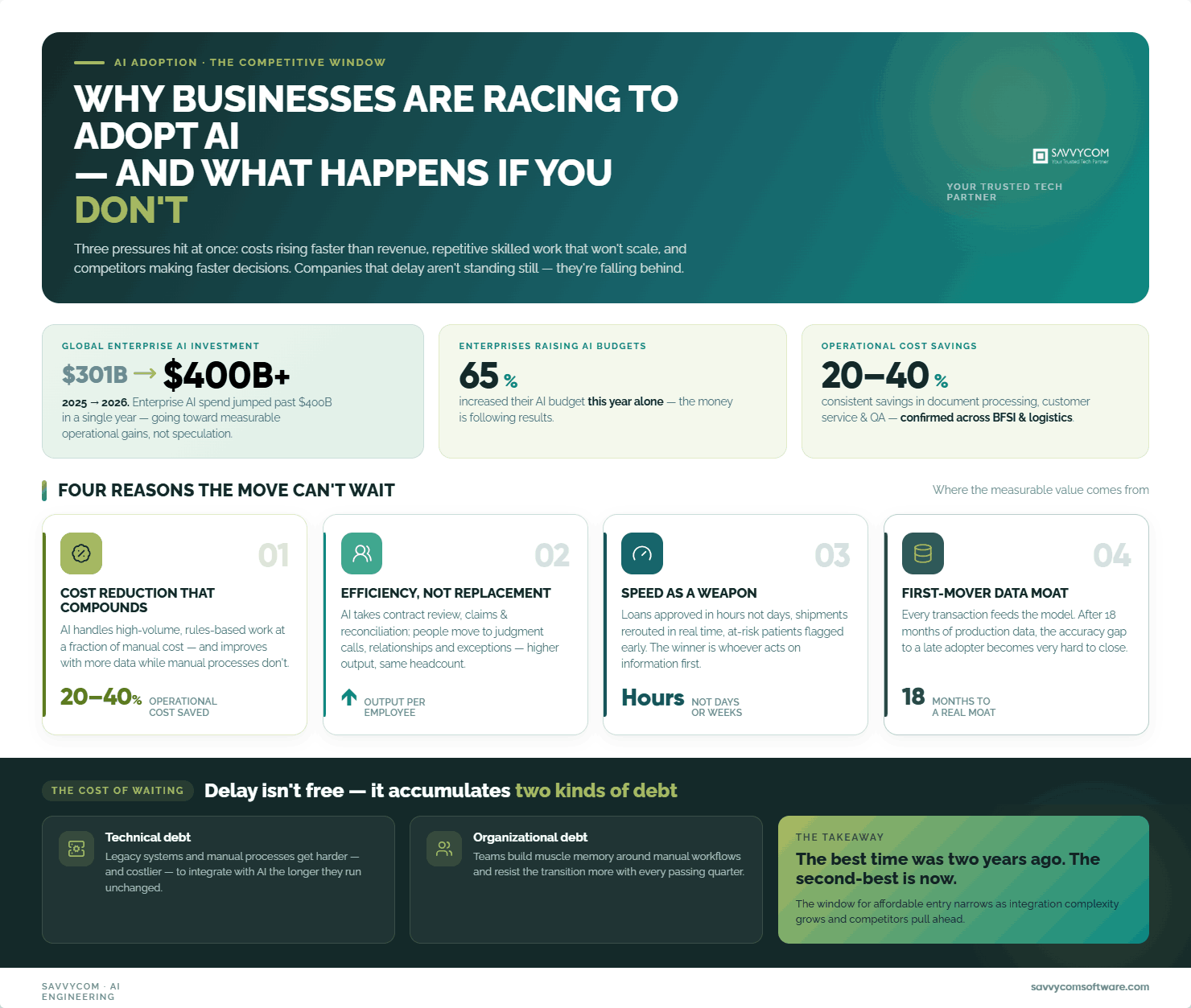
Businesses are adopting AI because three pressures hit simultaneously: operating costs are rising faster than revenue, skilled labor for repetitive work is increasingly hard to scale, and competitors with AI-enabled workflows are making faster decisions. Companies that delay AI adoption aren’t standing still. They’re falling behind.
The urgency isn’t theoretical. Global enterprise AI investment reached $301 billion in 2025 and jumped past $400 billion in 2026. 65% of enterprises increased their AI budgets this year. That money isn’t speculative. It’s going toward measurable operational gains.
Cost reduction that compounds
AI handles high-volume, rules-based work at a fraction of the manual cost. In document processing, customer service, and QA workflows, production AI deployments consistently deliver 20-40% operational cost savings. Savvycom’s own deployments across BFSI and logistics verticals confirm this range. The savings compound because AI systems improve with more data, while manual processes don’t.
Labor efficiency, not labor replacement
The real value isn’t replacing people. It’s redirecting them. When AI handles contract review, claims processing, or inventory reconciliation, your team focuses on judgment calls, client relationships, and exception handling. These are the tasks that actually need human intelligence. The result: higher output per employee without increasing headcount.
Speed as a competitive weapon
In banking, the institution that processes loan applications in hours instead of days wins the customer. In logistics, the company that reroutes shipments in real time based on weather and port congestion data captures margin that slower competitors leave on the table. In healthcare, the hospital network that flags high-risk patients before readmission reduces costs and improves outcomes simultaneously.
First-mover data advantage
Companies that deploy AI early in their vertical build a compounding advantage. Every transaction, every customer interaction, every operational cycle feeds the model. After 18 months of production data, the accuracy gap between an AI-enabled competitor and a late adopter becomes extremely difficult to close.
This is not a theoretical moat. We’ve seen it in BFSI deployments where early-adopting banks now have credit scoring models that took two years of production data to reach their current accuracy. A competitor starting today can’t buy that advantage. They have to earn it, and they’re already two years behind.
The cost of waiting is not zero
Companies delaying AI adoption aren’t just missing opportunities. They’re accumulating two kinds of debt.
- Technical debt: legacy systems and manual processes that become harder to integrate with AI the longer they run without change.
- Organizational debt: teams that build muscle memory around manual workflows resist the transition more with each passing quarter.
The best time to start was two years ago. The second-best time is now. But the window for affordable entry is narrowing as integration complexity grows and competitors pull further ahead.
3. What types of AI systems are businesses building, and which industries use them most?
Six types of AI systems account for the majority of enterprise investment today. Which one fits depends on your industry, the volume of data you process, and the type of decisions you need to automate.
| AI System Type | What It Does | Industries Using It Most |
|---|---|---|
| Predictive AI / ML Models | Forecasting, anomaly detection, recommendations | BFSI (credit scoring, fraud detection), Logistics (demand planning), Healthcare (readmission risk) |
| Intelligent Document Processing | Extract, classify, and validate data from contracts, invoices, records | BFSI (KYC/AML), Healthcare (medical records), Logistics (shipping documents), Legal |
| Generative AI Applications | Content generation, code assistance, customer communication | Retail, Financial services, Professional services |
| Agentic AI / Multi-Agent Systems | Autonomous task execution, orchestrated multi-step workflows | Operations, Finance, Customer service automation |
| Computer Vision / Vision AI | Object detection, quality inspection, document scanning | Manufacturing (quality control), Logistics (container tracking), Healthcare (medical imaging) |
| AI Workflow Automation | Cross-system orchestration, automated handoffs between processes | Cross-industry: any workflow with multiple handoffs between systems or teams |
A few patterns worth noting.
BFSI and healthcare organizations tend to start with Document AI because the ROI is fastest and easiest to measure. Processing thousands of loan applications, insurance claims, or patient records manually is expensive and error-prone. AI cuts that cost immediately and reduces errors at the same time.
Manufacturing and logistics companies often start with Computer Vision because the use case is physically visible: inspecting products on a production line, reading container IDs in a yard, scanning documents at a warehouse dock. The ROI is tangible and the business case is easy to explain to non-technical stakeholders.
Agentic AI and multi-agent systems are the newest category and the fastest-growing. These systems don’t just process data or make predictions. They execute multi-step tasks autonomously, coordinating between different tools and data sources. Think of an AI agent that receives a customer complaint, pulls the order history, checks inventory, and drafts a resolution without human intervention. This is where the most aggressive enterprise AI investment is heading in 2026 and beyond.
Generative AI applications get the most media attention but represent a smaller share of enterprise spending than the categories above. Most production generative AI deployments focus on internal productivity (document drafting, code assistance, customer communication templates) rather than customer-facing products. The highest-value generative AI use cases combine generation with proprietary data through retrieval-augmented generation (RAG), essentially teaching a language model to answer questions using your company’s internal knowledge base.
4. How does the AI development process work?
AI development is not a one-time build. It follows a phased process that moves from problem definition through prototyping, production build, and ongoing optimization, with defined deliverables and go/no-go checkpoints at each stage.
You’ll see different vendors describe this as 4 phases, 5 stages, 6 steps. The number doesn’t matter. What matters is that the framework covers four non-negotiable checkpoints: validating the right problem before building, testing assumptions on real data before committing budget, managing integration as a first-class concern (not an afterthought), and planning for post-launch maintenance from day one. Strip away the branding, and every credible AI development process reduces to these same checkpoints. The difference between vendors isn’t the framework diagram on their website. It’s whether they actually enforce those checkpoints in practice or skip them under schedule pressure.
Savvycom structures this as a 4-phase engagement. Here’s what each phase covers and why it exists.
Phase 1: Discovery & Alignment
Define the right problem before writing any code. This means mapping existing workflows, assessing data readiness (do you have the data, is it labeled, is it clean enough to train on), identifying compliance obligations, and defining measurable success metrics.
Output: Requirements document, feasibility assessment, and realistic budget estimate. All completed before any development contract is signed.
Why this matters: roughly 40% of AI projects that skip formal discovery end up solving the wrong problem or building on data that can’t support the use case. Discovery costs a fraction of what a misaligned build costs.
Phase 2: Validation & Prototyping
Build a prototype fast and test core assumptions against real data before committing the full development budget. This phase catches the most expensive mistakes early. Can the model reach acceptable accuracy on a representative data sample? Does the integration path to existing systems actually work? Are there data quality issues that need resolution before full build?
Output: Working prototype with measured accuracy on a representative dataset. If the prototype shows the approach won’t work, you pivot before the bulk of the budget is committed. If it validates the concept, you have concrete performance baselines for the full build.
Phase 3: Build & Integration
Full development plus integration with existing systems: ERP, CRM, core banking, electronic health records, warehouse management, or whatever the tech stack includes.
This is the phase that gets consistently underestimated. Integration typically accounts for 30-40% of total project cost because legacy systems are rarely as well-documented or as flexible as their vendors claim. A loan origination AI that works perfectly in isolation but can’t communicate with the core banking system is worthless. For a closer look at what integration actually involves across different use cases, see 15 real-world AI integration examples.
Output: Production-ready system with compliance validation, security audit, and documented integration points. This phase runs best in agile sprints with regular demos so there are no surprises at deployment.
Phase 4: Optimization & Continuous Development
AI systems are not set-and-forget. Model performance drifts as real-world data patterns change. New edge cases surface that the training data didn’t cover. Business requirements evolve.
This phase covers model drift monitoring, retraining schedules when data distributions shift, performance optimization, and feature expansion as the business identifies new use cases.
Output: SLA-backed MLOps support with defined response times and performance guarantees. Budget 15-20% of initial build cost annually for this phase. Companies that skip ongoing optimization typically see model accuracy degrade 10-15% within the first year.
5. What does AI development cost, and what drives the differences?
AI development costs range from $30,000 for a focused MVP to over $1,000,000 for enterprise platforms with multi-system integration. Five factors determine where your project lands in that range.
Five factors that drive cost
- Scope and complexity. A single-use-case ML model (fraud detection for one transaction type) costs a fraction of a multi-use-case platform (fraud detection plus credit scoring plus customer segmentation on a unified data pipeline). Define the MVP scope tightly before budgeting.
- Integration depth. A greenfield system with a clean API is straightforward. Integrating with five legacy systems, each with different data formats, authentication methods, and update cycles, multiplies the engineering effort. Ask your vendor how many integration engineers they’re staffing. That number tells you what they really expect.
- Compliance overhead. HIPAA, GDPR, PDPA, and the EU AI Act each add requirements for data handling, model explainability, and audit trails. Budget an additional 15-25% for projects in regulated industries. This isn’t optional if you’re in BFSI or healthcare.
- Data readiness. Clean, labeled data ready for training is the best case. Raw data that needs extraction, cleaning, deduplication, and labeling before it’s useful is the common case. Data preparation can consume 30-50% of total project time and budget.
- Geography and vendor type. A global system integrator (Accenture, Deloitte) typically quotes $500K+ for projects that an APAC specialist with equivalent engineering quality delivers for $50K-$400K. In-house teams avoid vendor margins but carry hidden costs: recruiting timelines, infrastructure setup, management overhead, and the opportunity cost of slower time-to-production.
Cost ranges by AI system type
| AI System Type | Typical Range | Timeline |
|---|---|---|
| Focused ML model (single use case) | $30,000 – $80,000 | 8-14 weeks |
| Document AI / IDP system | $50,000 – $200,000 | 10-20 weeks |
| Generative AI application | $40,000 – $150,000 | 8-16 weeks |
| Computer Vision system | $80,000 – $300,000 | 12-24 weeks |
| Multi-agent / Agentic system | $100,000 – $500,000+ | 16-32 weeks |
| Enterprise AI platform (multi-use-case) | $300,000 – $1,500,000+ | 6-18 months |
These ranges assume an APAC-based development partner with strong AI engineering capability. Global SI rates will be 2-3x higher for comparable scope. In-house builds often match or exceed SI costs once you factor in recruiting timelines and infrastructure setup. For a more granular breakdown of cost components (team composition, infrastructure, hidden costs), see How much does artificial intelligence cost?
AI Development Cost Estimator
Select your project parameters to get a ballpark cost range and timeline.
6. What compliance requirements must your AI system meet?
Compliance requirements depend on your industry, geography, and whether the system influences clinical or financial decisions. APAC businesses often must comply with multiple frameworks simultaneously, with conflicting requirements around data residency and consent.
| Framework | Applies To | Key AI Requirements |
|---|---|---|
| GDPR (EU) | Any system processing EU resident data | Right to explanation for automated decisions, data minimization, privacy impact assessments |
| EU AI Act | AI systems deployed in or affecting the EU market | High-risk classification for BFSI and healthcare AI, conformity assessments, transparency obligations. High-risk system rules take effect August 2026 |
| HIPAA (US) | Healthcare AI handling protected health information | Encryption, access controls, audit trails, business associate agreements with all AI vendors |
| FDA SaMD | AI used in clinical decision-making | Pre-market authorization, Good Machine Learning Practices, predetermined change control plans for model updates |
| PDPA (Singapore / Thailand) | Systems processing personal data in Southeast Asia | Consent requirements, data protection officer appointment, cross-border transfer restrictions |
| APPI (Japan) | Systems processing Japanese personal data | Purpose limitation, opt-out mechanisms, restrictions on sensitive data categories |
| PIPA (South Korea) | Systems processing Korean personal data | Consent-based processing, algorithmic impact assessments for high-impact AI (new under 2026 Framework Act) |
The APAC multi-jurisdiction challenge
This is where most global guides fall short. If you’re operating across APAC, you’re not dealing with one compliance framework. You’re dealing with several, often with conflicting requirements.
Singapore’s PDPA requires data to stay within Singapore for certain categories. Japan’s APPI has different consent requirements than Korea’s PIPA. Thailand’s PDPA (separate from Singapore’s, despite the same acronym) has its own cross-border transfer rules. Vietnam’s Personal Data Protection Law, expected to take full effect in 2026, adds another layer.
South Korea’s Framework Act on Artificial Intelligence Development, effective January 2026, is the first comprehensive AI law in APAC. It introduces specific obligations for “high-impact” AI systems, including mandatory impact assessments and transparency requirements. If you’re deploying AI in the Korean market, this matters now.
The EU AI Act adds a new dimension for any company with EU exposure. Starting August 2026, AI systems classified as “high-risk” (including most BFSI and healthcare AI) must meet conformity assessment requirements, maintain technical documentation, and ensure human oversight capabilities. Fines reach up to 35 million euros or 7% of global annual turnover.
For a healthcare AI system deployed across multiple APAC markets, you might need to comply with HIPAA (if US patients are involved), PDPA, APPI, and local medical device regulations simultaneously. The architecture needs to support different data residency requirements, consent mechanisms, and audit trail formats from day one. Retrofitting compliance after build is expensive and sometimes architecturally impossible.
The practical advice: identify your compliance requirements during Phase 1 (Discovery), not Phase 3 (Build). The cost difference is significant. If you’re in a regulated industry, an AI readiness checklist for regulated industries can help you assess where you stand before engaging a vendor.
7. What AI development results are businesses actually achieving?
Production AI systems deliver measurable results when scoped correctly and integrated into existing workflows. The consistent pattern across Savvycom deployments: AI handles high-volume structured work, humans handle edge cases and consequential decisions.
Two production deployments illustrate what realistic AI outcomes look like.
Contract review automation for a leading South Korean logistics conglomerate
A leading South Korean logistics conglomerate needed to process over 1,000 contracts per month across multiple business units. Manual review was slow, inconsistent across reviewers, and couldn’t scale with business growth.
Savvycom deployed a Document AI system that automated extraction, classification, and validation of contract terms against predefined business rules. The results:
- 50% reduction in contract review time
- 95% extraction accuracy on structured contract fields
- 1,000+ contracts processed monthly with consistent quality
The team that previously spent most of its time on routine data extraction now focuses on negotiation strategy and exception handling for edge cases the AI flags for human review.
Yard Management System with Computer Vision
The same logistics operation needed to track containers across a complex yard with thousands of movements daily. Manual tracking caused delays, misidentified containers, and wasted hours searching for misplaced units.
Savvycom built a Computer Vision system that processes container images in real time, identifies containers with 95% accuracy, and reduced search time by 60%. The system updates the yard management database automatically and flags exceptions for human review.
Both projects share a pattern that holds across most successful AI deployments. AI didn’t replace the operations team. It handled the high-volume, repetitive portion of their work at a speed and consistency humans can’t match. The team redirected their time to judgment-intensive work that actually needs human intelligence.
FAQ
What are the 5 biggest AI fails?
The five most common AI failures are:
- Building without defined business metrics.
- Training models on poor-quality data.
- Underestimating integration with legacy systems.
- Skipping prototype validation before committing budget.
- Treating AI as a one-time build with no maintenance.
All five are preventable with phased development and proper discovery.
What is an AI development framework?
An AI development framework is a structured methodology guiding an AI project from problem definition through deployment and maintenance. It defines stages for discovery, data preparation, model development, integration, and optimization, each with clear deliverables and checkpoints. The number of stages varies by vendor, but the core structure is consistent across credible approaches.
How long does AI development take?
Most enterprise AI projects take 8 to 32 weeks from discovery to production deployment. Focused ML models and generative AI applications land in the 8-16 week range. Multi-agent systems and enterprise platforms require 16-32 weeks or longer. Data preparation and discovery typically consume 20-30% of the total timeline.
What's the difference between AI development and buying an AI SaaS product?
AI SaaS products offer general-purpose capabilities across industries. Custom AI development builds systems trained on your proprietary data, integrated into your specific workflows, and compliant with your regulatory requirements. Choose SaaS for generic use cases. Choose custom development when your data is proprietary, your workflow is industry-specific, or compliance demands audit trails.
Looking for a Trusted Tech Partner That Delivers Your Measurable Values?
Savvycom's Document AI team has shipped contract review and computer vision document processing systems in production across South Korea, Vietnam, and Southeast Asia.
If you are scoping an AI document processing project and want to understand what is realistic for your document types and integration environment, the conversation starts here: AI Solutions and AI Services.