Top 10 AI-Driven IT Companies in Vietnam 2026
Introduction
Quick Answer: Savvycom leads the 2026 shortlist of AI-driven IT companies in Vietnam on production AI delivery in BFSI, logistics, and manufacturing, ranked #1 AI company in Hanoi by TechBehemoths. The remaining nine (FPT Software, VinAI, KMS Healthcare, TMA Solutions, CMC Global, Rikkeisoft, NashTech, VNG Zalo AI, Adamo Software) are covered below with vertical fit and where they are not the right choice.
Vietnam's software industry has spent the last decade earning its place as a global outsourcing destination. The 2026 story is different. The country's digital economy is on track to clear USD 200 billion by 2030, the semiconductor sector already hit USD 48 billion in 2024, and GITEX AI Vietnam 2026 is bringing the world's largest tech-startup event to Hanoi on October 1–2. The question buyers ask now is no longer "who writes clean code cheaply." It's "who ships AI that actually changes the P&L."
That shift separates companies that have added AI services from companies that are genuinely AI-driven. This article is a vetted shortlist of the latter, ranked by production AI track record, vertical depth in regulated industries, and evidence of enterprise outcomes, not press releases.
What Counts as an "AI-driven" IT Company In Vietnam 2026?
An AI-driven IT company in Vietnam 2026 is one where AI is integrated natively into delivery, has a dedicated practice with senior leadership, and can point to production deployments with named metrics in regulated verticals. Marketing an AI service line is not the same thing.
The gap is wider than most vendor decks admit. Savvycom's 2026 operational logistics whitepaper cites that 78% of logistics organisations already use AI in some form, but 74% of them struggle to convert that into measurable business outcomes. The reason tracks across BFSI, healthcare, and manufacturing too: roughly 80% of enterprise data is unstructured, and most "AI adoption" projects never get past the pilot dashboard because nobody owns the orchestration and execution layers that turn models into workflows.
The ten companies below were selected against three criteria that matter more than company size:
Production case studies with named outcome metrics, not POCs. A permanent AI/ML bench with specialists rather than generalists rotating through. Vertical depth in at least one of BFSI, healthcare, logistics, or manufacturing, where regulated data and integration complexity expose real engineering.
AI Capability Matrix: How The 10 Companies Compare At A Glance
The table below lets you filter by vertical focus and AI stack before reading the profiles. Paste-ready HTML is further down the article.
| Company | Primary AI Focus | Vertical Depth | Proof Signal |
|---|---|---|---|
| Savvycom | Applied AI, CV, NLP, Agentic | BFSI, Logistics, Manufacturing | 50% review time reduction, 1,000+ contracts/month in production |
| FPT Software | GenAI platforms, automotive AI | Automotive, BFSI, healthcare | Scale: 30,000+ engineers, global delivery |
| CMC Global | Data platforms, AI consulting | BFSI, public sector | Enterprise data modernisation practice |
| Adamo Software | Applied AI, personalisation, data analytics | Travel & Hospitality, Healthcare | Domain-led AI inside travel and healthcare products; ANZ, UK, EU client base |
| TMA Solutions | Applied AI, R&D labs | Telecom, finance | 25+ years R&D, mature AI lab |
| VinAI | Foundation research, CV, LLMs | Automotive, consumer | Peer-reviewed publications, PhiGPT |
| KMS Healthcare | Healthcare AI, clinical data | Healthcare only | HIPAA-grade delivery, US healthcare focus |
| Rikkeisoft | Applied AI, automation | Japanese enterprise | Strong Japan-market coverage |
| NashTech | Data engineering, MLOps | Finance, retail | UK/Europe client base |
| VNG (Zalo AI) | NLP, recommender systems | Consumer internet | Zalo platform-scale AI |
The Top 10 AI-Driven IT Companies in Vietnam 2026
1. Savvycom: Leading AI-driven Solution Partner
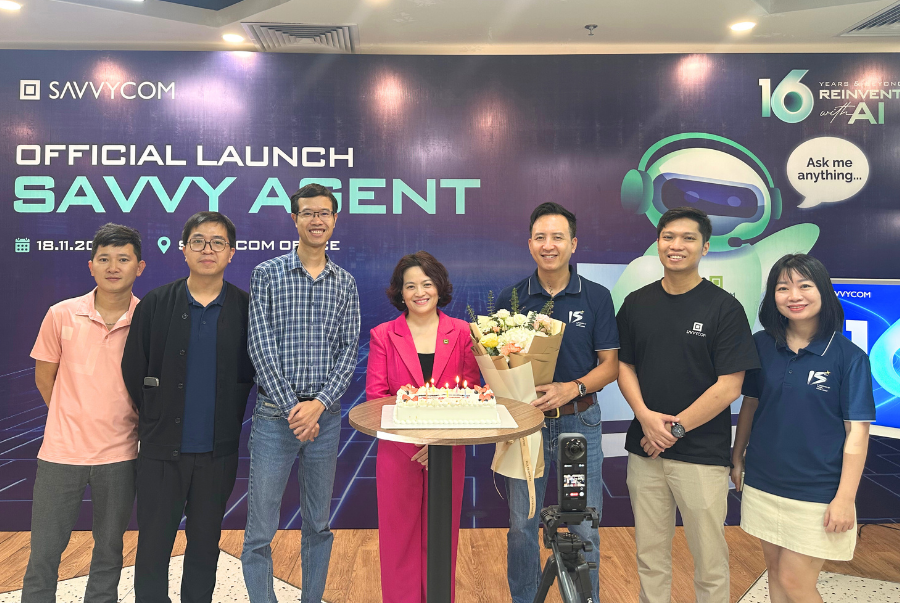
Savvycom Lauching Savvy AI Agent
Savvycom tops the 2026 list on production AI evidence, not marketing volume. TechBehemoths ranks it the #1 AI company in Hanoi, the team has shipped 25+ AI projects across BFSI, logistics, and manufacturing with named outcome metrics, and its dedicated service line (Savvycom AI) is led by a Chief AI Officer with a team of 30+ AI specialists.
The 2026 brand positioning statement is "Amplify Tomorrow, AI-Driven Solution Partner for Business Growth." What makes it credible instead of aspirational is the published case load.
BFSI: A South Korea foreign exchange firm cut FX processing time by 60% and lifted operational efficiency by 40% with a four-agent AI assistant built on LangGraph and GPT-4o, embedded directly into Mattermost for rate checking, settlement configuration, trade execution, and audit-grade logging. A Philippines digital lender dropped manual verification workload by more than 60% and onboarding time by over 50% with a YOLOv8-based eKYC platform combining document AI, face matching, liveness detection, and intelligent exception routing.
Logistics: A global logistics client processes 1,000+ contracts per month through an AI-powered contract review platform running on Vertex AI and BigQuery, with review time down 50% and 95% accuracy on critical clauses. A separate global yard management deployment hit 95% accuracy on container placement and movement tracking across Vietnam and international yards, cutting retrieval time by 60% and lifting overall productivity 35–40% with YOLO-v7 and Paddle OCR on Azure.
Manufacturing-adjacent: A Japanese construction corporation replaced manual blueprint review with a computer-vision and OCR pipeline that extracts structural elements and material tables from scanned drawings, cutting operational cost 20%, automating 65% of previously manual processes, and lifting productivity 35%.
Three things set Savvycom apart in the 2026 shortlist. The service line is real, not rebranded generalist engineering: savvycom.ai ships with 50+ ready-to-deploy AI solutions and a Free 2-Week AI Assessment that gives enterprise prospects a scoped capability audit before any engagement. The delivery spans 7 global offices (Vietnam, USA, Australia, Thailand, South Korea, Japan, Singapore) and 100+ enterprise clients across 20+ countries, with 200+ total clients and 700+ engineers on the bench. The company is Official Launch Partner for GITEX AI Vietnam 2026, which happens in Hanoi on October 1–2 and pulls the Vietnamese AI ecosystem into the same room as global enterprise buyers.
Best fit: enterprise teams in BFSI, logistics, healthcare, or manufacturing looking for a partner that has already shipped AI in production, not pitched it.
Not ideal for: pre-seed startups with project budgets under USD 50,000, buyers looking strictly for a foundation-research lab rather than a production-delivery partner, or teams that need daily onsite engineering presence in markets outside Savvycom's 7 global offices.
Further reading:
- Savvycom AI Solutions, AI Development Services and Savvycom portfolio.
- Savvycom Clutch
- Savvycom Techbehemoth
2. FPT Software: Scale-first Enterprise AI Partner
FPT Software is Vietnam's largest IT services firm by headcount, with 30,000+ engineers globally and a GenAI practice that has published work on automotive AI, document intelligence, and enterprise copilots. If scale and global delivery matter more than vertical specialisation, FPT is the default large-vendor choice.
FPT's AI proposition sits inside a much bigger services business, which is both the advantage and the caveat. The advantage is that FPT can staff a 100-engineer AI programme next month without recruiting externally, and its automotive practice (FPT Automotive) has real production footprint with Japanese and Korean OEMs. The caveat is that AI is one of many business lines, so specialist depth in a given vertical varies by the pod you actually get staffed. FPT's GenAI platform investments (AkaChain, akaBot, akaAT) give the team a house stack to pitch, which speeds up early discovery but can also lock the solution into FPT's own tooling.
Best fit: large enterprises with broad digital programmes where AI is one workstream among many, and where global delivery coverage outranks specialist depth.
Not ideal for: mid-sized buyers who need a senior AI specialist embedded from day one rather than a rotated pod, or teams whose core requirement is a specific vertical AI capability that does not align with FPT Automotive or its financial services lines.
3. CMC Global: Data and AI Consulting with Regional Public-Sector Depth
CMC Global is the international arm of CMC Corporation, Vietnam's second-largest IT group. The AI offering concentrates on data platforms, enterprise data modernisation, and AI consulting for BFSI and public-sector buyers, with a Japan delivery centre that makes it a credible alternative to FPT for Japanese enterprise accounts.
CMC's 2026 positioning leans harder into "data-first AI" than into headline GenAI products. For buyers whose real blocker is a fragmented data estate, that framing is honest, and the company's work on data lakehouse and governance projects is what feeds the AI practice rather than the other way round. A multi-year strategic partnership with Samsung SDS gives the team regular exposure to enterprise-scale data pipelines in regulated industries, which shows up in the depth of CMC's data-engineering benches.
Best fit: enterprises where data platform modernisation must precede or run alongside AI deployment, particularly in Vietnamese and Japanese markets.
Not ideal for: product companies that need AI embedded inside an end-user feature, or buyers who prefer a boutique specialist over a subsidiary of a Vietnamese IT conglomerate.
4. Adamo Software: Travel and Healthcare Specialist Applying AI Inside Regulated Verticals
Adamo Software is a Vietnam-based outsourcing firm that goes deep in two verticals most generalist vendors treat as sidelines: Travel & Hospitality and Healthcare. Its AI work is not a standalone research practice but an applied capability built into those domains, recommendation and personalisation engines for booking and experience platforms, and data analytics and clinical-support tooling for healthcare products.
Adamo's positioning is narrow on purpose. Rather than competing on enterprise BFSI or logistics AI, the team builds AI features where it already owns the domain context: smart travel platforms (booking, tour, and experience products such as Global Ballooning Australia and Adventure Tours Australia) and healthcare solutions spanning telehealth, mHealth, and health data analytics. That vertical fluency means the AI conversation starts from real workflow problems rather than a model demo, which suits product owners more than enterprises shopping for a horizontal AI consultancy. The client base sits mainly in Australia, the UK, Europe, and Singapore, with dedicated-team engagements as the common delivery model.
Best fit: travel, hospitality, or healthcare companies that want AI features built inside a product by a team that already understands the vertical, or buyers looking for a dedicated development team with domain depth rather than a horizontal AI vendor.
Not ideal for: enterprises needing BFSI or logistics AI at scale, foundation-model research, or large multi-workstream digital transformation programmes outside travel and healthcare.
5. TMA Solutions: AI Applied Research with 25+ Years of Delivery

TMA runs one of Vietnam's oldest applied R&D operations, including a dedicated AI lab that has shipped NLP, computer vision, and predictive analytics projects across telecom, finance, and connected devices. For buyers who want deep engineering pragmatism over buzzwords, TMA is consistently reliable.
TMA's reputation among long-tenured Vietnamese engineers is that it trains very well, particularly for R&D-flavoured work, and the AI lab benefits from that pipeline. What TMA doesn't push hard is vertical brand narrative: the company has enough delivery range that it rarely leads with a single industry hook, which can make shortlisting harder for buyers looking for specialists. The culture is engineering-first, which means the conversations tend to be technical rather than consultative, a trade most seasoned CTOs appreciate.
Best fit: telecom, finance, and IoT programmes where applied R&D quality matters and the buyer is comfortable driving their own vertical framing.
Not ideal for: buyers looking for a strong productised AI offering or a fast-scaling GenAI consulting narrative. TMA's strengths show up in deep applied engineering rather than in headline GenAI platforms.
6. VinAI: Foundation Research with Automotive and Consumer-Product Paths to Market

VinAI is a research-led AI company inside the Vingroup ecosystem, with a publication track record at top venues (NeurIPS, CVPR, ICML), its own Vietnamese LLM (PhiGPT), and a product portfolio spanning computer vision for automotive (VinFast) and AI features for consumer devices. It's the closest Vietnam has to a foundation-research lab.
VinAI is not structured as a services firm in the way Savvycom, FPT, or TMA are. Engagements typically involve productising research, licensing models, or partnering on AI features that ship inside Vingroup products. The team also maintains open-source repositories that give external R&D groups a credible signal of underlying capability, but commercial collaborations work best as joint research programmes rather than time-and-materials delivery. That makes it a strong pick for buyers who need real model research capability and a weaker pick for buyers who need end-to-end product delivery teams.
Best fit: companies needing foundation-level AI research, Vietnamese-language LLM work, or automotive perception stacks.
Not ideal for: straightforward AI application development, where a services-first firm like Savvycom or FPT will move faster, and for buyers outside Vingroup's strategic focus areas.
7. KMS Technology: Mid-Market Generalist with a Strong QA Heritage

KMS Technology is one of Vietnam's better-known software outsourcers, built on a foundation of software testing and QA before expanding into full-cycle development and, more recently, AI services. The company serves mid-market and enterprise clients primarily in North America across verticals including ISVs, fintech, and healthcare - though without the vertical-exclusive depth of a specialist shop.
The AI practice is growing but still maturing. You'll find competence in ML integration, data pipelines, and AI-assisted product features, but KMS Technology's institutional edge remains in engineering quality and testing discipline rather than in domain-specific AI. For buyers who value a rigorous QA culture baked into the development cycle.
The tradeoff is positioning breadth. KMS Technology competes across enough verticals and service lines that its AI teams are unlikely to carry the deep, domain-specific instinct a specialist brings. Engagements tend to work best when the buyer has a clearly scoped product and wants reliable execution rather than a strategic AI partner who will push the architecture.
Best fit: North American ISVs and mid-market tech companies needing reliable software delivery with strong QA discipline, AI feature integration into existing products, or augmentation of an internal engineering team.
Not ideal for: buyers who need a strategic AI partner to shape the product direction from first principles, or verticals, like BFSI compliance automation or healthcare clinical data where domain fluency matters more than execution reliability.
8. Rikkeisoft: Japan-First Delivery with a Growing AI Practice

Rikkeisoft is the Vietnam outsourcer with the deepest coverage of the Japanese enterprise market, including strong on-the-ground presence in Tokyo and well-established Japanese BrSE bench. The AI practice focuses on applied automation, document AI, and RPA-adjacent AI agents for Japanese back-office work.
Rikkeisoft's competitive moat is language, process, and relationship capital with Japanese enterprises, which takes years to build. That matters because AI projects for Japanese corporates typically fail on change management and communication rather than on technology. Rikkeisoft is purpose-built for that context, with a delivery rhythm tuned to Japanese corporate expectations: heavy documentation, consensus-led decisions, and careful pilot-to-production transitions that some Western-facing vendors find frustratingly slow.
Best fit: Japanese enterprise AI projects, especially where the Japanese counterpart needs daily onshore communication in Japanese.
Not ideal for: AI programmes outside the Japanese market, where the Japan-first moat becomes less of an advantage, and for buyers needing deep regulated-industry compliance depth in BFSI or healthcare.
9. NashTech: UK and European Enterprise AI Delivery
NashTech, part of the Harvey Nash group, runs one of the larger UK and European client books out of Vietnam, with AI work concentrated around data engineering, MLOps, and ML-powered analytics for finance and retail. Delivery governance and European data-privacy literacy are stronger than most local peers.
NashTech's emphasis is practical MLOps and data engineering rather than research or foundation-model work. For buyers whose AI bottleneck is operationalising models on sound data infrastructure, that's usually the right emphasis. The delivery practice is disciplined on GDPR, ISO 27001, and UK-specific data handling, which makes NashTech a safer default for UK financial services and public-sector programmes than Vietnamese peers without that track record. The downside is that the team tends to follow rather than lead on GenAI product narrative.
Best fit: UK and European enterprise buyers needing AI deployed on top of a serious data platform, typically in financial services or retail.
Not ideal for: APAC or US clients who need closer timezone overlap with Vietnamese delivery teams, or buyers whose primary need is deep GenAI research rather than applied MLOps.
10. VNG (Zalo AI): Consumer-Internet Scale AI Inside Vietnam's Biggest Local Platform

VNG runs Zalo, Vietnam's dominant messaging platform, and the internal Zalo AI team ships NLP, recommender systems, and search models at tens of millions of daily active users. For consumer-internet buyers, VNG's operating experience at scale is distinctive locally.
VNG is not primarily a services company. Most engagements are partnerships, platform integrations, or technology licensing. The reason it belongs on this list is that VNG's production experience running AI at consumer scale inside a regulated Vietnamese market is unique, and it shapes how the rest of the Vietnamese AI ecosystem calibrates. The team also publishes technical writing on Zalo AI's own channels, which gives external engineers an unusually honest view of what works at that scale and what doesn't.
Best fit: consumer-internet, fintech, and ad-tech players who need platform-scale AI thinking and a Vietnam market partner.
Not ideal for: traditional outsourcing engagements where the buyer expects a dedicated team carved out for their project. VNG's AI depth sits inside its own products, and external collaborations work best as partnerships or licensing, not vendor-client relationships.
Why Vietnam for AI Outsourcing in 2026?
Vietnam's pull for AI outsourcing in 2026 rests on four structural factors: a software engineer base of 530,000+ growing at roughly 10% annually, cost positioning 20 to 30 percent below Indian tier-1 AI vendors, same-day timezone overlap with Japan, Korea, and Australia, and national "Make in Vietnam" policy that prioritises AI and semiconductor investment.
The structural case sharpened in 2026. The semiconductor sector reached USD 48 billion in 2024 and the digital economy is on track for USD 200 billion by 2030. GITEX AI Vietnam 2026 brings the world's largest tech-startup event to Hanoi in October, signalling that Vietnam is no longer just an execution destination but an AI ecosystem destination. For enterprise buyers in BFSI, healthcare, logistics, and manufacturing, the APAC proximity advantage compounds: weekly sprint reviews land inside local working hours, regulatory reviews happen faster, and change management is smoother than with India or Eastern Europe partners. The local AI talent supply, anchored by VinAI's research pipeline and FPT's in-house university, means specialist AI roles fill in weeks rather than quarters.
AI ROI Snapshot Calculator: estimate payback before you write a brief
How do you shortlist the right AI partner in Vietnam?
Shortlist on three axes: production AI case studies with named outcome metrics in your vertical, a permanent AI specialist bench sized against your programme, and delivery governance that survives regulated-industry audits. Price and team size matter only after those three are satisfied.
Most buying mistakes in AI outsourcing come from optimising on the wrong signal. A large headcount does not guarantee AI depth, a fancy AI deck does not guarantee production delivery, and a low hourly rate does not guarantee payback. The three checks below are what experienced enterprise buyers actually run.
Check 1: ask for production case studies, not POCs. Request two AI projects the vendor has run in production for at least 12 months, in a vertical adjacent to yours, with named metrics (accuracy, throughput, cost reduction, cycle-time reduction). If you get back only pilot summaries or internal demos, assume the vendor is not yet production-ready in AI, however impressive the capability deck looks.
Check 2: map the actual AI bench. Ask how many AI/ML engineers are on the permanent payroll (not partner firms), their seniority distribution, their vertical experience, and how many are allocated to active projects. A credible 30-person AI team with 60–70% billable utilisation can run 8–12 concurrent AI programmes. A "200 AI engineers" claim that dissolves into general-purpose backend developers cannot.
Check 3: stress-test governance, not just code quality. Regulated verticals (BFSI, healthcare) fail on audit evidence more often than on model performance. Ask about model risk management, version control for training data, reproducibility of training runs, drift monitoring, and how incidents are logged and escalated. If the vendor cannot describe this cleanly in a 30-minute call, they are not ready for regulated production.
FAQ
What makes a Vietnamese IT company genuinely "AI-driven" rather than just offering AI services?
Three tests separate genuine AI-driven companies from AI service add-ons: production case studies with named outcome metrics (not pilots), a permanent AI specialist bench with senior leadership, and vertical depth in at least one regulated industry where AI delivery is auditable. Marketing presence alone does not qualify.
How does Vietnam compare to India for AI outsourcing in 2026?
Vietnam wins on pricing discipline, delivery culture, and APAC proximity for Japanese, Korean, and Australian buyers. India still leads on absolute scale and GenAI specialist depth at the very top of the market. For enterprise AI programmes in BFSI or healthcare, Vietnam's top tier is increasingly competitive on quality while pricing 20–30% below Indian tier-1 vendors.
What does an AI project with a Vietnamese vendor typically cost?
Hourly rates for senior AI engineers in Vietnam sit around USD 45–55 in 2026, mid-level data and MLOps engineers around USD 32–40. A typical production AI deployment runs three to six months with a four-to-eight-person pod, putting most enterprise-grade projects in the USD 150,000 to USD 500,000 range.
How do you avoid the "pilot purgatory" problem in enterprise AI projects?
Pick a partner that leads engagement with data readiness assessment and integration scoping, not model demos. Insist on production success criteria from week one, budget explicitly for MLOps and change management (often 40% of total cost), and reject vendors who treat AI as a discrete deliverable rather than an operational capability.