CEO Van Dang Featured On The Cover Of Entrepreneur Magazine: Shaping A Green Future
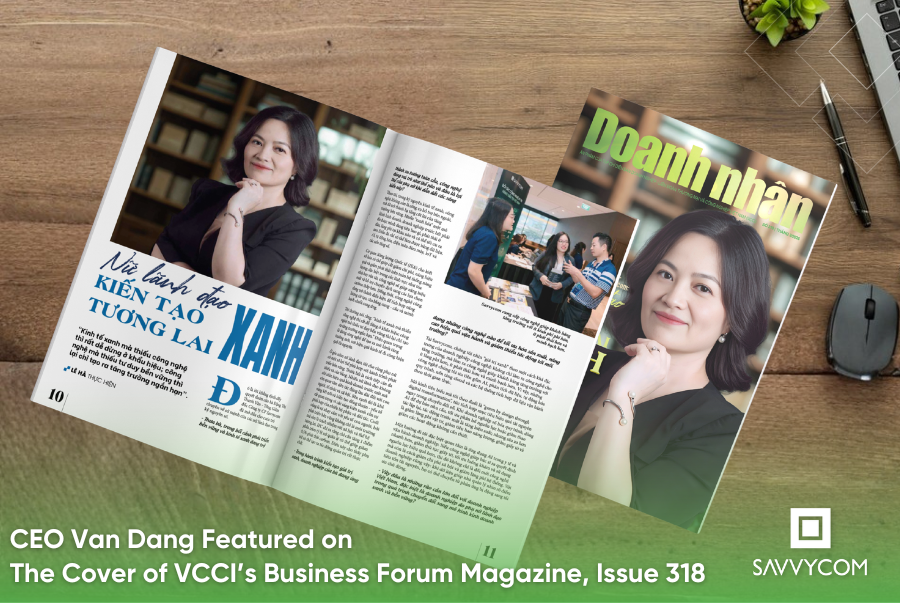 March has just over, as Savvycom celebrated Women’s Month – a time to honor the brilliance, resilience, and leadership of women in our organization. In the celebratory spirit, Savvycom is immensely proud to share that Ms. Van Dang – CEO of Savvycom has been featured as the cover face for issue 318 of Entrepreneur Magazine (the official publication of the Business Forum Magazine – News Agency of VCCI).
Under the theme “Female Leaders Shaping a Green Future,” the feature interview explores the vital link between Technology and Sustainable Development. Moving beyond theoretical concepts, the article delves into how a tech-driven enterprise like Savvycom is actualizing its commitment to the environment and society through digital solutions. Ms. Van Dang asserts that in the new economic era, “Greening” is no longer a choice or a simple CSR activity. Instead, it has become the core infrastructure and the ultimate metric of a business’s competitiveness on the global map.

Savvycom would like to introduce the English version of the interview between CEO Van Dang and reporter Le Ha of Business Forum Magazine below:
In the context of sustainable development and the green economy becoming global trends, what role does technology play, and what are the advantages for women in leading these initiatives?
In my view, in the green economy era, technology is no longer an external support tool; it has become the core infrastructure for sustainable growth. To “green” a business model, an enterprise must first measure what it consumes, where it emits, where waste occurs, and how to optimize. This can only be achieved through data, AI, automation, cloud computing, IoT, and digital platforms.
The International Energy Agency (IEA) states that digitalization can help cut costs, increase efficiency, and reduce emissions across the entire energy system. Particularly in sectors like buildings or transport, digital technology enhances performance and supports the transition to lower-carbon options. Simultaneously, technology is becoming a prerequisite for integrating renewable energy, balancing supply and demand, and ensuring supply chain transparency.
I often say: “A green economy without technology risks becoming a mere slogan; technology without sustainable thinking only creates short-term growth.” The key is to use technology to create a new growth model where economic efficiency goes hand-in-hand with resource efficiency.
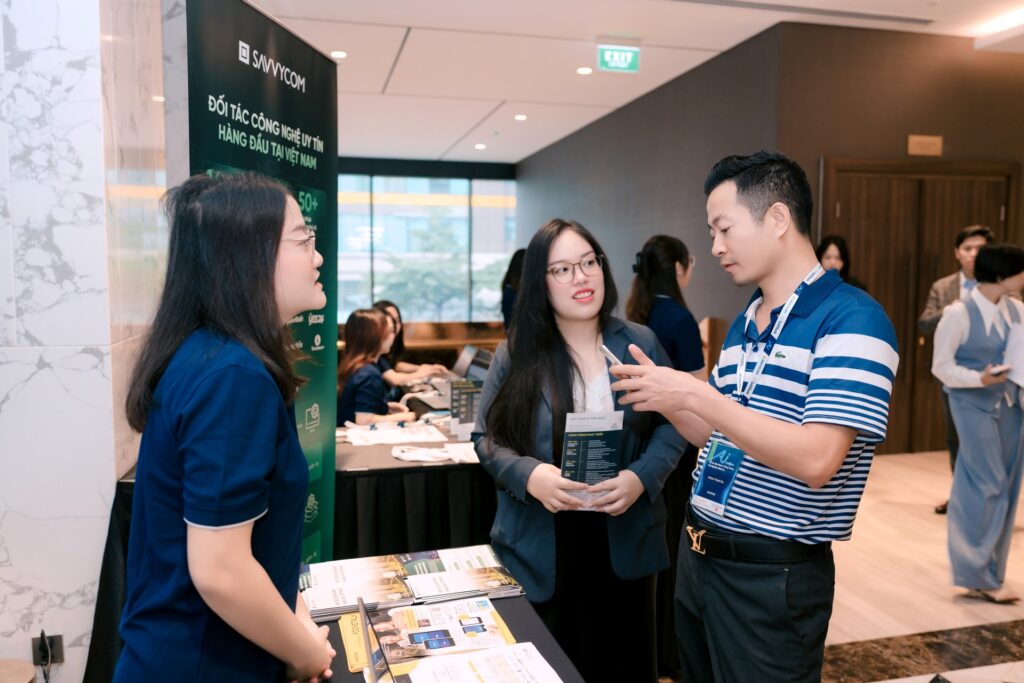 From a female leadership perspective, I believe women possess several advantages suited for the journey of sustainable development. First is the multidimensional and balanced approach. Many female leaders look beyond immediate business results to consider long-term impacts on people, organizations, and society. Additionally, there is the ability to connect and build consensus – a crucial factor since green initiatives require coordination across many departments and partners.
Finally, there is a sensitivity to the human element, as sustainable development is not just about the environment but also social responsibility and future generations. The IFC has pointed out that just a 1 percentage point increase in the ratio of female managers can help reduce carbon emissions by 0.5%. This shows that women can create a very substantial impact on governance.
In the journey of creating green value, what technologies is your company applying to optimize production, enhance operational efficiency, and minimize environmental impact?
At Savvycom, we view “green value” in a way that is quite characteristic of a tech firm: we don’t just build technology for growth; we build technology that helps customers grow with less waste, fewer emissions, and greater transparency. Therefore, our priority technologies include AI, data analytics, process automation, cloud platforms, and real-time operational data integration systems.
 The typical model I pursue is “Green by Design through Digital Transformation” – integrating resource efficiency goals directly into the digital transformation process. When a business digitalizes processes, uses AI to forecast demand, optimizes resource allocation, or reduces repetitive tasks, the immediate impact is increased performance. However, the deeper impact is the reduction of material waste, energy consumption, paperwork, and unnecessary activities.
One direction I am particularly interested in is the application of AI in healthcare and business operations. If technology helps doctors make faster decisions, reduces paperwork, optimizes patient flow, and uses resources more effectively, that is not just technological innovation, it is a way to reduce social costs and systemic waste. The same applies to businesses: when data allows managers to see resource-heavy points clearly, they can shift from passive reaction to proactive optimization.
What are the major barriers for Vietnamese enterprises, especially female-led ones, in the process of transitioning to green and sustainable business models?
In my opinion, the biggest barrier isn’t that Vietnamese businesses don’t want to go green, but that many lack the capacity to turn that will into a system of action.
- First is the capital equation: According to the World Bank, Vietnam needs approximately $368 billion between 2022 and 2040 to both adapt to climate change and reduce emissions. The private sector alone needs to contribute about $184 billion, roughly 4% of GDP annually. This scale is massive, showing that without appropriate financial mechanisms, businesses will find it hard to move fast.
- Second is the policy framework and implementation infrastructure: Businesses need more measurement standards, green investment incentives, green credit, and infrastructure for electricity, data, and logistics, as well as market tools like green bonds or carbon pricing. The World Bank warns that without timely action, climate change could cost Vietnam up to 12-14.5% of GDP by 2050, indicating that green transition is no longer an option but a vital requirement for the economy.
- Third is the lack of human resources and measurement capacity: Many businesses want to implement ESG, reduce emissions, or build sustainability reports but lack a team that understands both technology and operations.
- Fourth is leadership openness: Green transition often requires changes in operating models, supplier standards, cost structures, and even management mindsets. If the leader only sees this as a PR activity, the business is likely to give up halfway.
The IFC notes that women-owned SMEs in Vietnam still face limitations in accessing capital, with a financing gap of about $1.19 billion, and they account for only about 22% of jobs in green industries. This highlights the need to expand access to resources and leadership opportunities for female entrepreneurs in the green transition process.
To accelerate this process, what additional support mechanisms or resources do businesses need?
From my perspectives, Vietnamese businesses need three groups of support:
- Finance: Green credit, co-financing funds, and risk-sharing mechanisms for transition projects.
- Capacity: Training in ESG, carbon accounting, data, and AI for mid-to-senior management.
- Market: Transparent standards that help businesses see clearly that if they don’t transition, they will lose orders, investors, and their position in the global value chain. When market pressure aligns with policy support, green transformation can occur on a large scale.
How should the role of a leader, including female entrepreneurs, be manifested so that “greening” business operations becomes a long-term strategy?
“Greening” a business is only sustainable when it stems from the leader’s conviction, translates into operational discipline, and finally becomes the organizational culture.
Many businesses talk about sustainability but delegate the entire topic to a small department or turn it into a communication campaign. If a leader truly considers sustainable development a long-term strategy, that spirit must permeate how the business chooses customers, designs products, manages costs, hires people, and measures effectiveness.
In my view, the leader’s role is first to redefine the standard of success. Success cannot be measured solely by short-term revenue or profit; it must be measured by the quality of growth: is that growth sustainable, does it create new capabilities for the organization, and does it create positive value for society? For female entrepreneurs, the advantage lies in the ability to combine strategic decisiveness with human sensitivity, helping the sustainable transition become the collective spirit of the enterprise.
At Savvycom, I believe in building an organization where every technological decision must answer three questions: What value does it create? What does it save? And what impact does it leave for the future? When that mindset enters every project and every management decision, the business truly shifts from “talking about green” to “operating green.”
Sustainability culture is not created by slogans, but by the consistent daily decisions of the leadership team. In a global context, this is also a factor increasingly tied to a company’s competitive edge.
From your experience, do you have a message or advice for the younger generation of female entrepreneurs who are starting or running businesses, on how to both develop effectively and pursue green goals?
If there is one thing I want to share with young female entrepreneurs, it is this: Do not view sustainable development as an “add-on” task after the business has succeeded. If you wait until you are big enough to think about green values, your business model might already be built on a foundation that is hard to fix. From the very beginning, ask yourself: What problem is my product solving? What resources is it consuming? And can I create more value with fewer resources?

In the digital age, technology and data are opening up opportunities for businesses to grow while reducing environmental impact. The strongest business is one that can generate economic value while simultaneously creating positive value for society.
👉 Explore the original interview here:
👉 The March publication of Entrepreneur Magazine: https://diendandoanhnghiep.vn/an-pham/an-pham-in-doanh-nhan-so-318-thang-3-2026-222.html
👉 Online version of Business Forum Magazine: https://diendandoanhnghiep.vn/nu-lanh-dao-kien-tao-tuong-lai-xanh-10175419.html