Digital Transformation Trends in 2026 for Enterprises
The digital transformation trends defining 2026 are the shift from AI adoption to orchestrated multi-agent systems, governance and digital trust as prerequisites for scaling, data sovereignty and geopatriation, AI-native software development, and physical AI moving into operations. The common thread across all five is a move from experimentation toward governed, measurable deployment.
The gap between adoption and value is the real story. McKinsey reports that 88% of organizations use AI in at least one function, but only about 23% have scaled it into workflows that change how the business operates (McKinsey). Gartner is blunter still: it forecasts that 40% of agentic AI projects will be cancelled by 2027 due to unclear ROI and inadequate governance. The trends below matter not because they are new, but because getting them right in 2026 separates the organizations that capture value from those that write off failed pilots.
This guide covers the five trends that will shape enterprise transformation planning in 2026, grounded in Gartner and McKinsey research rather than vendor forecasts. For the foundational concepts behind transformation, see the guide on what is digital transformation.
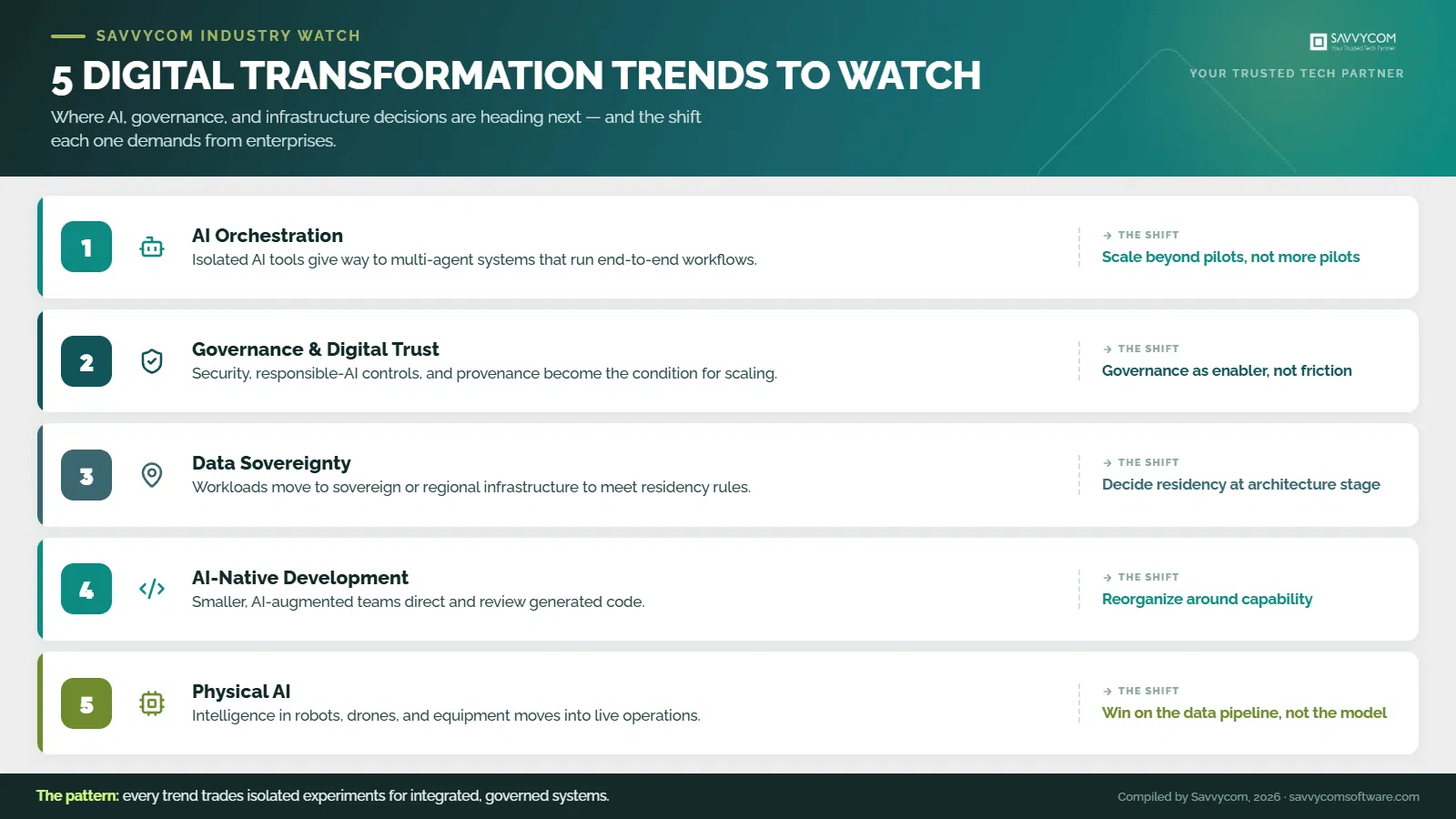
1. How is AI orchestration transforming enterprise workflows?
Multi-agent systems as the orchestration layer
Gartner names multi-agent systems a top-10 strategic technology trend for 2026. These are modular AI agents that collaborate to automate complex, multi-step workflows: end-to-end ticket triage routed to resolution, invoice processing chained to approval, and claims assessment linked to payout. The orchestration layer is what turns individual AI capabilities into operational workflows. For a deeper look at how these systems are architected, see multi-agent systems.
The workflows converting first share a pattern: high volume, structured inputs, measurable outcomes, and short feedback loops.
Domain-specific language models over general-purpose AI
General-purpose models are giving way to domain-specific language models (DSLMs) trained on specialized industry data, such as healthcare, legal, and finance. Gartner identifies these as delivering higher accuracy and compliance for industry-specific use cases. For a regulated enterprise, a model that understands clinical terminology or financial regulation out of the box removes a substantial validation burden that a general model imposes.
The experimentation-to-scale gap
The uncomfortable pattern of 2026: many AI agent pilots never reach production, with evaluation gaps, governance friction, and model reliability cited as the top blockers. Adoption is easy. Scaling is where the transformation either happens or stalls. The organizations closing this gap treat AI as an operating-model change, not a technology rollout.
2. Why are governance and digital trust critical for transformation?
Preemptive cybersecurity
Gartner names preemptive cybersecurity a top-10 trend for 2026. The shift is structural: as enterprises deploy more AI agents and expand their attack surface, waiting for a breach to respond is no longer viable. AI-powered SecOps, programmatic denial, and deception techniques are becoming the baseline for enterprise security architecture rather than an advanced option.
AI governance and responsible AI maturity
Only a minority of organizations reach a higher responsible-AI maturity level across strategy, governance, and agentic controls, and notably the Asia-Pacific region leads globally on that maturity. The organizations investing in governance are not treating it as friction. They treat it as the enabler that lets them scale AI without accumulating the risk that forces cancellations.
Digital provenance and content integrity
As enterprises rely more on third-party software, open-source code, and AI-generated content, verifying digital provenance, the origin, ownership, and integrity of digital assets, has become essential. Gartner lists it among the 2026 top trends. Software bills of materials (SBoM), attestation databases, and digital watermarking are the emerging tools for validating what enters the enterprise data and software supply chain.
3. Data sovereignty and the geopatriation of enterprise workloads
Why data residency drives architecture decisions
Data residency rules are no longer policy footnotes handled after deployment; they are architecture constraints that shape design before any code is written. APPI in Japan, PIPA in South Korea, and PDPA in Singapore and Thailand each restrict how data crosses borders. A multi-market operator that defaults to a single cloud region may violate local residency requirements in three jurisdictions at once. This is one reason enterprise transformation programs now settle compliance architecture before platform selection.
Confidential computing
Gartner names confidential computing a top-10 trend for 2026. It allows data to be processed while encrypted, without exposing it to the infrastructure it runs on. For healthcare and financial analytics that must combine sensitive data across sources, confidential computing enables compliant processing that would otherwise require moving data into a single trusted environment, which residency rules often prohibit.
The APAC sovereignty angle
A health network or bank running analytics across facilities in Japan, South Korea, and Singapore must resolve data residency at the architecture stage. This is one area where the 2026 trend picture looks materially different in APAC than in a US-only deployment.
4. How does AI-native development reshape engineering teams?
From coding to orchestrating
AI-native platforms embed generative AI directly into the development process. Engineers collaborate with AI to write, test, and optimize code rather than building from scratch. Adoption at the tool level is already deep, with AI coding assistants now standard across most large enterprises. The shift is from writing every line to directing and reviewing AI-generated output.
Democratised development within governance guardrails
AI-native platforms let non-technical domain experts build applications safely within governance frameworks. This democratizes innovation across departments, but only when the governance guardrails exist. Without them, democratized development becomes shadow IT at scale, which is precisely the risk that governance-mature organizations are structuring against.
The operating-model shift
Team structure is changing alongside tooling. McKinsey research shows organizations using centralized or hub-and-spoke AI operating models report around 36% higher AI ROI than those with decentralized models, a pattern we cover in depth in the guide to enterprise digital transformation. The trend is toward smaller, AI-augmented teams organized around capability rather than headcount, a change that reshapes hiring, budgeting, and org design.
5. Physical AI and the extension of automation into operations
IoMT, robotics, and connected equipment
Gartner names physical AI a top-10 trend for 2026. McKinsey projects that AI-powered agents and robots could generate roughly $2.9 trillion in US economic value per year by 2030. The category spans continuous glucose monitors in healthcare, autonomous inspection drones in infrastructure, and computer-vision systems in logistics yards, anywhere real-world sensor data can drive an operational decision.
Where physical AI delivers first
Physical AI converts fastest in high-volume, structured operational environments where the return is measurable. Logistics yards, manufacturing lines, and warehouse operations are early adopters because their workflows are repetitive, their inputs are visual and structured, and their outcomes are quantifiable in terms of throughput and error rates.
The data pipeline behind physical AI
Physical AI is only as effective as the data pipeline behind it. A real-world deployment illustrates the pattern. A global logistics operator handling a high daily volume of container movements needed to read container IDs from camera feeds, match them against shipping manifests, and flag discrepancies in real time. Savvycom built a pipeline that combined YOLOv8 and PaddleOCR computer vision with DeepSORT tracking, streaming through Kafka into a cloud analytical layer that logged each container in near real time.
The lesson for physical AI in 2026 is that the intelligence is not the hard part; the real-time data pipeline connecting sensors to decisions is.
6. How should enterprises prioritize transformation investments in 2026?
Not sure where your organization should start? The selector below reads your current state and points to the stage to invest in first.
Indicative only. A structured discovery phase validates readiness against your actual data, governance, and operations.
Foundation before orchestration
Gartner organizes its 2026 trends into a deliberate sequence: build foundations (AI-native platforms, confidential computing), then orchestrate (multi-agent systems, domain-specific models), then protect (preemptive cybersecurity). Organizations that jump straight to AI agents without a data and governance foundation typically experience failures within 12 months. Sequence is strategy.
Separating signal from vendor noise
Every vendor calls their product a 2026 trend. The filter is evidence: does the trend have adoption data from Gartner or McKinsey, production references rather than demos, and documented ROI rather than projected ROI? Most enterprises plan to raise technology budgets in 2026; the discipline is spending that increase on trends with evidence, not on narratives.
Why partnerships raise success rates
McKinsey research indicates partnerships can roughly double AI deployment success, not because partners bring better technology but because most scaling friction is change management, which partnerships are structured to handle. For organizations without deep in-house AI and data engineering capability, the build-versus-partner decision is one of the more consequential 2026 planning choices.
7. Frequently asked questions
What is the digital trend for 2026?
The dominant digital trend for 2026 is agentic AI: multi-agent systems that autonomously plan, decide, and act across multi-step workflows. Gartner reports that 40% of enterprise applications now embed task-specific agents, up from under 5% in 2025, though only a minority of organizations have scaled beyond pilots.
What technology trend is most likely to dominate in 2026?
Agentic AI and multi-agent systems are most likely to dominate 2026, according to Gartner's Top Strategic Technology Trends. However, Gartner also forecasts that 40% of agentic AI projects will be cancelled by 2027 due to unclear ROI and inadequate governance, making disciplined implementation the differentiator, not adoption alone.
What are the digital workplace trends for 2026?
The key digital workplace trends for 2026 are AI-augmented engineering teams that get smaller as generated code takes on more of the work, democratized development within governance guardrails, and AI-assisted knowledge work. The shift shrinks team size while raising the skill and governance requirements for each role.
How do enterprises prioritize digital transformation trends in 2026?
Enterprises should prioritize in sequence: foundational infrastructure and governance first, AI orchestration second, and physical and edge AI last. Gartner notes that organizations skipping the foundation and jumping straight to AI agents typically experience governance failures and cost overruns within 12 months.
Looking for a Trusted Tech Partner That Delivers Your Measurable Values?
Savvycom helps enterprises turn transformation trends into production systems across BFSI, healthcare, logistics, and retail in APAC, Japan, South Korea, Australia, and the US.
Explore the engagement model: Digital Transformation Solutions