Digital Transformation in Vietnam: A Rapidly Growing Frontier
In June 2026, on the “Vietnam’s Economic Landscape 2026–2030” series run by Vietnam Wealth Advisors, Savvycom CEO Van Dang described the coming five years as Vietnam’s “dual opportunity window”: global trade realignment and AI adoption converging at the same moment. That framing is a useful lens for this article, because digital transformation in Vietnam has just crossed from promise into measurable reality, and the numbers now allow an honest audit.
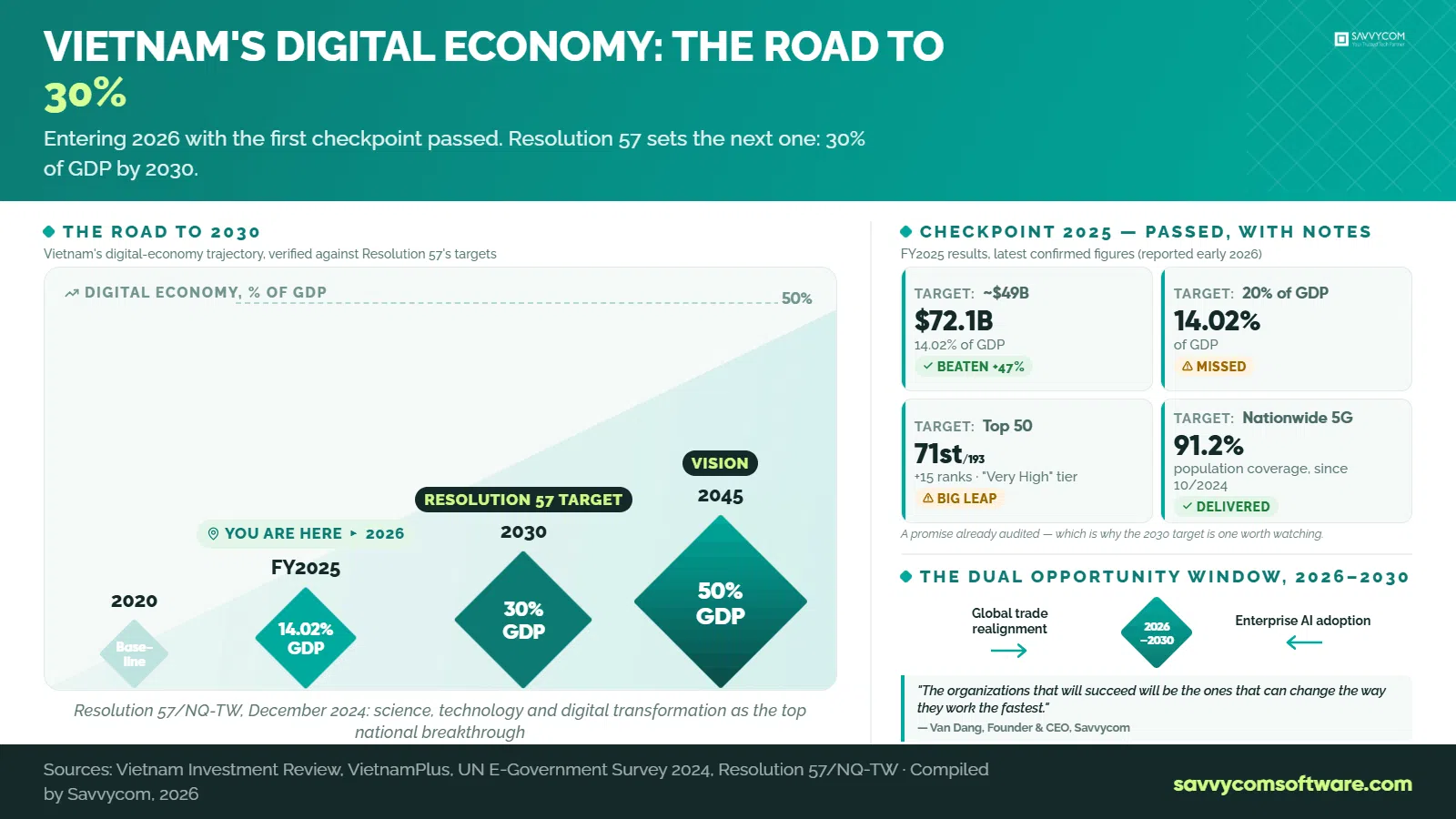
Vietnam’s digital economy reached approximately $72.1 billion in 2025, contributing 14.02% of GDP, a 1.64-fold increase over 2020. The country entered the UN’s “Very High” e-government group for the first time, commercial 5G now covers over 91% of the population, and Resolution 57 has reset national targets: a digital economy worth 30% of GDP by 2030.
This is a market report from inside that market. Savvycom has built software from Hanoi for global clients since 2009, and for Vietnamese enterprises through the same period, so alongside the macro picture this article covers what the transformation actually looks like on the ground: where traditional businesses really are, which use cases are working, and what 2026–2030 is likely to reward.
1. Where does Vietnam’s digital transformation stand in 2026?
Ahead of its own value projections, behind its share targets, and structurally further along than most outside observers assume. The clearest way to see it is to compare what the National Digital Transformation Program promised for 2025 with what was actually delivered.
| 2025 target (set circa 2020–2022) | Reality | Verdict |
|---|---|---|
| Digital economy worth ~$49 billion | ~$72.1 billion in 2025 (VIR) | ✔ Beaten by half again |
| Digital economy at 20% of GDP | 14.02% of GDP in 2025 | △ Missed the share |
| Top 50 in UN E-Government Index | 71st of 193, up 15 places, first entry into the “Very High” group (VietnamPlus) | △ Missed rank, made the leap |
| Nationwide 5G | Commercial launch October 2024; 91.2% population coverage by end of 2025 (VietnamPlus) | ✔ Largely delivered |
Savvycom Vietnam Digital Decade Landscape
Read together, the scorecard says something specific: Vietnam’s digital transformation is not a story of missed promises or of unqualified triumph. Absolute growth keeps outrunning projections while relative targets slip, because the rest of the economy refuses to stand still. That tension, everything growing at once, is the defining condition of this market.
2. Why is Resolution 57 the biggest policy shift since the program began?
Resolution 57, issued by the Politburo in December 2024, elevated science, technology, innovation, and digital transformation to the status of “top breakthrough” national priority, and reset the targets: a digital economy contributing at least 30% of GDP by 2030 and 50% by 2045.
The practical significance for businesses is less in the slogans than in the machinery. The resolution ties administrative reform, public investment, and technology procurement to digital outcomes, which changes what government agencies and state-linked enterprises are required to buy and build. It also formalizes something the market had already priced in: the state now treats digital capability as economic infrastructure, in the same category as ports and power. For private enterprises, that translates into a policy environment where waiting out the transformation is no longer a neutral choice.
The macro backdrop makes the stakes concrete. The private sector contributes around 51% of Vietnam’s GDP, over 40 million jobs, and nearly 60% of total social investment, figures the VWA series used to frame its 2026–2030 outlook. If the 30%-of-GDP digital economy target is to be hit, most of the distance will be covered or lost inside private companies, not government programs.
3. Where are Vietnam’s traditional businesses really at?
Honestly: most are digitized, not transformed. Paper became files, counters became apps, but core workflows, decision-making, and operating models in the majority of traditional enterprises still run the way they did a decade ago, with digital tools layered on top.
This is the gap we see repeatedly from the delivery side. Banking has pulled far ahead: Vietnamese banks compete on digital experience now, and cashless payment rails built by the MoMo and ZaloPay generation changed consumer expectations for every other industry. E-commerce runs at regional standard, with Shopee, Lazada, and TikTok Shop making sophisticated logistics and data operations look ordinary. But step into a typical mid-size manufacturer, distributor, or family-owned retail chain and the picture changes: ERP exists but feeds nobody’s decisions, inventory truth lives in one veteran employee’s head, and “going digital” has so far meant accounting software plus a fanpage.
“AI is not a technology project. AI is an enterprise AI adoption program.”
Van Dang, Founder & CEO of Savvycom, at the “AI in Business: Signal or Noise?” webinar, 2026
The same is true of digital transformation generally, and it explains most Vietnamese transformation failures we encounter: technology purchased as a project, while workflows, decision rights, and skills stayed untouched. Her sharper distinction from the VWA series applies here too: companies using digital tools to run existing processes faster will collect efficiency gains, but the breakthrough growth belongs to companies willing to redesign how they engage customers, structure teams, and deliver, with technology embedded rather than attached. The concepts behind that redesign are covered in our guide to what digital transformation is; this article’s point is narrower: in Vietnam, the redesign gap, not the technology gap, is where the next five years will be decided.
4. What do working use cases actually look like in Vietnam?
The pattern across successful Vietnamese deployments is consistent: a specific operational problem, a data foundation fixed first, and technology embedded into the daily workflow of the people doing the work. The showcase names and the unglamorous projects follow the same logic.
At the visible end, VinFast’s manufacturing operation made Vietnam a live case study in smart-factory practice, and the payment ecosystem moved a famously cash-first economy to the point where QR codes are default infrastructure from ministries to street vendors. Those stories matter because they reset what Vietnamese customers, employees, and regulators consider normal.
From Savvycom’s own delivery floor, three examples show the same pattern at enterprise scale:
None of these began as “an AI project” or “a digital project.” Each began as an operational problem with a number attached, which is precisely why they produced numbers in return.
5. What should the market expect from 2026 to 2030?
Expect the dual window Van Dang described to sort Vietnamese businesses into two groups at unusual speed: those that use the trade realignment and the AI wave to redesign how they operate, and those that adopt tools without changing anything underneath. Four forces will do the sorting.
- Resolution 57 execution: the 30%-of-GDP target implies roughly doubling the digital economy’s share in five years. Even partial execution means sustained public procurement, incentives, and pressure radiating into every regulated industry.
- AI compressing old advantages: capabilities that once required large teams and capital are becoming accessible at a fraction of the cost. As Van Dang argued on the VWA series, resource size alone is no longer a reliable moat, which cuts both ways for incumbents: cheaper to transform, easier to be disrupted.
- The skills constraint: the binding limit on most transformation roadmaps in Vietnam is not budget but people who can redesign workflows and operate intelligent systems. Companies that treat capability-building as part of every project, not a separate HR initiative, compound their advantage.
- Infrastructure catching up unevenly: 5G coverage at 91.2% of the population closes one gap, but the rural-urban divide in adoption, and the cybersecurity exposure that grows with every newly connected system, remain the two risks most likely to slow the headline numbers.
“The organizations that will succeed in the future will not be those with the most AI. They will be the ones that can change the way they work the fastest.”
Van Dang, Founder & CEO of Savvycom
That is the fairest one-sentence forecast for this market. (Both talks are covered in full in our news coverage of the VWA economic series and the enterprise AI adoption webinar.)
6. What does this mean for your business?
For a Vietnamese enterprise: start from one operational problem with a measurable cost, fix the data and workflow foundation first, and treat every technology decision as an operating-model decision. For a foreign business: Vietnam in 2026 is simultaneously a market to sell into and an engineering base to build from, and the second is still underpriced.
Vietnamese enterprises planning their move do not need another technology inventory; they need sequencing, and the sequencing logic is the same one laid out in our digital transformation strategy guide: outcomes defined before tools are bought, foundations before intelligence, adoption funded as seriously as licenses.
For international readers, the underreported half of the story is capability. The same market conditions driving Vietnam’s internal transformation, engineering talent at scale, government investment in digital infrastructure, and now a national AI push, are what let global companies run serious product engineering from Vietnam at 40 to 60% below Western cost bases. The digital transformation of Vietnam and digital transformation from Vietnam are the same trend wearing two hats.
FAQs: More about digital transformation in Vietnam
2. Which industries are leading digital transformation in Vietnam?
Key sectors driving digital transformation in Vietnam include:
- Banking and Fintech: Widespread adoption of mobile banking, AI, and blockchain technologies.
- E-commerce and Retail: Growth driven by platforms like Shopee and Lazada, alongside AI-powered customer analytics.
- Healthcare: Telemedicine and digitization of medical records.
- Manufacturing: Integration of IoT and smart factory technologies.
What challenges does Vietnam face in digital transformation?
Some key challenges are:
- Infrastructure Disparities: Limited access to high-speed internet in rural areas.
- Cybersecurity Risks: Increasing threats of cyberattacks as digital adoption grows.
- Skill Gap: Shortages of workers with advanced digital skills needed for Industry 4.0.
How can businesses in Vietnam start their digital transformation journey?
Businesses can begin by:
- Conducting a digital maturity assessment to understand their current capabilities.
- Partnering with reputable technology providers like Savvycom for tailored solutions.
- Developing a clear roadmap that aligns technology adoption with business goals.
What is the government’s role in Vietnam’s digital transformation?
The Vietnamese government has introduced several key initiatives, including:
- The National Digital Transformation Program by 2025: Aims to digitize 80% of public services.
- AI National Strategy: Targets top 4 ASEAN ranking in AI research and application by 2030.
- 5G Deployment: Nationwide rollout to enhance connectivity and enable advanced digital applications.
What role do startups and foreign investments play in Vietnam’s digital transformation?
- Startups: Vietnam’s vibrant ecosystem features over 200 fintech startups and multiple AI-focused companies, driving innovation in digital transformation.
- FDI: Global corporations like Samsung and Intel have invested heavily in Vietnam’s digital and tech sectors, boosting local capabilities.
Transforming in or from Vietnam?
Savvycom has been building enterprise software from Hanoi since 2009, for Vietnamese enterprises modernizing their operations and for global companies using Vietnam as their engineering base. The projects quoted in this article are our own delivery work, and the thinking behind them starts long before any code is written.