Digital Transformation in Retail: Where to Start in 2026
Digital transformation in retail means redesigning how a retailer sells, serves, and sources using connected data and systems, not adding more apps. It starts by unifying product, inventory, and customer data across channels, then automating the decisions that depend on it. In 2026, 47% of retail executives rank it among their top priorities, according to Deloitte.
The shift is no longer optional at the margins. The US Census Bureau reports that online sales reached 17.1% of total retail sales in the second quarter of 2026, up 12.2% from a year earlier. A store and its website are now one business with several doors. This guide covers what changes first, what current data shows about where retailers invest, and what slows the work down. For the general concept, start with what digital transformation is and how it works.
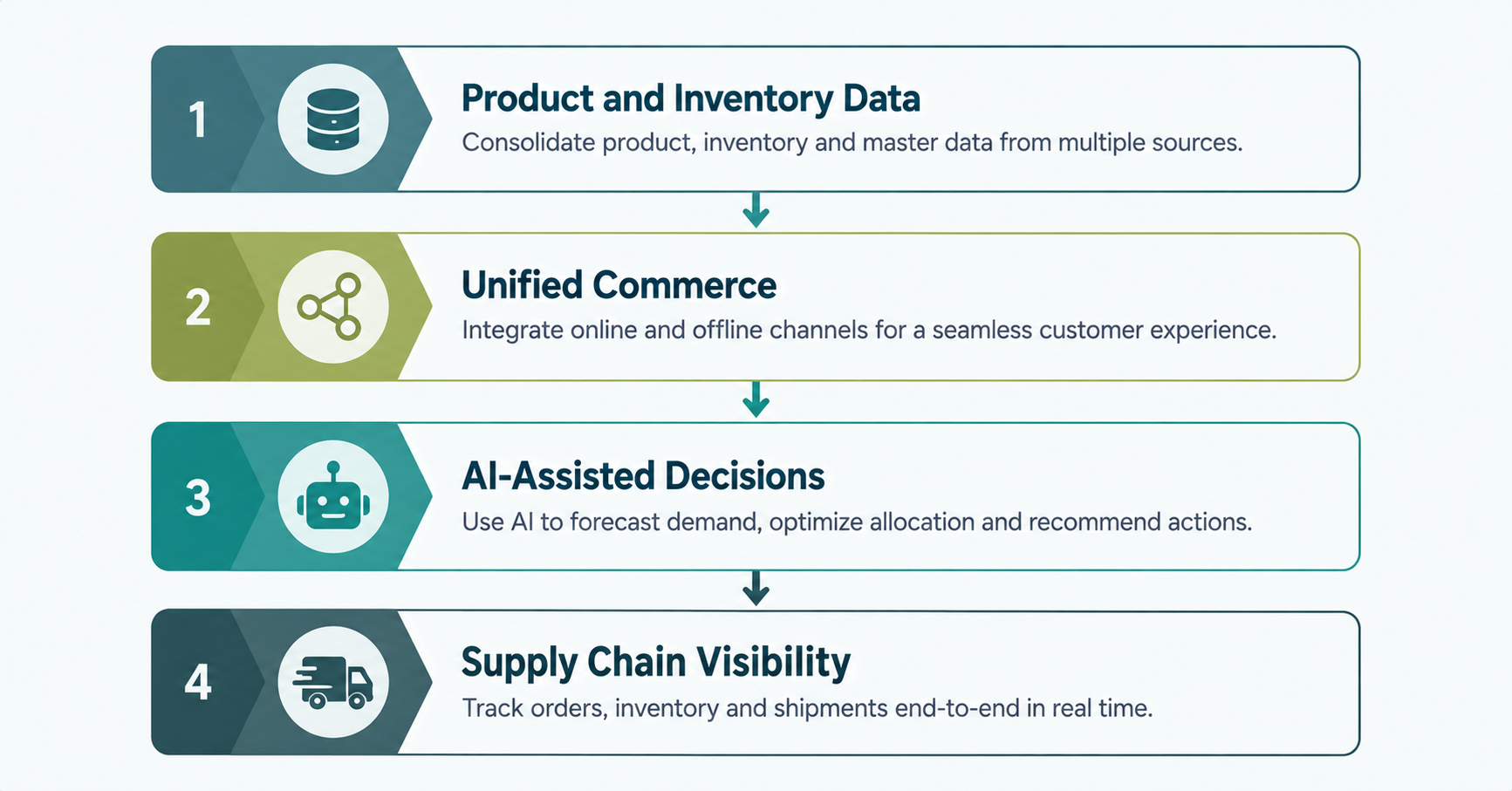
Four layers that change first in retail digital transformation each depend on the one before it.
1. What Is Digital Transformation in Retail?
Digital transformation in retail is the redesign of retail operations around shared digital data, so product, inventory, pricing, and customer information stay consistent across stores, apps, websites, marketplaces, and the supply chain. It differs from launching an online shop because it changes how decisions are made, not only where sales happen.
Three shifts define the work:
- From separate channels to one commerce system. A customer sees the same price, stock level, and order status wherever they ask.
- From reports to automated decisions. Pricing, replenishment, and service responses run on live data instead of weekly spreadsheets.
- From store-centric to connected supply chains. Stock, suppliers, and logistics partners share visibility, so a promise made online can be kept on the shop floor and in the warehouse.
2. Why Are Retailers Transforming Now?
Customers now move freely between channels while many retailers’ systems still cannot. Deloitte’s 2026 survey of 330 retail executives found that 46% name the omnichannel experience as their top growth opportunity, yet 44% say legacy systems are slowing innovation. The pressure comes from customers on one side and the back office on the other.
The survey ran online from October to November 2025, and 86% of respondents work at retailers with at least US$1 billion in annual revenue. Smaller retailers should read the figures as direction, not as a benchmark for their own size.
Demand is also growing from a larger base each year. The 2025 e-Conomy SEA report from Google, Temasek, and Bain puts Southeast Asia’s e-commerce gross merchandise value at US$181 billion, up 16% from 2024. For retailers selling in the region, the question is no longer whether to sell online but whether their systems can support it.
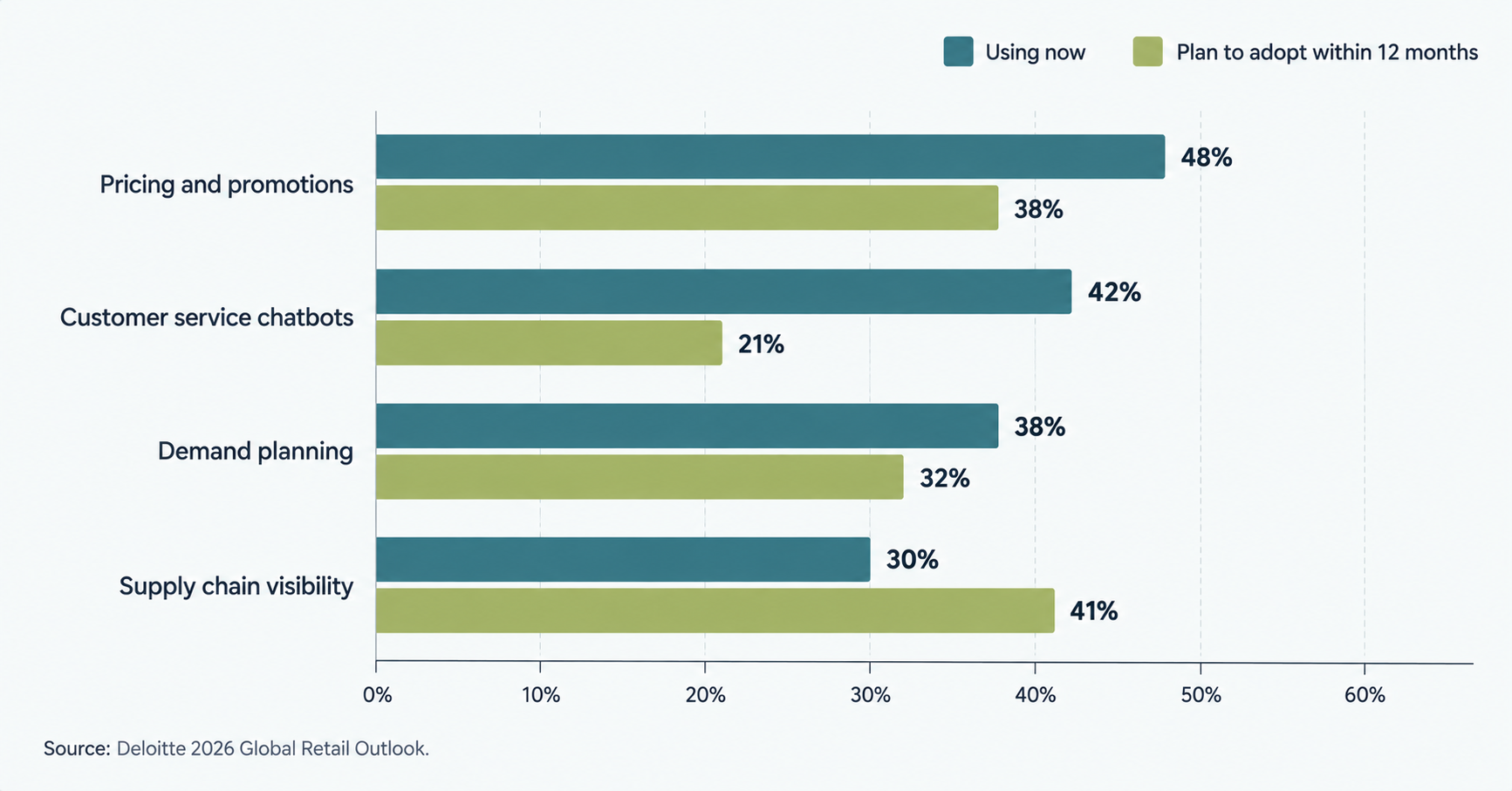
AI adoption in retail is concentrated where data already exists, with pricing optimization leading at 48%, with supply chain visibility set for the fastest near-term growth.
3. Which Parts of a Retail Business Change First?
Four layers change first: product and inventory data, unified commerce across channels, AI-assisted decisions such as pricing and demand planning, and supply chain visibility. Each layer depends on the one before it, so the order matters, and retailers that skip the first layer tend to rebuild later.
Product and Inventory Data
Every later step reads from product and inventory records, so errors here multiply. Start by giving each product one identifier, one price source, and one stock count that stores, the website, and marketplaces all read. Retailers that skip this step end up automating the disagreements between their systems.
A practical audit asks three questions: how many systems hold a stock count, how often do they sync, and who resolves a mismatch? If the answers are “several,” “nightly,” and “whoever notices,” the data layer is the first project.
Unified Commerce Across Channels
Unified commerce means the same inventory, pricing, and customer record serve every channel, so a customer can order online, pick up in store, and return elsewhere without a seam. Deloitte found 28% of retailers plan to expand marketplace presence and 22% to strengthen social commerce, which adds channels faster than most systems can connect them.
Building each channel as its own stack is the common failure. It works for the first launch and breaks when the third channel needs the same stock count as the first two.
AI-Assisted Decisions
AI adoption in retail is concentrated where data already exists. In Deloitte’s survey, 48% of retailers use AI for pricing and promotions and 42% for customer service chatbots today, while demand planning stands at 38%. Agentic AI is the next wave: 68% expect to deploy it for key operations within 12 to 24 months.
| AI use case | Using now | Plan to adopt within 12 months |
| Pricing and promotions optimization | 48% | 38% |
| Customer service chatbots | 42% | 21% |
| Demand planning and forecasting | 38% | 32% |
| Supply chain visibility | 30% | 41% |
Source: Deloitte 2026 Global Retail Outlook, share of surveyed retail executives. Each use case needs consistent product and stock data underneath it, which is why product and inventory data comes first.
Supply Chain and Fulfillment Visibility
Retail promises are only as reliable as the stock and logistics behind them. Deloitte found AI use for supply chain visibility is set to rise from 30% to 41% of retailers within a year, and 59% expect a positive return from AI supply chain initiatives within 12 months. Physical operations are where those gains have to show up.
A logistics example shows what this looks like in delivery. Savvycom built an AI-powered yard management system for a global logistics provider whose yards handle 400 to 500 container movements a day, with more than 500 containers stored at each site. AI cameras read container IDs, trailer IDs, and truck license plates at entry and exit, and a 2D digital map shows each container’s position in real time.
Over a nine-month project, the client reported 95% accuracy in container placement and tracking and a 60% reduction in container search and retrieval time. The client was a logistics provider, not a retailer. Retailers that import goods rely on yards, ports, and warehouses with the same visibility problem, so the pattern carries over even though the sector differs.
4. What Do Real Retail Transformations Look Like?
Real transformations are usually partial and uneven. Deloitte’s 2026 retail outlook describes IKEA testing pickup points, smaller city-center stores, and third-party platforms in Asia, and American Eagle reporting that customers still buy through its website even as app and mobile revenue grows. Both show retailers adjusting channel mix to how customers actually buy.
The lesson is about the system underneath. Channel decisions will keep changing as customer behavior changes, so the product, stock, and customer data layer has to support a new channel without a rebuild. A retailer that can add a pickup point or a marketplace in weeks is better placed than one that treats each as a new project.
5. What Slows Retail Transformations Down?
Five problems recur: legacy systems that cannot share data, channel-by-channel builds, AI added before the data is clean, success measured by launches instead of operations, and changes that are not communicated across teams. Deloitte’s survey puts legacy systems first, with 44% of executives saying they slow innovation.
- Legacy systems. Older point-of-sale, inventory, and order systems often cannot share data in real time, so every new initiative needs a custom workaround.
- Channel-by-channel builds. Each new channel gets its own stack, so stock counts and prices drift apart.
- AI before data. Models fed inconsistent product and stock records repeat the inconsistency at higher speed.
- Launch metrics. Counting apps shipped hides whether stockouts, search time, or fulfillment errors improved.
- Missing communication. An American Eagle executive told Deloitte that changes not communicated upstream and downstream capture only a fraction of their value.
Teams scoping a first project can review digital transformation solutions to see how projects are structured and phased.
6. Frequently Asked Questions