Cross-Border Logistics Software: Compliance and Integration
Cross-border shipping now runs on customs data as much as on trucks and containers. The EU received 4.6 billion e-commerce parcels valued under €150 in 2024, and the duty rules for those parcels are changing in both the EU and the US. This guide, part of our wider guide to logistics software development, explains what to check when you evaluate software for international shipments.
Quick answer
Cross-border logistics software manages the shipment and the customs data that travels with it: documents, duties, advance filings, and partner handoffs. No single TMS is best for everyone. Choose by the lanes you run, the customs rules you face, and how well the system integrates with brokers, carriers, and your ERP.
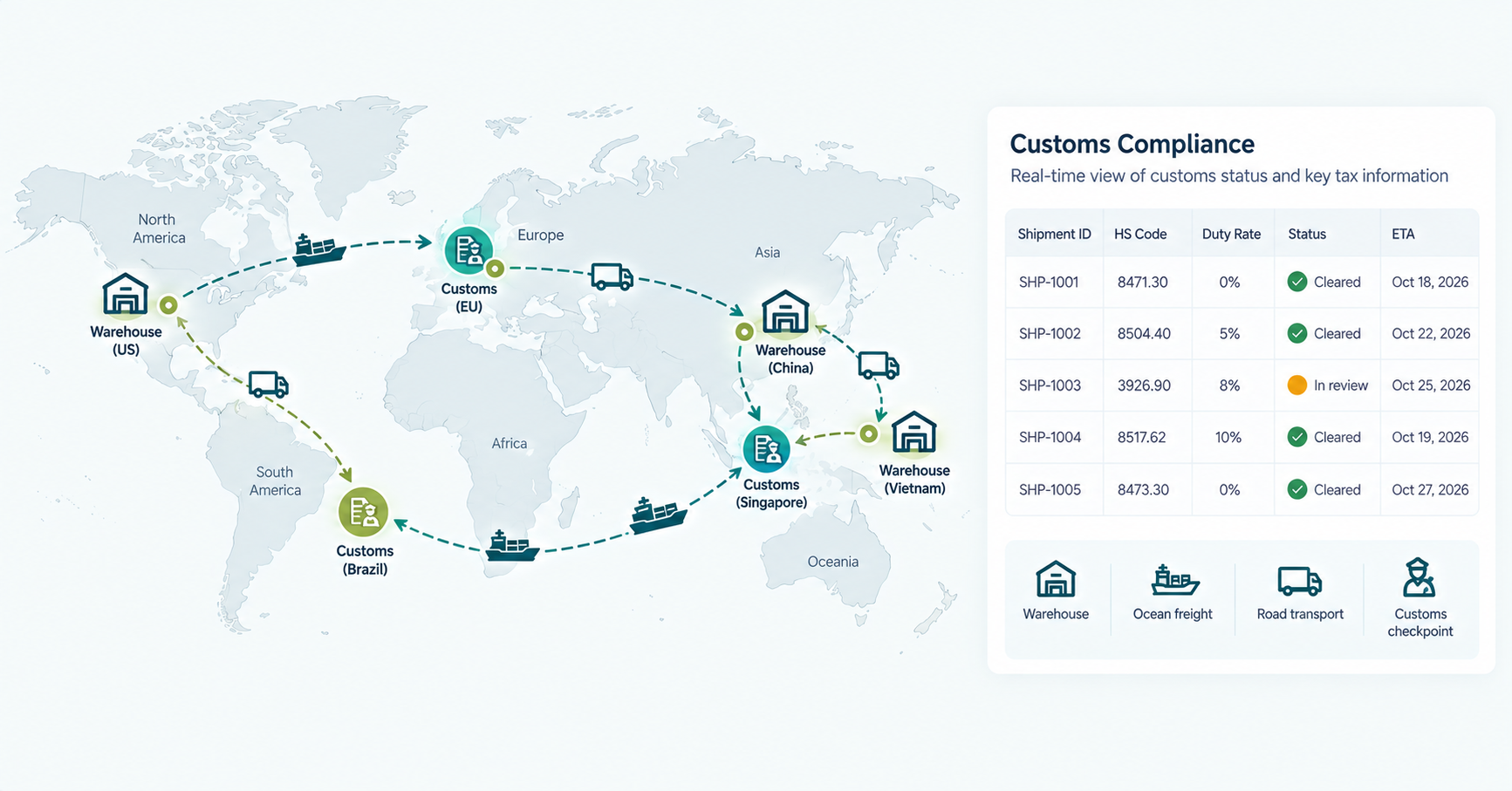
Every international shipment carries a customs data requirement software is what keeps it current
1. What Is Cross-Border Logistics?
Cross-border logistics is the movement of goods between countries, including the transport, customs clearance, documentation, duties, and handoffs between carriers, brokers, and authorities that international shipping requires. Compared with domestic logistics, it adds legal steps and data requirements to every shipment, so software must manage compliance as well as movement.
Volumes keep growing. In October 2026 the WTO raised its forecast for 2026 merchandise trade growth to 3.9%, from 1.9% in the spring, and projected 4.1% growth for 2027. More border crossings mean more declarations to file, and each one is a data problem before it is a transport problem.
2. Which Rules Change What the Software Must Do?
Recent rules in the US and EU push cross-border software toward item-level data and earlier filing. The US ended duty-free de minimis treatment for all countries on August 29, 2025, and the EU applies a €3 duty to small parcels from July 1, 2026. Software must now calculate duties per item and send data before arrival.
| Rule | What changed | What the software must handle |
| US de minimis suspension | Duty-free treatment ended for goods valued at $800 or less from all countries, effective August 29, 2025 (Executive Order 14324) | Duty calculation on low-value shipments and entry filing in the Automated Commercial Environment (ACE) |
| EU small parcel duty | A €3 duty per item category on parcels under €150 from July 1, 2026, until the EU customs data hub is operational | Item-category data per parcel; a parcel with three product types owes €9 |
| EU €150 relief removal | Agreed by the Council in November 2025; applies once the data hub operates, expected in 2028; not yet in force | Duty from the first euro; sellers and platforms treated as the importer in distance sales |
| EU ICS2 | Every consignment entering the EU should have a valid Entry Summary Declaration (ENS) from June 1, 2026 | Advance cargo data filing; for air freight, a minimum data set before loading |
These rules differ by market and keep changing. Confirm current requirements with a customs broker before designing a workflow around them.
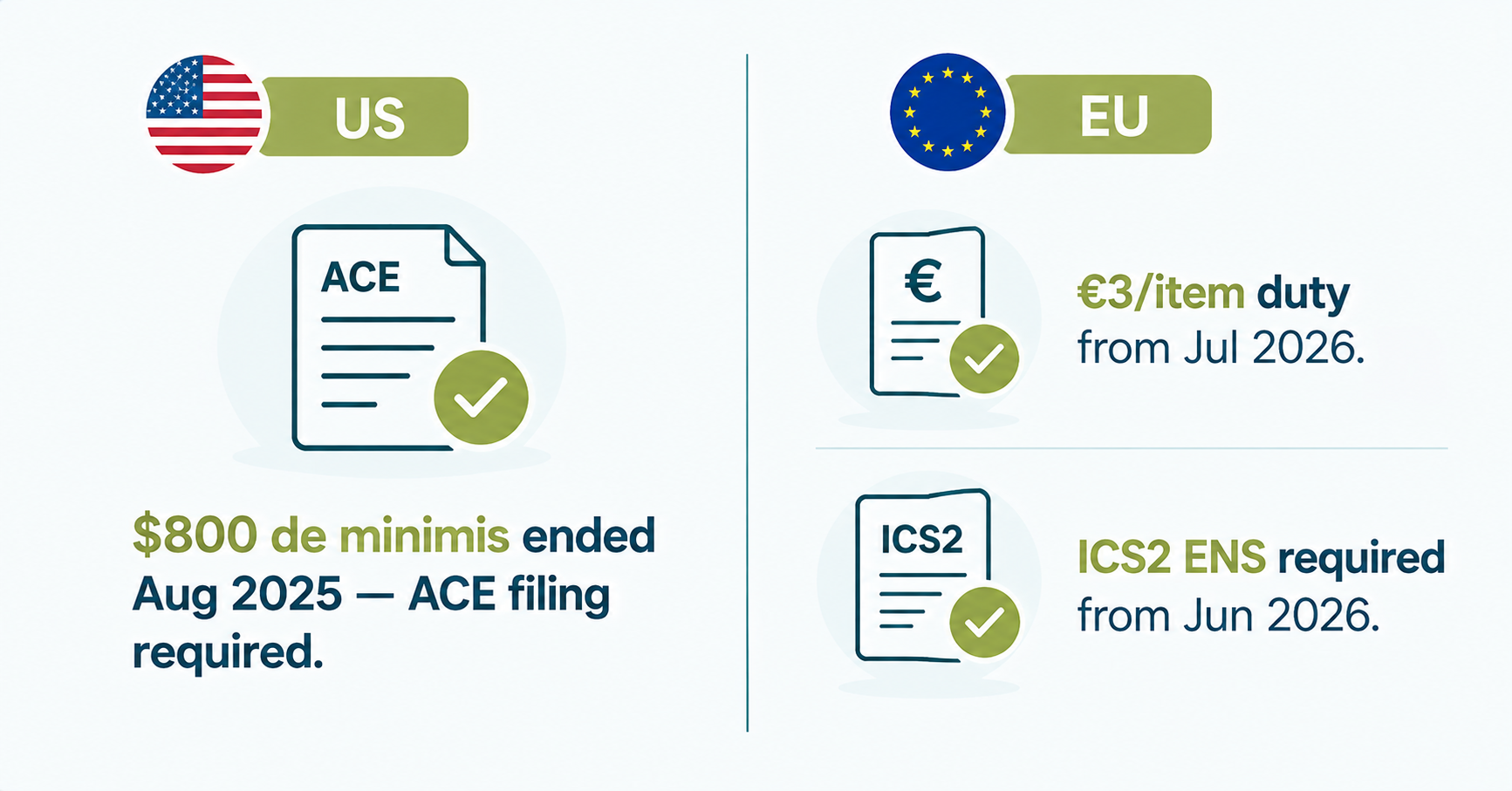
US and EU rule changes in 2025–2026 push software toward item-level data and earlier filings
3. What Should Cross-Border Logistics Software Do?
Cross-border logistics software should do five jobs: hold clean product and customs data, file declarations in the formats each authority requires, calculate duties and landed cost, share shipment events with every partner, and keep an audit trail. If a tool covers transport but not these data jobs, expect spreadsheets to fill the gap.
- Product and customs data. Each item needs a description, origin, value, and a Harmonized System (HS) code, the international classification customs administrations use. Wrong data produces wrong duties.
- Declarations and advance filings. The system should produce or pass on the data that ICS2, ACE, and other national systems require, in the right format and on time.
- Duties and landed cost. Duty, tax, and freight should be calculated per item before the shipment moves, so the buyer or seller is not surprised at delivery.
- Partner handoffs and events. Brokers, forwarders, and carriers should work from one shipment record, with status events flowing back to your team.
- Audit trail. Record who filed what and when, so corrections and customs audits do not depend on email threads.
4. Which TMS or Logistics Software Is Best?
No TMS is best for every cross-border operation. The better question is which system fits your lanes, modes, customs rules, and partners. A TMS plans and executes transport, but customs filing often sits in separate trade compliance or broker software, so check where the TMS ends before you compare features.
| What to check | Question to ask | Why it matters |
| Lane and mode coverage | Does it support the countries, modes, and carriers you use today and plan to add? | Gaps force manual booking |
| Customs capability | Does it file declarations itself, or pass data to a broker or customs system? | Decides who owns the compliance data |
| Rule updates | Who updates duty logic and filing formats, and how quickly? | Rules changed in 2025 and 2026 |
| Integration | Which APIs, EDI formats, and ERP connectors are available? | Decides how much data you can reuse |
| Data ownership | Can you export shipment and customs data in open formats? | Reduces lock-in |
| Pilot fit | Can you test it on one real lane before committing? | Real data exposes gaps that demos hide |
This is our checklist, not a vendor ranking. The answer will differ for a forwarder, a manufacturer, and an e-commerce seller.
5. Where Do Integration and Compliance Projects Go Wrong?
Integration, not features, usually decides whether cross-border software works. Customs authorities, brokers, carriers, marketplaces, and your own ERP each use different formats, and every handoff can lose data. The 2025 UN survey of 174 economies found cross-border paperless trade implemented at only 49%, against a 71% global average across all trade facilitation measures.
- Product data quality. Missing or wrong HS codes and values spread into every declaration built on them.
- Partner formats. Brokers and carriers accept different formats, so mapping is ongoing work, not a one-time task.
- Hard-coded rules. Duty logic written into the code breaks when a threshold or rate changes.
A practical start is one lane under one customs regime, with two or three measures such as clearance time, rework rate, and the share of declarations filed without manual edits.
What a Savvycom Project Shows
Savvycom built an AI contract review platform for a logistics company with an international network of suppliers and service agreements. The platform checks agreements against international compliance standards and connects to the client’s legacy system through a custom API. The client reported 50% less review time, 95% accuracy on key clauses, and over 1,000 contracts a month.
This is a document compliance project, not a customs filing system. It shows the same pattern described above: connecting to a legacy system and to an international compliance standard was the larger part of the work. Savvycom builds custom logistics software and integrations rather than selling a licensed TMS, so it is relevant mainly where an off-the-shelf system leaves gaps.