AI Development Outsourcing: Models, Costs, and How to Choose
Building an AI system from scratch takes three things most companies do not have at once: the right engineering talent, a production deployment track record, and enough runway to get through the learning curve before the budget runs out.
AI development outsourcing solves the talent and track record problem. Instead of spending 6 to 12 months hiring, onboarding, and ramping a team, you engage a partner that has already shipped the type of system you need. The decision is not whether outsourcing works for AI. The decision is when it is the right model, which engagement structure fits your situation, and how to avoid the failure modes that push timelines and costs past what the original business case could justify.
This guide covers the main engagement models, when to outsource versus augment your team, what AI development outsourcing actually costs, which types of companies are providing these services, and what separates a viable partner from one that will quote fast and deliver slowly. For a full breakdown of the AI development lifecycle and what production deployment actually requires, see What Is AI Development: A Complete Guide.
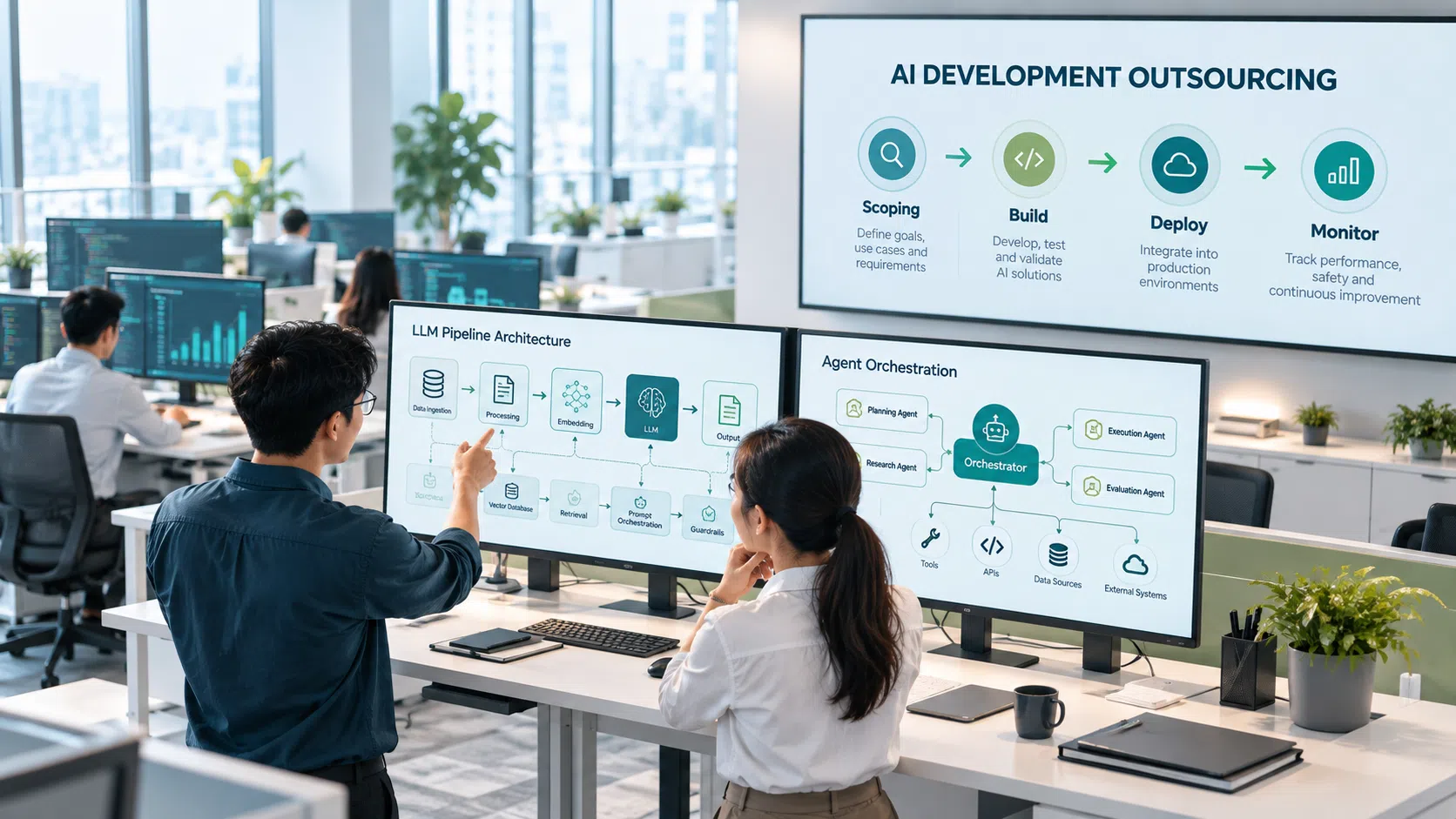
Outsourcing AI development means engaging a team with production deployment experience, not just framework knowledge.
1. What is AI development outsourcing?
AI development outsourcing is the engagement of an external team to design, build, and deploy AI-powered systems, agents, or pipelines on behalf of an organization.
The scope varies significantly by contract. Some engagements cover a single model integration: connecting an LLM to an existing product via API and building the prompting layer and guardrails around it. Others span the full AI lifecycle: requirements analysis, data pipeline architecture, model selection and fine-tuning, agent orchestration, compliance controls, and post-deployment monitoring.
What distinguishes AI outsourcing from general software outsourcing is the combination of fast-moving tooling and production deployment complexity. Frameworks like LangGraph, AutoGen, and CrewAI have matured significantly in 2025 to 2026, but the gap between a working proof of concept and a compliant, monitored, production-grade system is still where most projects stall. An outsourced team that has navigated that gap before is substantively different from one quoting off a framework tutorial.
2. What are the main AI development outsourcing models?
Three engagement models cover the majority of AI outsourcing contracts: project-based delivery, dedicated AI team, and staff augmentation. The right model depends on how well-defined your requirements are and how much internal ownership you want after delivery.
| Model | How it works | Best for | Risk |
| Project-based | Fixed scope, milestone-based delivery. Partner owns delivery end-to-end. | Well-defined systems: a specific agent, a document AI pipeline, a chatbot | Scope creep if requirements shift mid-build |
| Dedicated AI team | A managed team of AI engineers, ML ops, and product/QA embedded in your workflow on a monthly retainer. | Ongoing development: multi-agent systems, evolving compliance, iterative AI products | Higher monthly cost; needs clear direction from your side |
| Staff augmentation | Individual engineers placed with your team. Your direction, their execution. | Filling specific skill gaps: ML engineer, AI architect, LLMOps specialist | Management overhead stays with you; less ownership accountability |
A fourth model is emerging in 2026: the AI-native retainer, where the partner brings both engineering capacity and an orchestration platform. Savvycom’s AI-powered dedicated team model works this way, pairing engineers with AI agents that handle code generation, QA, and documentation, reducing the headcount needed to deliver a given scope.
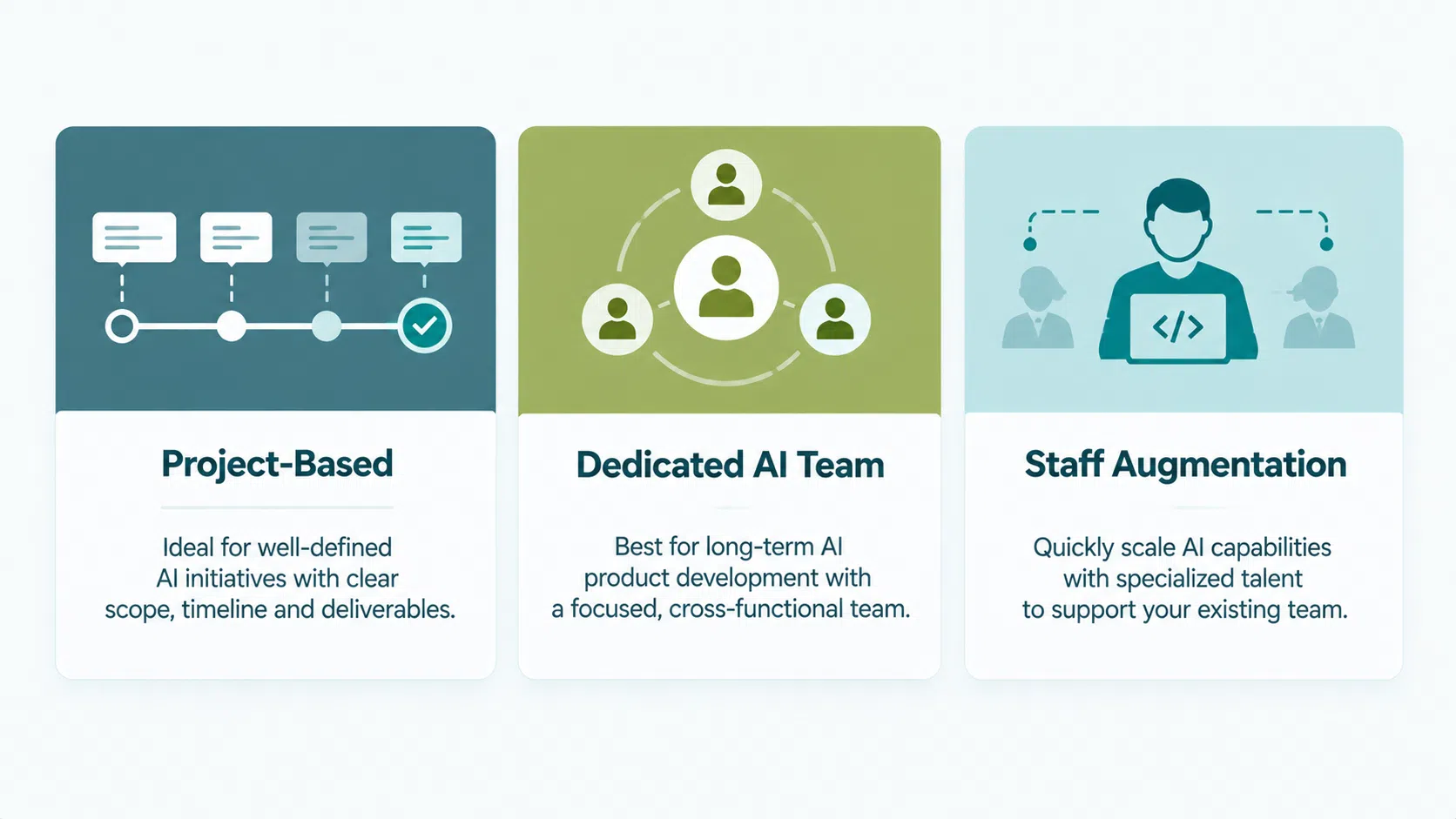
Three distinct models serve different risk profiles: project-based for defined deliverables, dedicated team for ongoing AI product development, and augmentation for filling specific skill gaps.
3. AI outsourcing versus AI augmentation: which model fits your situation?
AI outsourcing transfers the build to an external team; AI augmentation embeds AI tools and agents into your existing team’s workflow. They solve different problems.
The confusion between the two creates mismatched contracts. A team that needs to move faster but has strong domain knowledge is usually better served by augmentation: AI coding assistants, automated testing, and agent-assisted documentation that multiply what existing engineers can deliver. A team that lacks the AI engineering capability entirely and needs a production system in a defined timeframe is a better fit for outsourcing.
Signals that outsourcing is the right call
- No internal ML or LLM engineering experience
- A defined deliverable with a deadline (product launch, compliance requirement, customer commitment)
- The system needs to meet a compliance framework your team has not worked in before (HIPAA, SOC 2, PDPA)
- Budget is milestone-based rather than headcount-based
Signals that augmentation is the right call
- Your team ships software reliably but is losing velocity to manual QA, documentation, and code review
- You have strong domain knowledge that an external team would take months to absorb
- You want to retain full ownership of AI architecture and tooling decisions
Many engagements start as outsourcing and transition to augmentation after the first system is live. The partner builds the foundation; the internal team takes over iteration. This is one of the few outsourcing transition patterns that consistently works, because the internal team inherits a production system rather than a hand-off document.
4. What does AI development outsourcing cost in 2026?
AI development outsourcing projects typically range from $30,000 for a single-agent integration to $300,000 or more for a multi-agent enterprise system with compliance architecture and LLMOps infrastructure.
| Scope | Cost range | Timeline | What drives cost |
| Single LLM integration (API + prompting layer) | $30,000 – $60,000 | 4 – 8 weeks | Integration complexity, guardrail requirements |
| Autonomous agent (single domain) | $60,000 – $120,000 | 8 – 16 weeks | Tool integrations, compliance controls, testing scope |
| Multi-agent system (2–5 agents) | $120,000 – $300,000 | 3 – 6 months | Orchestration architecture, state management, human-in-the-loop design |
| Dedicated AI team (monthly retainer) | $15,000 – $40,000/month | Ongoing | Team size, AI tooling layer, SLA requirements |
Geography affects rates substantially. Vietnam-based AI engineering teams with equivalent capability to US teams typically bill at 30 to 50% of US rates, which is where most of the cost arbitrage in APAC outsourcing comes from. The caveat: rate arbitrage is only valuable if the team has genuine production AI deployment experience. A lower rate on a team learning LangGraph on your project is not a discount.
Compliance overhead adds 15 to 25% to any project touching regulated data: HIPAA for US healthcare, GDPR for European user data, and PDPA for Southeast Asia. This is not optional architecture; it is a fixed cost of operating in those markets.
5. Which AI outsourcing companies are worth evaluating?
The companies that consistently deliver production AI systems share three characteristics: verifiable production deployments (not demos), engineering teams with LLMOps and compliance experience, and structured discovery before any contract.
The AI outsourcing market in 2026 spans a wide range of providers, from large IT services firms with new AI practices to specialist shops built around specific frameworks. The relevant question is not which company is largest but which has shipped a system close enough to what you need that your project is not their first in that category.
Savvycom
Vietnam · US · APAC ISO 27001 · ISO 9001 HIPAA-compliant
Vietnam-headquartered, with offices in the US, Australia, Japan, South Korea, Thailand, and Singapore. Savvycom operates as an AI-native delivery partner, embedding AI agents into its own engineering process, as well as building them for clients. Production deployments include a four-agent FX operations system for a South Korea-based financial firm (60% reduction in processing time per transaction), an AI contract review platform for LX Pantos processing 1,000+ contracts monthly at 95% clause extraction accuracy, and EHR integrations and clinical AI tools across the US, Japan, and Southeast Asia.
Engagement models: dedicated AI team (monthly retainer) and project-based delivery. Entry point: a free 2-week scoping engagement.
DataArt
US · Eastern Europe Enterprise · Financial services
US and Eastern Europe-based IT services firm with established AI and ML practices. Strong delivery track records in financial services and healthcare. Higher rate base than APAC providers; well-suited to enterprise contracts requiring US-based account management.
Turing
Global marketplace Staff augmentation
Marketplace model connecting companies to pre-vetted AI engineers for augmentation. Faster time to placement than a traditional outsourcing engagement. Better fit for staff augmentation than end-to-end project delivery.
Scale AI / Surge AI
Data specialists Fine-tuning · RLHF
Focused on data labeling, RLHF pipelines, and model fine-tuning rather than full-stack AI product development. Relevant if your outsourcing need is specifically around training data quality or model customization, not system delivery.
Provider selection should be driven by reference checks on systems in active production, not sales decks. The single most useful evaluation question: “Can you connect us with an engineering lead from a project in our sector that went live in the last 12 months?”
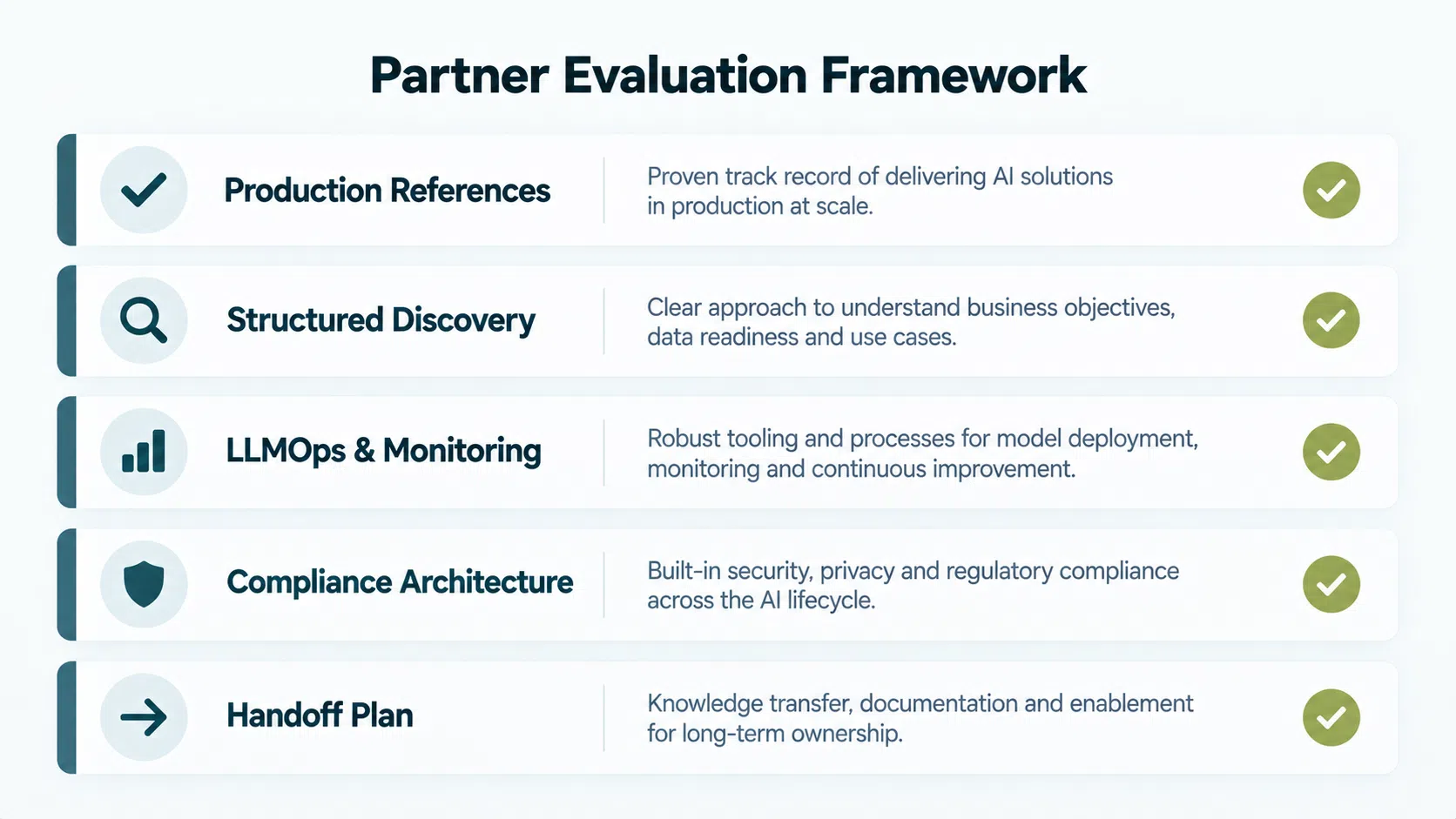
The gap between a demo portfolio and a production reference is the most reliable signal for separating capable AI outsourcing partners from those still building experience on client projects.
6. What should you look for when choosing an AI development partner?
The failure modes in AI outsourcing are predictable: teams without production experience, discovery skipped in favor of fast quoting, and compliance treated as a final-stage checklist rather than an architecture input.
Five signals that a partner is ready for production AI work:
Production references, not demo portfolios
Ask for a system in active production use, the engineering lead who built it, and what broke and how they fixed it. Partners who have only shipped proofs of concept will not have an answer to the third question.
Discovery before commitment
A partner that quotes a fixed price before understanding your data infrastructure, compliance obligations, and integration surface is pricing off assumptions. When those assumptions are wrong, and they usually are, the contract renegotiates.
LLMOps and monitoring included
Model behavior in production differs from behavior in testing. Prompt drift, latency spikes, and hallucination rates need to be monitored. A partner that does not include observability infrastructure in the default scope is handing you a system with no instruments.
Compliance architecture as standard
ISO 27001, HIPAA-compliant infrastructure, and data residency planning should be standard deliverables, not add-ons. Ask to see how they handled a compliance constraint mid-project.
Structured handoff plan
If you plan to bring AI development in-house eventually, the outsourcing partner should be building toward that, not away from it. Ask what the team transition plan looks like after delivery.
7. How do you get started with AI development outsourcing?
The highest-value first step is a scoped discovery engagement before any development contract, not an RFP sent to five vendors based on a website review.
A 2-week discovery engagement with a prospective partner does three things that an RFP cannot: it maps your actual data and compliance requirements, produces a realistic cost estimate based on your specific integration surface, and gives you a working view of the partner’s engineering culture before you commit to a multi-month contract.
The sequence that consistently works:
Map the workflow first
Define the specific business process the AI system will operate in, the inputs, the decision points, and the expected outputs. The more precisely this is defined before engaging a partner, the better the discovery output will be.
Identify your compliance constraints up front
If the system will touch patient data, financial records, or personal data across jurisdictions, list those constraints before the first vendor conversation. They change architecture decisions.
Run a 2-week scoping engagement with your top candidate
Most serious AI development partners offer this. It is the fastest way to calibrate whether their understanding of your problem matches yours.
Evaluate the discovery output, not the sales pitch
A discovery output that surfaces integration risks, compliance constraints, and a phased delivery timeline tells you more about the partner than any credentials page.
8. Frequently asked questions
Looking for a Trusted Tech Partner That Delivers Your Measurable Values?
For teams building their first AI system in a regulated environment, see What Is AI Development: A Complete Guide for a full breakdown of the AI development lifecycle and what production deployment actually requires.
Related reading:
What Is AI Development: A Complete Guide
Savvycom AI Development Services