
AI Governance Framework: Pillars, Principles, and Key Standards
An AI governance framework is a structured set of principles, policies, and controls that define how an organization develops, deploys, and monitors AI systems responsibly.
Several established frameworks exist. The NIST AI Risk Management Framework (AI RMF), ISO/IEC 42001, the EU AI Act compliance structure, and Microsoft’s Responsible AI Standard are the most widely referenced in enterprise AI deployments. Each addresses a similar core problem from a different angle: how do you build AI systems that are accurate, explainable, fair, and auditable without treating governance as an afterthought that slows delivery?
This article covers the structural elements common to all major frameworks, the specific standards worth understanding, and how to select the right governance layer for your context. For how governance requirements shape the design of autonomous AI systems from the start, see AI Agents for Business: Types, Use Cases, and Getting Started.
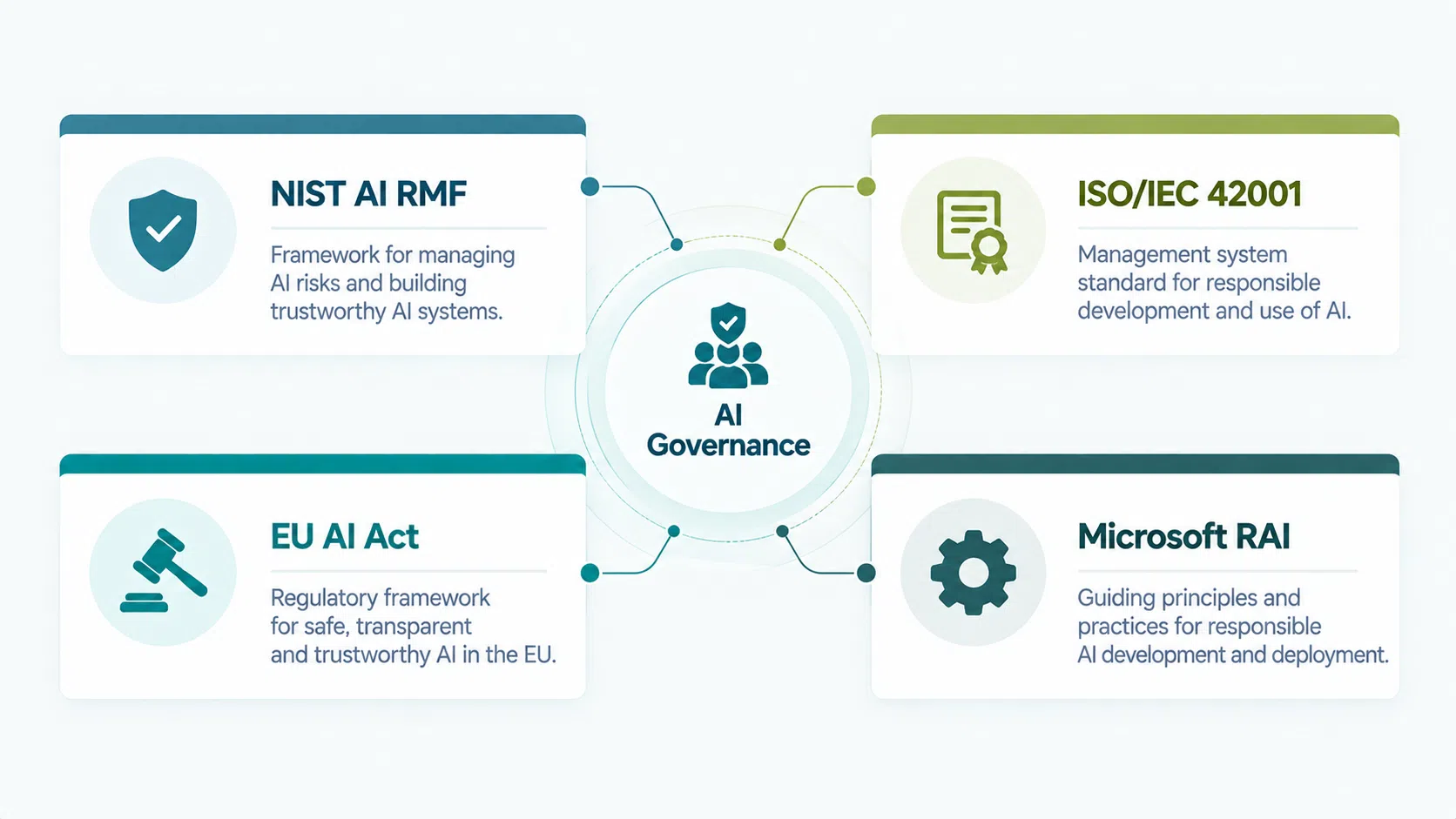
The four major AI governance frameworks active in 2026 serve different organizational needs: risk process, certification, legal compliance, and practical engineering implementation.
1. Is there an AI governance framework?
Yes. Multiple AI governance frameworks exist at the international, national, and organizational levels, and several carry certification or compliance status that enterprise procurement and regulated industries recognize.
The major frameworks active in 2026:
NIST AI RMF (US)
Published by the National Institute of Standards and Technology in 2023 and updated in 2024. The most widely adopted framework in the US public sector and enterprise AI procurement. Non-prescriptive: it provides a risk management approach rather than a fixed checklist.
ISO/IEC 42001 (International)
Published in 2023 by the International Organization for Standardization. The first international standard specifically for AI management systems. Certification-ready: third-party auditors can certify an organization against it, similar to ISO 27001 for information security.
EU AI Act (European Union)
Phased into enforcement from 2024 to 2026. A regulatory framework that classifies AI systems by risk level and imposes mandatory compliance requirements on high-risk applications. It is not a framework organizations adopt voluntarily: it is a legal obligation for any AI system deployed in the EU market.
Microsoft Responsible AI Standard
Microsoft’s internal governance standard, made public in 2022. Widely referenced as a practical organizational template because it translates high-level principles into engineering requirements, review gates, and team accountability structures.
OECD AI Principles
Five high-level principles adopted by 46 countries and used as the foundation for most national AI policy frameworks. Not certification-eligible, but forms the ethical backbone of most enterprise AI policies.
Most enterprise AI governance programs draw from more than one of these. NIST AI RMF and ISO 42001 are frequently used together: NIST provides the risk management process; ISO 42001 provides the management system structure and certification path.
2. What are the three pillars of AI governance?
The three pillars of AI governance are accountability, transparency, and risk management. These appear across all major frameworks as the foundation that supporting policies, controls, and audit processes build on.
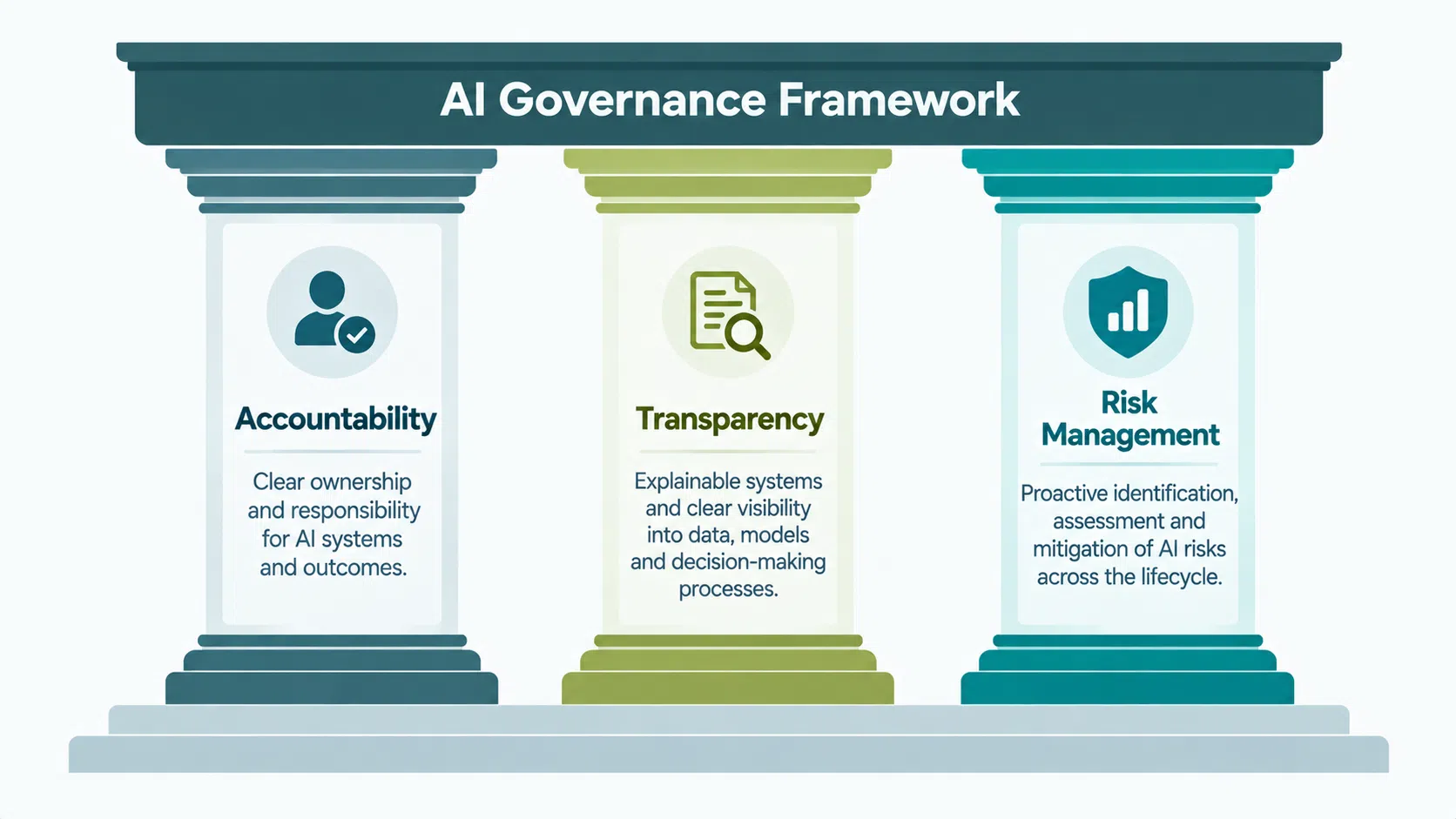
Accountability, transparency, and risk management are the three structural pillars that all major AI governance frameworks, including NIST AI RMF and ISO 42001, build their requirements around.
Accountability
Accountability defines who is responsible for AI system outcomes. At the organizational level, this means assigning named roles: a model owner who approves training data and deployment decisions, a risk officer who reviews system outputs, and an escalation path when the system produces results that harm users or violate policy. The Microsoft Responsible AI Standard formalizes this through a Sensitive Use Review process and executive-level AI accountability assignments. ISO 42001 requires documented top-management commitment and defined responsibilities as a prerequisite for certification.
Transparency
Transparency covers what the system does, how it makes decisions, and what data it was trained on. For internal teams, this means model cards that document training data, known limitations, and intended use boundaries. For external users and regulators, it means explainability: can a person understand why the system produced a given output? The EU AI Act makes explainability a legal requirement for high-risk AI systems, including those used in hiring, credit scoring, medical diagnosis, and law enforcement.
Risk management
Risk management is the ongoing process of identifying, evaluating, and mitigating AI-specific risks: data bias, model drift, adversarial inputs, and unintended outputs. The NIST AI RMF organizes this into four functions: Govern, Map, Measure, and Respond. Govern sets the organization-wide risk culture and policy. The map identifies where AI systems operate and what risks exist. The measure evaluates those risks systematically. Respond activates mitigations, communications, and recovery actions when risks materialize.
3. What are the five principles of AI governance?
The five principles of AI governance, as established by the OECD AI Principles and reflected across NIST, ISO 42001, and national frameworks, are fairness, transparency, accountability, safety and robustness, and privacy.
These are not abstract ethical positions. Each principle maps to specific engineering and operational requirements in mature frameworks:
| Principle | What it requires in practice | Framework reference |
| Fairness | Bias testing across demographic groups before deployment; ongoing monitoring for differential outcomes in production | NIST AI RMF: Measure function; ISO 42001: Clause 8 |
| Transparency | Model cards, system documentation, explainability requirements for end users and regulators | EU AI Act: Article 13; Microsoft RAI Standard: transparency pillar |
| Accountability | Named model owners, documented approval gates, escalation paths for harmful outputs | ISO 42001: Clause 5; NIST AI RMF: Government function |
| Safety & robustness | Adversarial testing, performance thresholds, fail-safe mechanisms, incident response plans | NIST AI RMF: Measure and Respond; EU AI Act: Article 9 |
| Privacy | Data minimization, consent management, and GDPR/HIPAA/PDPA compliance are baked into data pipelines, not added post-deployment | GDPR Article 5; PDPA; ISO 42001: Clause 8.4 |
4. What is the NIST framework for AI governance?
The NIST AI Risk Management Framework (AI RMF) is a voluntary US framework that helps organizations identify, assess, and manage risks from AI systems throughout their lifecycle, structured around four core functions: Govern, Map, Measure, and Respond.
Published in January 2023 and supplemented by the NIST AI RMF Playbook, it is the dominant governance reference for US federal procurement and widely adopted by enterprises building AI systems for regulated industries. Key characteristics:
Voluntary, not prescriptive
NIST AI RMF does not mandate specific technical implementations. It provides a risk management process that organizations adapt to their context.
Lifecycle coverage
The framework applies from the initial design decision through deployment and decommissioning. It is not a pre-deployment checklist; it is an ongoing management system.
Complementary to ISO 42001
NIST AI RMF describes what to do across the AI risk management cycle. ISO 42001 provides the management system structure for how to institutionalize it, including the documentation and certification path.
Generative AI supplement (2024)
NIST published a companion profile for generative AI risks in 2024, covering hallucination, data poisoning, and IP issues specific to large language models. This is the relevant layer for teams deploying LLM-based agents and systems.
The NIST AI RMF is freely available at nist.gov/itl/ai-risk-management-framework. ISO 42001 requires purchase and, for certification, engagement with an accredited certification body.
5. How do the main AI governance frameworks compare?
NIST AI RMF, ISO 42001, the EU AI Act, and Microsoft’s Responsible AI Standard each address a different primary need: risk management process, management system certification, legal compliance, and practical engineering implementation, respectively.
| Framework | Primary purpose | Certification? | Best for |
| NIST AI RMF | Risk management process across the AI lifecycle | No (voluntary) | US enterprise and federal risk-focused teams |
| ISO/IEC 42001 | AI management system with third-party auditability | Yes (third-party) | Organizations needing verifiable governance credentials for procurement or regulation |
| EU AI Act | Legal compliance by risk classification | Mandatory (EU market) | Any AI system deployed to EU users or in EU-regulated markets |
| Microsoft RAI Standard | Organizational governance template with engineering requirements | No (internal, public) | Teams building a practical internal AI governance program from scratch |
| OECD AI Principles | High-level ethical principles for national and organizational AI policy | No | Policy foundation; underpins most national frameworks |
6. What does an AI governance framework look like in practice?
A practical AI governance framework translates principles into operating procedures: a model inventory, review gates before deployment, monitoring thresholds in production, and a named escalation path when outputs exceed acceptable risk levels.
The components that separate a working governance program from a policy document:
AI system inventory
A register of every AI system in production, including its purpose, training data source, model type, risk classification, named owner, and compliance status. Without an inventory, governance controls cannot be applied consistently. ISO 42001 requires this as a documented asset register.
Pre-deployment review gates
Defined checkpoints before any AI system goes live: bias testing results, explainability review, security assessment, and sign-off from the designated model owner. The Microsoft Responsible AI Standard operationalizes this through Sensitive Use Reviews, which apply to any system that could affect safety, fairness, or privacy at scale.
Production monitoring and drift detection
Governance does not end at deployment. Model behavior changes as input distributions shift, new edge cases emerge, and base models are updated. A governance-compliant system includes monitoring for accuracy degradation, output bias, and latency anomalies, with alert thresholds and response procedures defined before launch.
Incident response and audit trail
When an AI system produces harmful or unexpected outputs, the organization needs a documented response process: who investigates, how outputs are quarantined, how affected users are notified, and how regulators are informed under frameworks that require breach notification (GDPR: 72 hours; HIPAA: 60 days). The audit trail generated by monitoring infrastructure is also the primary evidence base for ISO 42001 certification audits.
see What Is AI Development: A Complete Guide for a breakdown of how governance requirements shape AI architecture from the design stage.
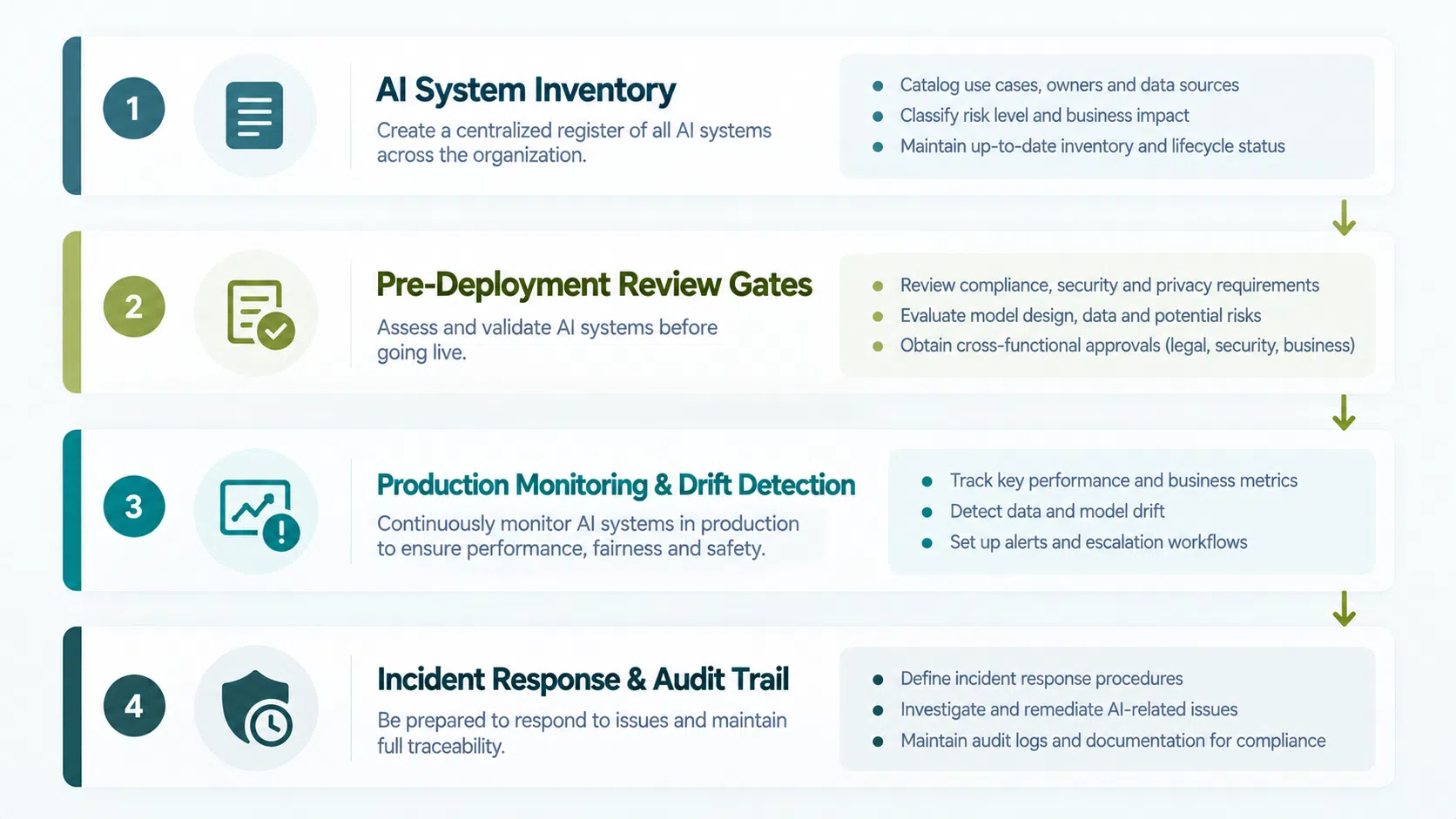
The four operational components that separate a working AI governance program from a policy document: system inventory, review gates, production monitoring, and incident response.
7. How do you get AI governance certification?
ISO/IEC 42001 is the primary certifiable AI governance standard, following the same audit process as ISO 27001: document a management system, conduct an internal audit, then engage an accredited certification body for Stage 1 and Stage 2 audits.
The path to ISO 42001 certification typically takes 6 to 18 months depending on the organization’s existing documentation maturity and the number of AI systems in scope. Key prerequisites:
An AI management system policy signed by senior leadership
A documented AI system inventory with risk classifications
Defined roles, responsibilities, and accountability structures
Evidence of risk assessments conducted before deployment for in-scope systems
Internal audit capability or an external partner that can conduct the pre-certification review
Organizations already certified to ISO 27001 have a structural advantage: the management system architecture, documentation controls, and internal audit processes transfer directly. The substantive new work is the AI-specific risk assessment methodology and the model inventory.
EU AI Act conformity assessment is a separate, parallel process for high-risk AI systems. For most enterprise AI, this involves self-declaration against the Act’s requirements. For AI systems classified as high-risk (hiring, credit, medical, law enforcement), a notified body assessment may be required.
8. Frequently asked questions


