Airbnb Case Study: A Look into the Revolutionary Travel Platform
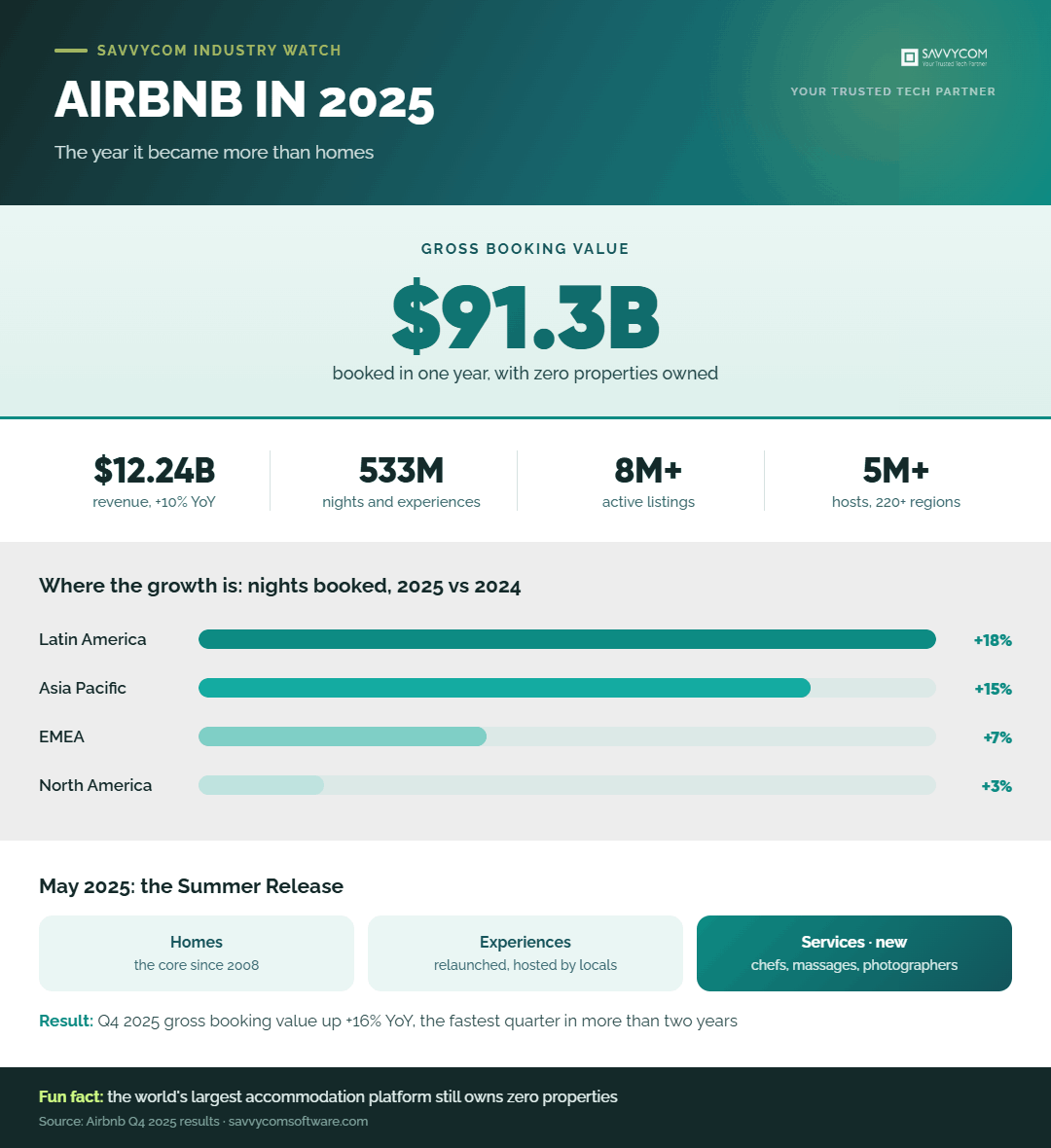
In May 2025, Airbnb did something it had not done since going public: it changed what it sells. The Summer Release rebuilt the app around three tabs (Homes, Experiences, and a brand-new category called Services) so that private chefs, massages, and photographers can now be booked to wherever you are staying. Two quarters later, gross booking value was growing 16% year over year. That is the fastest pace in more than two years. The company that turned spare rooms into an industry is now trying to turn the entire trip into its product.
That makes this a better moment than any in years to revisit the Airbnb case study: how a rent-money hack became a $91 billion booking platform, what the business model actually is, and what its 2025 reinvention teaches anyone building a marketplace or platform product.
Source: Airbnb Q4 2025 financial results
1. The origin story: an air mattress and a design conference
Founded in 2008 by Brian Chesky, Joe Gebbia, and Nathan Blecharczyk, Airbnb started as a way to make rent. With a design conference sold out of hotel rooms in San Francisco, the founders rented out air mattresses in their apartment to visiting attendees. The insight was accidental but durable: travelers wanted cheaper, more local alternatives to hotels, and homeowners had unused space they were willing to monetize.
savvycom-airbnb-2025
The early years produced one of startup lore’s favorite chapters: to stay alive, the founders sold politically themed cereal boxes, Obama O’s and Cap’n McCain’s, during the 2008 election, earning enough to keep going and quirky enough to get noticed by Y Combinator. The accelerator’s funding and a rebrand from “AirBed & Breakfast” to “Airbnb” set up the growth run that followed. The durable lesson is not the cereal; it is that the founders validated real demand with almost no capital before building almost anything.
2. How does Airbnb’s business model work?
Airbnb is a two-sided marketplace: it owns no property, but connects hosts who have space with guests who need it, and takes a service fee from each booking. Most bookings use a split fee (roughly 3% from the host, up to around 14% from the guest), while professional hosts can opt for a host-only fee of about 15%.

Image source: Gary Fox
The asset-light structure is what made the scaling math work: adding a million listings costs Airbnb approximately nothing in real estate, while every listing makes the platform more useful to guests, and every guest makes it more attractive to hosts. The flywheel only spins, though, if both sides keep getting value:
| What hosts get | What guests get |
|---|---|
| Income from unused space, listing tools with photos and pricing control, calendar and house-rule management, AirCover protection with up to $3 million in host damage coverage | Inventory hotels cannot match (entire homes, unique stays), verified profiles and reviews for trust, filtered search across price, location, and amenities, direct messaging with hosts |
3. What did Airbnb change in 2025, and why does it matter?
In May 2025, Airbnb relaunched Experiences, introduced Services (chefs, massages, personal training, photography, delivered to your stay), and redesigned the app around all three categories. It was the company’s most significant product expansion since going public: a deliberate move from renting rooms to capturing the whole trip.
The strategic logic mirrors what this series covered in the Grab case study: once a platform owns a high-frequency relationship, adjacent services reuse the same users, payment rails, and trust system at near-zero acquisition cost. Airbnb’s version: a guest who books a home in Da Nang can now book a private chef and a photographer through the same profile, the same payments, and the same review system.
Growth is also geographically instructive. Latin America nights grew 18% and Asia Pacific 15% in 2025, roughly triple North America’s 3%. That gap explains where Airbnb is pointing its product attention: expansion markets, including Southeast Asia.
4. What technology runs Airbnb?
Airbnb began as a Ruby on Rails monolith and evolved into a service-oriented architecture, with React across its web front-end, native mobile apps, AWS infrastructure, and machine learning driving search ranking, dynamic pricing, fraud detection, and personalization.
- Backend evolution: the original Rails monolith was gradually decomposed into services as scale demanded. Many successful platforms repeat that path: monolith first for speed, services later for scale.
- Front-end: Airbnb helped make React an industry standard and open-sourced significant tooling along the way.
- Data and ML: the highest-impact systems are invisible: search ranking that matches guests to listings they will actually book, pricing suggestions for hosts, and risk models screening bookings and payments.
- Infrastructure: AWS-based, built to absorb extreme seasonal and event-driven demand spikes.
The 2025 app redesign sits on top of this stack: rebuilding the product around three categories without breaking a platform serving hundreds of millions of bookings is an architecture story as much as a design one.
5. What made Airbnb’s marketing work?
Airbnb markets a feeling, not an inventory. Its storytelling formula (real hosts, real guests, real places) built emotional differentiation against hotel chains competing on price and points. The campaign layer stays deliberately theatrical: the Barbie Malibu Dreamhouse listing, character homes built with entertainment brands, and since 2024 the “Icons” category of once-in-a-lifetime stays. Each one is engineered to generate coverage far beyond its direct bookings. User-generated content does the rest: every memorable stay produces photos the platform never paid for.
The pattern worth copying: each stunt reinforces the core product promise of staying somewhere unlike a hotel, rather than chasing attention for its own sake.
6. What can builders actually learn from Airbnb?
Six lessons travel well beyond hospitality: validate demand before building, design trust as a product feature, stay asset-light where possible, invest early in data infrastructure, localize globally, and expand only into adjacencies that reuse your existing users and rails.
- Validate with almost nothing. Air mattresses and cereal boxes tested real demand before serious capital was raised. Most failed platforms build first and search for demand second.
- Trust is a feature, not a policy page. Reviews, verification, escrowed payments, and AirCover are product engineering. In any peer-to-peer model, the trust system is the product.
- Asset-light scales; asset-heavy defends. Owning no property let Airbnb outgrow hotel chains, but it also means supply can leave. The countermeasure is making the platform’s tools indispensable to hosts.
- Data infrastructure pays compound interest. Search ranking, pricing, and fraud models improve with every booking, an advantage competitors cannot copy by copying features.
- Global platform, local product. Payment methods, regulations, and travel norms differ by market; Airbnb’s growth in Asia Pacific and Latin America tracks its willingness to localize rather than translate.
- Expand along your rails. Services and Experiences reuse Airbnb’s users, payments, and trust system. Expansion that requires building new rails is a new company, not a new feature.
If this style of platform teardown is useful, the closest companion piece is the Grab analysis linked above, and the Uber Eats case study covers the same expansion playbook from the delivery side.
Frequently asked questions
What is the Airbnb case study about?
The Airbnb case study examines how a two-sided marketplace grew from renting air mattresses in 2008 to $91.3 billion in gross bookings in 2025 without owning property. It is studied for its asset-light business model, trust systems, network effects, and its 2025 expansion into Services and Experiences.
How does Airbnb make money?
Airbnb earns service fees on each booking. Most reservations use a split fee: hosts pay about 3% and guests pay up to around 14% of the booking subtotal, while many professional hosts use a host-only fee of roughly 15%. In 2025 this produced $12.24 billion in revenue.
Is Airbnb profitable?
Yes. Airbnb has been profitable on an annual basis since 2022 and generates strong free cash flow from its asset-light model. In 2025 it reported $12.24 billion in revenue, up 10% year over year, with gross booking value reaching $91.3 billion across 533 million nights and experiences.
What business model does Airbnb use?
Airbnb uses an aggregator or two-sided marketplace model: it connects hosts who have space with guests who need accommodation, takes a percentage fee from each transaction, and owns no real estate. Value comes from network effects, the trust system, and matching technology rather than physical assets.
What technology stack does Airbnb use?
Airbnb started on Ruby on Rails and evolved into a service-oriented architecture. Its stack includes React on the front-end, native iOS and Android apps, AWS cloud infrastructure, and machine learning systems for search ranking, dynamic pricing, personalization, and fraud detection across millions of listings.
Building a marketplace or platform product?
The patterns in this teardown (two-sided matching, trust systems, payments, data infrastructure) are the same ones Savvycom engineers for clients across APAC and beyond, from e-commerce ecosystems to on-demand platforms. See the production work in our case studies.
If a marketplace or booking platform is on your roadmap, see our mobile app development services or get in touch with our team.