Best Programming Languages for Finance in 2026

The best programming languages for finance in 2026 are Python, Java, TypeScript, C++, C#, Go, Rust, Scala, Kotlin, and SQL. Which ones your project needs depends on what it does: data and AI point to Python, core banking points to Java or C#, low-latency trading points to C++ or Rust, and payment infrastructure increasingly points to Go.
This guide covers all ten, what each is actually used for in finance, one limitation per language, and how development teams that build fintech products, including ours at Savvycom, decide among them.
The 10 languages at a glance
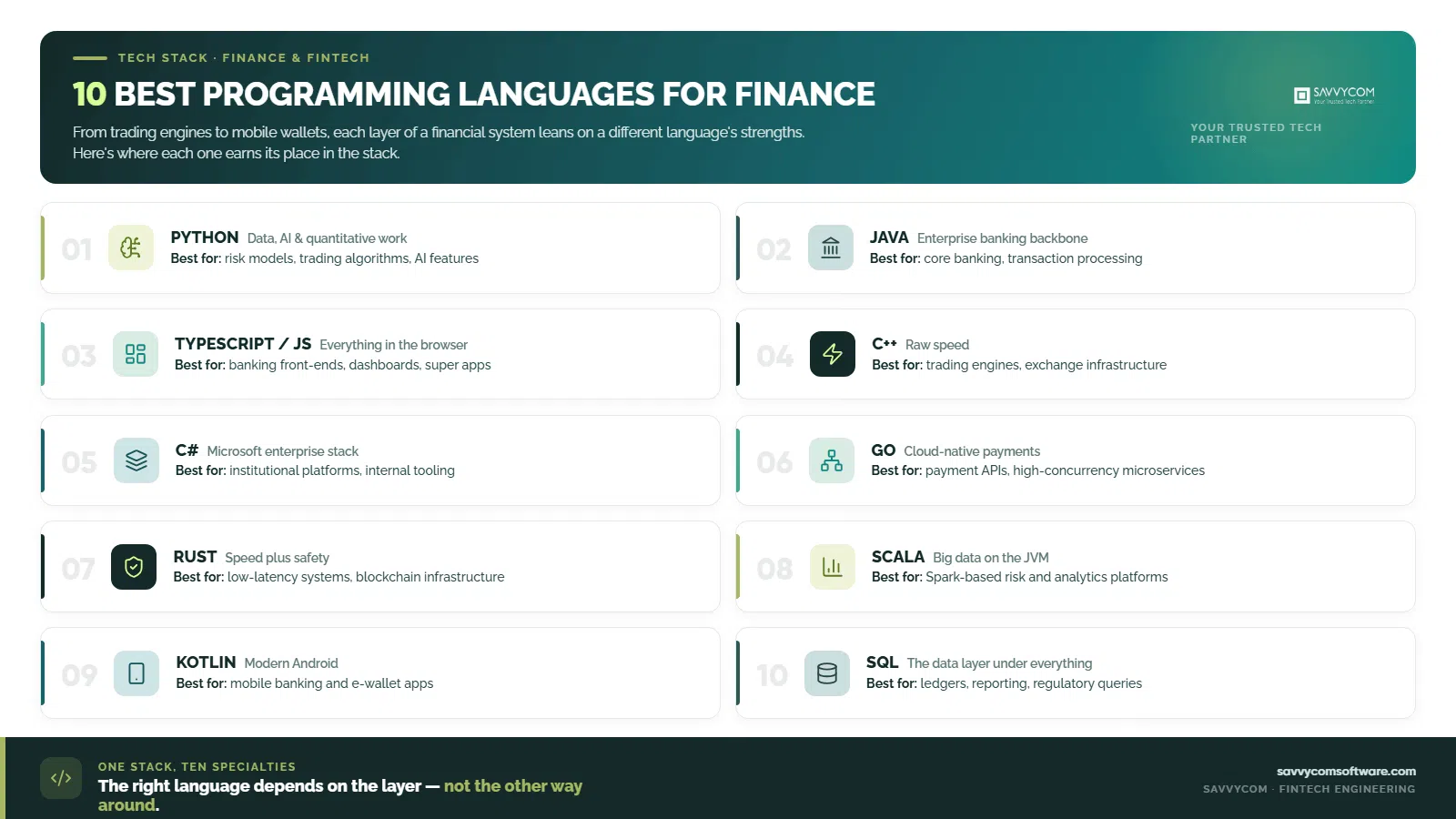
| Language | Role in finance | Best suited for |
|---|---|---|
| Python | Data, AI, and quantitative work | Risk models, trading algorithms, AI features |
| Java | Enterprise banking backbone | Core banking, transaction processing |
| TypeScript / JavaScript | Everything in the browser | Banking front-ends, dashboards, super apps |
| C++ | Raw speed | Trading engines, exchange infrastructure |
| C# | Microsoft enterprise stack | Institutional platforms, internal tooling |
| Go | Cloud-native payments | Payment APIs, high-concurrency microservices |
| Rust | Speed plus safety | Low-latency systems, blockchain infrastructure |
| Scala | Big data on the JVM | Spark-based risk and analytics platforms |
| Kotlin | Modern Android | Mobile banking and e-wallet apps |
| SQL | The data layer under everything | Ledgers, reporting, regulatory queries |
1. Python
Python holds the top spot on the TIOBE index with its widest lead ever, and finance is a large part of why: it is the default language of quantitative analysis, risk modeling, and now AI-powered financial features. Savvycom’s own fintech delivery reflects this: the multi-agent FX assistant we built for a South Korean financial services company, which cut FX processing time by 60%, runs its agent orchestration in Python because that is where the LLM tooling ecosystem lives.
- Data and AI ecosystem: NumPy, Pandas, and the modern LLM stack make Python the shortest path from financial data to insight.
- Readability: quants and developers can share the same codebase.
- Integration reach: connects easily to databases, market data feeds, and messaging systems.
Worth knowing: raw execution speed is Python’s weakness. Latency-critical paths get rewritten in C++ or Rust once a strategy proves out.
Used by: Robinhood, Stripe, and most quantitative trading desks.
2. Java

Java remains the backbone of institutional banking. Core banking systems, transaction processors, and settlement platforms run on it because it offers what regulated finance values most: stability, a mature security model, and two decades of proven behavior under massive transaction volumes.
- Battle-tested at scale: handles enormous concurrent transaction loads reliably.
- Security model: mature access control and cryptography libraries suited to regulated environments.
- Ecosystem and longevity: banks can hire for it, audit it, and maintain it for decades.
Worth knowing: development is slower and more verbose than modern alternatives. Fintech startups usually reach for lighter stacks first and adopt Java patterns as they scale into enterprise territory.
Used by: Barclays, HSBC, and most tier-1 banks.
3. TypeScript and JavaScript
Every banking dashboard, trading interface, and payment checkout a user touches in a browser runs on JavaScript, and in 2026 serious fintech front-ends are written in TypeScript, which now tops GitHub’s language rankings by repository activity (GitHub Octoverse). React and Next.js dominate the front-end layer, with Node.js running API services behind many of them. This is also the stack layer where financial super apps live or die: one codebase rendering dozens of financial products without becoming unmaintainable.
- Type safety where it counts: TypeScript catches errors at compile time, which matters when the number on screen is someone’s account balance.
- Full-stack coverage: one language from React front-end to Node back-end.
- Real-time interfaces: live price feeds, transaction statuses, and trading UIs are native territory.
Worth knowing: the ecosystem moves fast and build tooling churns. Long-lived financial products need disciplined dependency management to avoid drowning in framework migrations.
4. C++
Where microseconds equal money, C++ still rules. Exchange matching engines, high-frequency trading systems, and market data infrastructure are built in C++ because nothing else combines its raw speed with forty years of production hardening.
- Deterministic performance: full control over memory and execution for latency-critical paths.
- Risk system heritage: large-scale risk modeling and pricing engines across investment banks run on C++ codebases.
- Hardware proximity: the language of choice when software must extract everything the machine offers.
Worth knowing: development is slow, expertise is expensive, and memory bugs are costly. Teams increasingly reserve C++ for the hot path and build everything around it in friendlier languages.
5. C#

C# is the enterprise workhorse of the Microsoft ecosystem, and financial institutions with .NET estates build trading platforms, internal risk tools, and client portals on it. With .NET now fully cross-platform, C# fintech services run on Linux cloud infrastructure as comfortably as on Windows.
- Enterprise tooling: first-class IDE support, profiling, and debugging shorten development cycles.
- Managed performance: strong runtime performance with memory safety, a practical middle ground between Java and C++.
- LINQ and data handling: expressive querying over financial datasets built into the language.
Worth knowing: gravity still pulls toward the Microsoft ecosystem. Organizations running polyglot open-source stacks often pick Go or Java for services instead.
6. Go
Go is the language 2026 payment infrastructure gets written in. Built at Google for concurrent network services, it fits fintech’s dominant architecture: cloud-native microservices handling thousands of simultaneous API calls with predictable latency. Digital banks and payment processors adopted it aggressively, most famously Monzo, whose entire banking platform runs on Go microservices.
- Concurrency by design: goroutines make high-throughput payment APIs simple to write and reason about.
- Operational simplicity: single-binary deployments and fast startup fit containerized infrastructure.
- Predictable latency: a lightweight runtime keeps response times consistent under load.
Worth knowing: Go is deliberately minimal. Teams coming from feature-rich languages sometimes find the expressiveness limited for complex domain modeling.
7. Rust
Rust earns its place in finance through an unusual combination: C++-level performance with memory safety guaranteed at compile time. That profile fits two growing niches: low-latency trading infrastructure, where firms are rewriting critical paths from C++, and blockchain systems, where much of the industry’s core infrastructure, including the Solana ecosystem, is Rust-native.
- Memory safety without garbage collection: eliminates the crash-and-exploit bug classes that plague C++ systems, with no runtime pause penalty.
- Fearless concurrency: data races caught at compile time, critical for parallel transaction processing.
- Blockchain gravity: the default language of modern digital asset infrastructure.
Worth knowing: the learning curve is real, and Rust engineers command premium rates. It pays off where performance and safety are both non-negotiable, and is overkill where they are not.
8. Scala
Scala runs on the JVM with full Java interoperability, and its functional style plus Apache Spark made it the language of big-data finance: risk aggregation, regulatory reporting pipelines, and analytics platforms at investment banks.
- Spark-native: the natural language for large-scale financial data processing.
- Expressive type system: complex financial logic encoded with fewer errors reaching production.
- Java interop: plugs directly into existing enterprise JVM estates.
Worth knowing: the talent pool is thin and much new data engineering has drifted toward Python and SQL-first platforms. Scala is a strong incumbent more than a growing choice.
9. Kotlin
Kotlin is Google’s first-class language for Android, which makes it the default for the mobile side of finance: banking apps, e-wallets, and payment apps serving markets where the phone is the bank branch. Its null safety alone removes a class of crashes no financial app wants in production.
- Null safety: a whole category of runtime crashes prevented at the language level.
- Java interoperability: legacy Android banking codebases migrate incrementally.
- Coroutines: clean asynchronous handling for payment flows and real-time balance updates.
Worth knowing: Kotlin Multiplatform is maturing but most teams still pair it with Swift for iOS rather than sharing one codebase across both.
10. SQL
SQL is not a competitor to anything above; it is the layer beneath all of it. Ledgers, transaction histories, and the queries behind every regulatory report run on SQL, and in BFSI the ability to write it well remains one of the most quietly valuable skills in the building.
- Data integrity: constraints and transactions enforce the correctness that financial records legally require.
- Universality: every relational database that matters speaks it, from PostgreSQL to Oracle.
- Analytical reach: from operational queries to the statistical models financial analysts build on top.
Worth knowing: SQL manages data, not applications. It is a mandatory companion skill, never the whole stack.
How do you choose the right language for a fintech project?

Choose by system role and team reality, not language rankings: Python for data and AI, Go or Java for transaction services, TypeScript for the front-end, Kotlin and Swift for mobile, C++ or Rust only where latency is the product, and SQL underneath everything. Then weigh your team’s existing skills, hiring market, and compliance requirements before committing.
- Start from the system’s job: a robo-advisor, a payment API, and a trading engine have three different correct answers.
- Weigh team skills and hiring: the best language your team cannot hire for is the wrong language. This is also where fintech app development cost is really decided: talent availability moves budgets more than license fees.
- Check the ecosystem: payment gateway SDKs, banking APIs, and compliance tooling exist for some languages and not others.
- Plan for the audit: regulated products need languages and frameworks with established security track records that compliance teams recognize.
- Prototype before committing: a two-week spike in two candidate stacks costs less than a mid-project rewrite.
In production, fintech systems are polyglot by design. A typical modern build pairs a TypeScript front-end with Go or Java services, Python for data and AI features, Kotlin and Swift on mobile, and SQL underneath, exactly the pattern in most of the financial software development work shipping today, including our own e-wallet and digital banking builds (see the e-wallet app development guide for how those stacks come together).
Choosing a stack for a financial product?
Savvycom builds fintech and digital banking software across these stacks, from Python-based AI automation for financial operations to full e-wallet platforms, delivered to BFSI compliance standards across APAC and beyond. The architecture conversation starts with what your product actually does, and that is exactly where our discovery process begins.
FAQ

What are the top features that a modern banking app should have?
Modern banking apps aim to provide convenient, secure, and feature-rich experiences to users. Here are some top features that a modern banking app should ideally have:
- User-friendly Interface: A modern banking app should have an intuitive and user-friendly interface that allows customers to navigate through different features and functionalities easily. It should provide a seamless and visually appealing user experience across various devices and screen sizes.
- Account Management: Users should be able to view their account balances, transaction history, and manage multiple accounts within the app. Features like fund transfers, bill payments, and the ability to set up recurring payments should be included.
- Mobile Payments: Integration with mobile payment services such as Apple Pay, Google Pay, or other digital wallets allows users to make secure payments directly from their banking app. It simplifies the payment process and enhances convenience for users.
- Notifications and Alerts: Real-time notifications and alerts play a crucial role in keeping users informed about their account activities, such as large transactions, account balance updates, or payment due dates. Customizable push notifications and in-app alerts help users stay updated and monitor their finances effectively.
- Personal Financial Management: Including features for budgeting, expense tracking, and goal setting enables users to manage their finances more effectively. The app can provide visualizations, spending analysis, and insights to help users make informed financial decisions.
- Security Features: Banking apps must prioritize security. Biometric authentication, such as fingerprint or facial recognition, along with strong encryption protocols, provide robust security for user data and transactions. Two-factor authentication (2FA) adds an extra layer of protection.
- Customer Support: Integration with customer support features like in-app chat, messaging, or the ability to schedule appointments with bank representatives helps users resolve queries or seek assistance within the app itself.
- Card Management: Users should have the ability to manage their debit or credit cards, including card activation, temporary card locks, transaction controls, and notifications for card-related activities.
- ATM and Branch Locator: An integrated map-based feature that helps users locate nearby ATMs, branches, or partner networks provides convenience and enhances the overall banking experience.
- Personalized Offers and Recommendations: Leveraging user data and analytics, modern banking apps can provide personalized offers, rewards, and recommendations tailored to individual users' financial needs and preferences.
Which coding language is best for finance?
Python is the best overall programming language for finance in 2026, leading in data analysis, AI features, and quantitative modeling. The right choice still depends on the system: Java and C# dominate core banking, Go powers payment services, C++ and Rust handle low-latency trading, and TypeScript builds financial front-ends.
Is C++ or Python better for finance?
Python is better for most finance work: analytics, risk modeling, AI, and rapid product development. C++ is better where execution speed is the product, such as high-frequency trading engines and exchange infrastructure. Many firms use both, prototyping strategies in Python and rewriting latency-critical paths in C++.
What coding language does JP Morgan use?
JPMorgan primarily uses Python and Java. Its in-house Athena platform, which handles pricing, trading, and risk management, contains roughly 35 million lines of Python code, while Java runs many core banking systems. The bank also uses C++ for low-latency trading and SQL across its data infrastructure.