EHR vs EMR: What’s the Difference? (2026)
The core difference between an EHR and an EMR is scope and shareability: an EMR (electronic medical record) is a digital version of a single practice’s paper chart, used within that one organization, while an EHR (electronic health record) is a broader record designed to be shared across multiple healthcare providers and to follow the patient between organizations.
The two terms are used interchangeably even inside the industry, but the distinction matters for interoperability, compliance, and cost. Healthcare has largely moved from the EMR concept to the EHR: by 2024, more than 99% of US non-federal acute care hospitals had adopted a certified EHR, up from under 10% in 2008 (ONC / HealthIT.gov). The shift reflects a simple clinical reality: patients rarely stay with one provider, so their records cannot either.
This guide clarifies what each term means, compares them across the dimensions that matter, distinguishes them from adjacent systems like HIS and EPM, and explains which one an organization actually needs.
1. What is the difference between EHR and EMR?
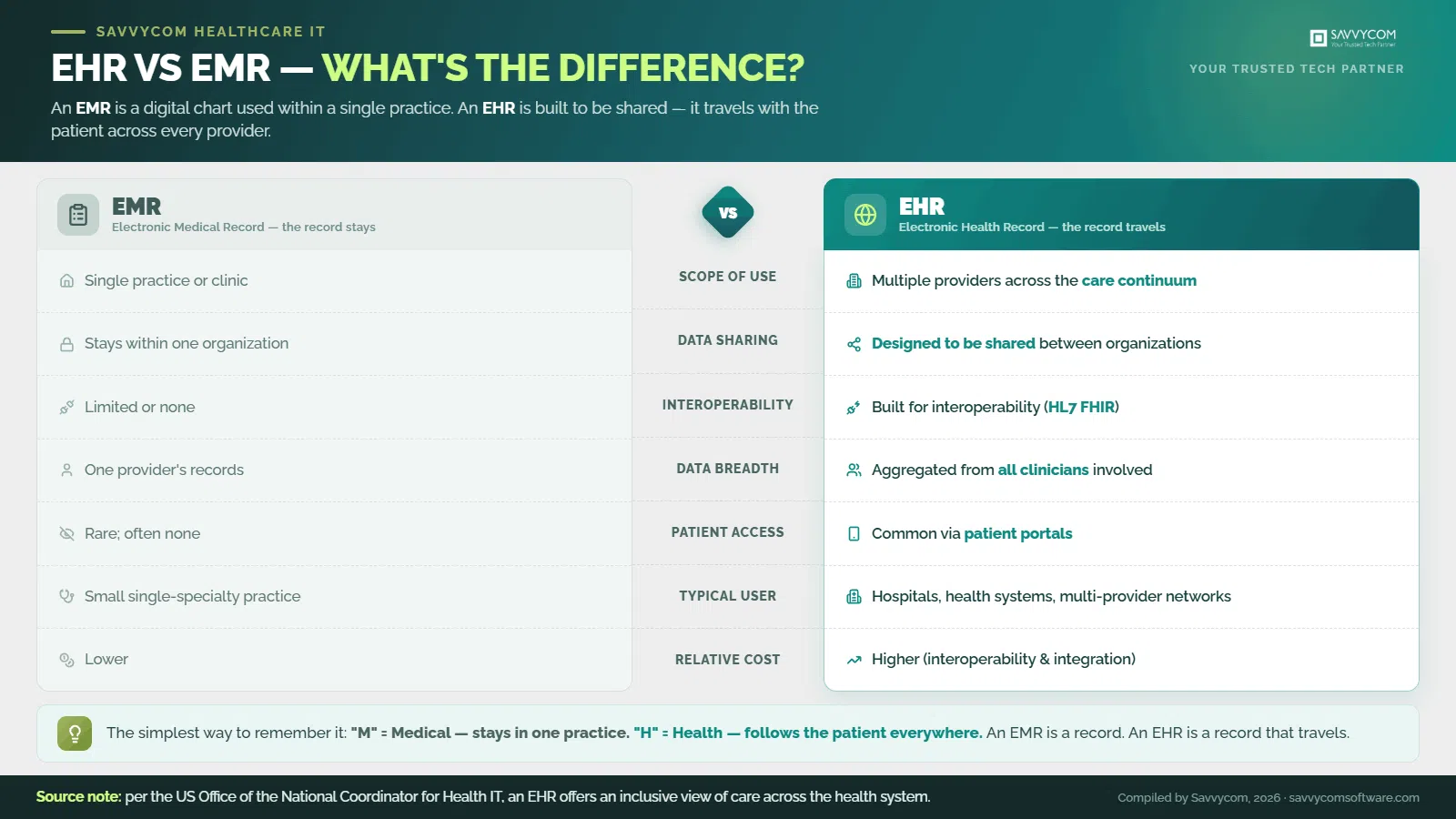
The core difference is scope and shareability: an EMR is a digital chart used within a single practice, while an EHR is a broader record designed to be shared across multiple providers and to travel with the patient between organizations.
What is an EMR?
An electronic medical record (EMR) is a digital version of the paper chart in a single clinician’s office. It contains the medical and treatment history of patients within that one practice: diagnoses, medications, allergies, immunization dates, and test results recorded by that provider. An EMR improves on paper by making records legible, searchable, and easier to track over time, but it is built for internal use. It is not designed to leave the practice, and sharing an EMR with an outside provider often means printing or emailing it.
What is an EHR?
An electronic health record (EHR) is a broader, more comprehensive record built to be shared. It contains everything an EMR does, but it is designed from the ground up to move with the patient, gathering information from every clinician involved in a patient’s care. According to the US Office of the National Coordinator for Health IT, an EHR is meant to go beyond standard clinical data collected in one provider’s office and to offer a more inclusive view of a patient’s care across the health system.
The one-sentence distinction
The simplest way to remember it: the “M” in EMR stands for medical, and the record stays within one medical practice. The “H” in EHR stands for health, a broader concept, and the record follows the patient’s overall health across every provider they see. An EMR is a record. An EHR is a record that travels.
2. EHR vs EMR comparison across key dimensions
EHR and EMR differ across six dimensions: scope of use, interoperability, data breadth, patient access, typical user, and cost, with the EHR being broader and more shareable across every dimension.
| Dimension | EMR (Electronic Medical Record) | EHR (Electronic Health Record) |
|---|---|---|
| Scope of use | Single practice or clinic | Multiple providers across the care continuum |
| Data sharing | Stays within one organization | Designed to be shared between organizations |
| Interoperability | Limited or none | Built for interoperability (HL7 FHIR) |
| Data breadth | One provider’s records | Aggregated from all clinicians involved |
| Patient access | Rare; often none | Common via patient portals |
| Typical user | Small single-specialty practice | Hospitals, health systems, multi-provider networks |
| Relative cost | Lower | Higher (interoperability and integration) |
Where the practical differences show up
The distinction becomes concrete during care coordination. When a patient is referred from a primary care doctor to a specialist, an EMR requires the record to be printed, faxed, or manually sent. An EHR lets the specialist access the relevant history directly. The same applies to patient portals: EHRs commonly let patients view their own records, request refills, and message providers, while EMRs typically do not. By 2024, 95% of US hospitals let patients view clinical notes electronically, and FHIR-based app adoption in outpatient settings had climbed from 49% in 2021 to 64% (ONC data brief, 2025). These capabilities depend on the EHR model, not the EMR one.
3. EHR and EMR in the wider health system landscape
EHR and EMR are patient-record systems distinct from adjacent systems they are often confused with: HIS manages hospital-wide operations, EPM handles billing and scheduling, and ERP runs enterprise business functions.
EHR and EMR vs HIS (Hospital Information System)
A Hospital Information System (HIS) manages the operations of an entire hospital: admissions, bed management, pharmacy, laboratory, radiology, and billing, in addition to clinical records. An EHR or EMR is the patient-record component. Put simply, the EHR is one module within the broader HIS. A hospital runs an HIS; the EHR lives inside it.
EHR vs EPM and PMS
An Electronic Practice Management (EPM) system, also called Practice Management Software (PMS), handles the administrative and financial side of a practice: appointment scheduling, insurance verification, billing, and claims. An EHR handles the clinical side: diagnoses, treatment, and clinical notes. The two are complementary and often integrated so that a completed clinical encounter in the EHR flows into billing in the EPM, but they are distinct systems solving distinct problems.
EHR vs ERP
An Enterprise Resource Planning (ERP) system manages a healthcare organization’s business functions: finance, human resources, supply chain, and procurement. An EHR manages clinical patient data. They serve entirely different purposes, clinical versus operational, and large health systems typically run both, integrated so that clinical activity informs resource and financial planning.
4. Which system does your organization need?
A single-specialty clinic with no need to share records externally may only need an EMR, but almost every organization that coordinates care across providers, participates in value-based care, or wants patient-facing access needs an EHR.
When an EMR is enough
An EMR can be sufficient for a small, single-specialty practice that operates independently, keeps records for internal use, and rarely coordinates care with outside providers. For a solo dermatology or dental practice with no referral-heavy workflow, a simpler and cheaper EMR may cover the need without the added cost of interoperability.
When you need an EHR
Almost every other scenario points to an EHR: multi-provider practices, hospitals, organizations that make or receive referrals, anyone participating in value-based care or accountable care arrangements, and any provider that wants to offer patients a portal. Regulatory direction reinforces this. US programs tie incentives and compliance to interoperable, certified EHRs, not standalone EMRs.
Quick check: does your organization need an EMR or an EHR?
Answer five questions about how your organization works with patient records.
Build vs buy: commercial platforms and custom systems
For organizations choosing an EHR, the next decision is build versus buy. Commercial platforms like Epic and Oracle Health (formerly Cerner) dominate the hospital market: Epic alone accounts for about 55% of US acute-care hospital beds (KLAS Research, 2024). These suit organizations whose workflows fit an established product. Custom development fits organizations with specialized workflows, specific integration needs, or multi-market compliance requirements that off-the-shelf platforms do not serve well. In Vietnam, Savvycom partners with MEDLATEC, one of the country’s largest healthcare service networks, on digital infrastructure including cloud-based health record systems, where local regulatory and language requirements make a tailored build a better fit than a foreign commercial platform.
5. Interoperability, compliance, and the future of health records
The trend line runs decisively toward interoperable EHRs, driven by regulatory mandates and the clinical need for records that follow the patient across a fragmented care system.
HIPAA and data protection
Both EMRs and EHRs must comply with data protection regulations, HIPAA in the US, and equivalents elsewhere. The EHR’s wider sharing raises the stakes: every additional provider and system that can access a record expands the surface that must be secured. This is why EHR architecture treats access control, audit logging, and encryption as core requirements rather than add-ons.
FHIR and interoperability mandates
The technical foundation of EHR interoperability is HL7 FHIR (Fast Healthcare Interoperability Resources). US regulatory programs, including the CMS Promoting Interoperability program (formerly Meaningful Use), tie incentives to FHIR-based data exchange. This is why the direction of travel is unambiguously toward interoperable EHRs. The data infrastructure behind these systems, from data lakes to analytics pipelines, is what makes that interoperability work at scale.
Global and APAC context
While US adoption is near-universal, other markets are at different stages. Adoption is high in countries like New Zealand and across much of Western Europe, while some markets are still building toward it. For organizations operating across Asia-Pacific, EHR deployment carries an added consideration: data residency rules under frameworks like PDPA and APPI shape where records can be stored and how they cross borders, which affects EHR architecture from the design stage.
6. Frequently asked questions
Is Epic an EHR or EMR?
Epic is an EHR (electronic health record). It is one of the largest EHR platforms globally, accounting for about 55% of US acute-care hospital beds, and manages comprehensive patient records that can be shared across providers. While people sometimes call it an EMR, its interoperability and cross-provider capabilities make it an EHR by definition.
What is the difference between EHR and EPM?
An EHR (electronic health record) stores and manages clinical patient data, while an EPM (electronic practice management) system handles the administrative and financial side, such as scheduling, billing, and insurance claims. Many practices integrate the two so clinical encounters flow into billing, but they remain distinct systems.
What is the full form of EMR and EHR?
EMR stands for electronic medical record, a digital version of a single practice's paper chart. EHR stands for electronic health record, a broader digital record designed to be shared across multiple healthcare providers. The key difference is that an EHR is built to be interoperable and follow the patient, while an EMR stays within one practice.
What are the similarities between EMR and EHR?
EMR and EHR both digitize patient medical information, replace paper records, improve accuracy and legibility, support clinical decision-making, and must comply with data protection regulations like HIPAA. Both store diagnoses, medications, and treatment histories. The difference is scope: an EHR is designed to be shared across providers, while an EMR is not.
Going deeper: this guide covered what separates the two record types. For how an EHR actually connects to the systems around it, integration patterns, standards, and common pitfalls, see the complete guide on electronic health record integration.