
How to Hire a Logistics Software Developer: Models and Rates
To hire a logistics software developer, decide first whether you need one specialist, a dedicated team, or a project team, then check domain proof in systems like WMS and TMS, integration history, and security practice. Published Vietnam blended rates run from $25 to $45 per hour, and a six- to seven-person team costs about $24,000 to $26,000 per month.
The rest of this guide covers which hiring model fits, what the rates include, how to vet a candidate or vendor, and what a delivered project looks like. For the wider picture of what logistics software covers, see this guide to logistics software development.
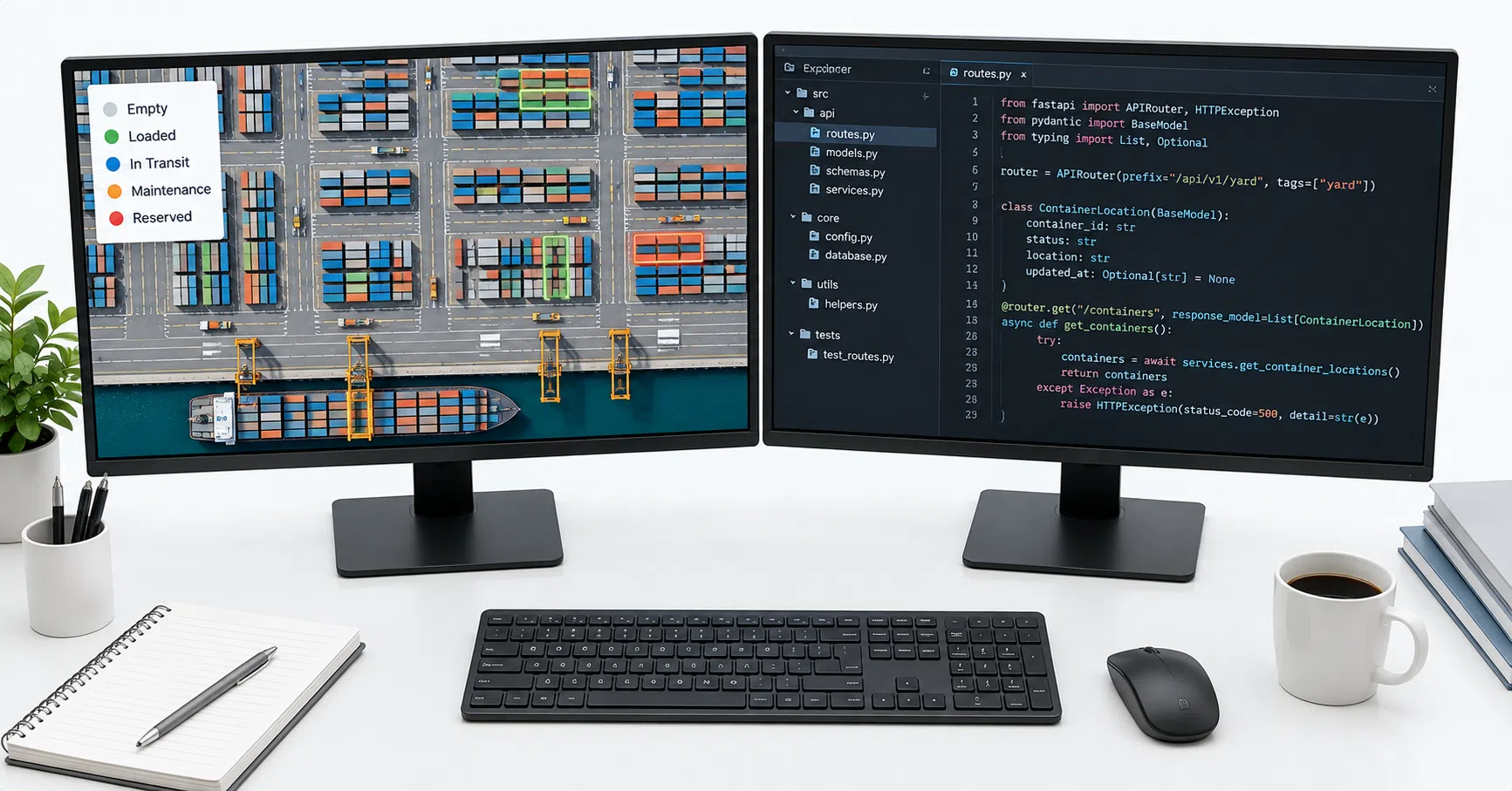
A logistics software developer specializes in WMS, TMS, and yard systems that handle hundreds of container movements per day.
1. What Does a Logistics Software Developer Do?
A logistics software developer builds and connects the systems that move goods and information: warehouse management, transport management, fleet and last-mile tracking, yard operations, and the integrations between them. The work differs from general web development because it depends on carriers, devices, and legacy systems that rarely share a data format.
Most logistics projects combine several of these layers:
- Warehouse and yard systems. Inventory, putaway, picking, and container or trailer location.
- Transport and fleet systems. Route planning, dispatch, driver apps, and live tracking.
- Integrations. ERP, carrier, customs, and telematics connections cause more delays than the screens users see.
- Data and AI. Computer vision, forecasting, and document processing built on top of clean operational data.
2. Which Hiring Model Should You Choose?
Choose the model by how well you can define scope. A fixed price suits a defined scope, time and materials suits a scope that will change, a dedicated team suits a long roadmap, and staff augmentation suits a company that already has technical leadership. Deloitte found 67% of executives now use managed or operate services, up from 45% two years earlier.
| Model | Best when | Main risk |
| Fixed price | Scope is defined, for example, after a discovery phase | Change requests turn into disputes; a price set too early locks in wrong assumptions |
| Time and materials | Scope will evolve, and you want to steer priorities | Budget drifts without a cap and a regular review |
| Dedicated team | Long roadmap, such as WMS plus TMS plus integrations | You manage priorities, and knowledge leaves if people rotate |
| Staff augmentation | You have a technical lead and need individual engineers | You own delivery and integration; accountability for outcomes is weakest |
Model descriptions reflect common practice. Satisfaction figures from Deloitte’s 2024 Global Outsourcing Survey.
Deloitte’s 2024 Global Outsourcing Survey of more than 500 business and technology leaders also found 29% still use legacy staff augmentation, and that satisfaction was 88% among managed or operated adopters against 71% among non-adopters. A discovery phase of two to four weeks, priced at $5,000 to $15,000 in Savvycom’s cost guide, is the usual way to turn an unclear scope into one that can carry a fixed price.
3. How Much Does It Cost to Hire Logistics Developers?
Published Vietnam blended rates run from $25 to $45 per hour, with senior AI and data roles at $55 and a mid-level blend near $32. A mid-scope WMS or TMS team of six to seven people costs about $24,000 to $26,000 per month, and senior-heavy teams run 20 to 30% higher.
| Item | Published figure |
| Blended hourly rate, Vietnam | $25 to $45 |
| Mid-level blended rate | Near $32 per hour |
| Senior AI and data roles | $55 per hour |
| Team of six to seven | $24,000 to $26,000 per month |
| Senior-heavy team | 20 to 30% higher |
| Discovery phase (2 to 4 weeks) | $5,000 to $15,000 |
| Lower quotes in the market | $15 to $20 per hour |
Source: Savvycom’s logistics software development cost guide. These are one vendor’s published rates, not market averages. The team in the guide is a tech lead, two or three backend engineers, a frontend engineer, a QA engineer, and part-time business analysis and project management.
Rate alone is a poor guide. The guide places Savvycom at the upper end of Vietnam pricing and says the premium pays for logistics domain depth, English-speaking business analysis, and ISO 27001-certified delivery. Quotes at $15 to $20 per hour exist, so ask what sits behind the number: who does the analysis, who tests, and who stays on the team.
Talent supply also shapes price. Vietnam’s Ministry of Science and Technology reports 74,000 IT enterprises employing over 1.2 million workers, while the Vietnam Information Technology Market Report put the 2025 shortage at about 200,000 skilled workers.
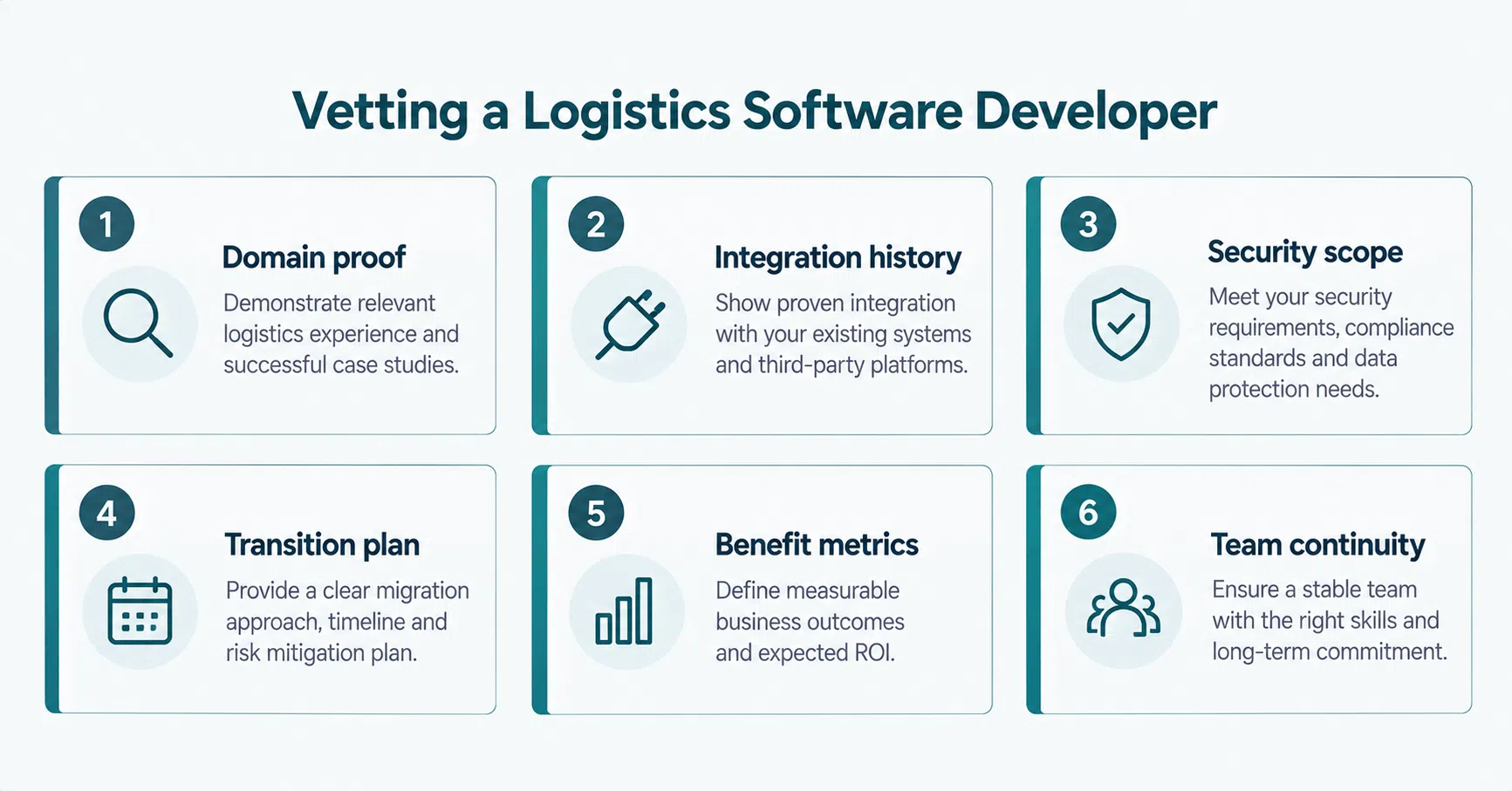
Vet on evidence: domain proof, integration history, security scope, transition plan, benefit metrics, and team continuity.
4. How Do You Vet a Logistics Software Developer?
Vet on evidence, not on a resume list. Ask for two logistics projects with figures and context, check integration history with carriers and ERP systems, confirm security certification scope, and agree on benefit metrics before kickoff. Deloitte found 55% of organizations lack benefit-realization tracking, the most common outsourcing challenge it reported.
- Domain proof. Ask for two logistics projects with numbers such as accuracy, time saved, or daily volume, and what the baseline was.
- Integration history. Ask which carrier, ERP, or device integration was hardest, what broke, and how it was fixed. Deloitte found 47% of organizations cite poor integration of vendor services.
- Security scope. If a vendor cites ISO 27001, ask which teams and sites the certificate covers.
- Transition plan. Deloitte found 46% cite poor vendor performance during transitions. Ask who handles knowledge transfer on day one and at exit.
- Benefit metrics. Agree on two or three measures before work starts, such as search time, dwell time, or on-time delivery, and how they will be reported.
- Team continuity. Ask who stays for the first six to twelve months and what happens if a key engineer leaves.
5. What Does a Delivered Logistics Project Look Like?
Savvycom built an AI-powered yard management system for a global logistics provider whose yards handle 400 to 500 container movements per day and store over 500 containers at once. The system reached 95% accuracy in container placement and movement tracking, cut search and retrieval time by 60%, and raised operational productivity by 35% to 40%.
The client relied on manual records, which caused inconsistencies, delays, and misplaced containers, and had little real-time visibility into container locations. The yard management case describes a solution built on visual recognition, continuous tracking, and a central operational view. The build took nine months.
A second logistics example is an AI contract review platform for a South Korean logistics operator, which cut review time by 50% at 95% accuracy and now processes over 1,000 contracts a month. Neither client is named in this article.
Where Savvycom is not the fit. Savvycom does custom development, not licensed WMS or TMS products, so buyers who want an off-the-shelf platform should look at commercial vendors. Teams needing 50 or more engineers immediately should ask for a written ramp-up plan before signing, and the company sits at the upper end of Vietnam pricing.
6. Should You Hire In-House or Outsource?
Most organizations use both. Deloitte found no surveyed executive relies exclusively on their own employees, and that access to talent, at 42%, is now the top reason to outsource, ahead of spend optimization at 34%. In-house suits core systems you will change daily, while outsourcing suits specialist or time-bound builds.
Cost reduction as the primary driver fell from 70% in 2020 and 48% in 2022 to 34% in 2024. For logistics, the practical split is often an in-house product owner and operations lead who know the business, paired with an external team that supplies engineering depth and integration experience.


