IT Consulting Services: What Does an IT Consultant Actually Do? (2026)
IT consulting services are advisory and project-based engagements in which external experts help organizations plan, implement, and optimize technology to achieve business objectives. An IT consultant is not a managed service provider who keeps your systems running and not a staffing agency that places a developer at your desk. An IT consultant diagnoses a technology problem, designs a solution, and often oversees implementation, then leaves when the engagement ends.
The growing demand for IT consulting reflects the increasing complexity of modern technology environments. Organizations today face talent shortages, cloud modernization initiatives, cybersecurity risks, regulatory requirements, and the rapid adoption of AI technologies. Against this backdrop, Gartner forecasts worldwide IT spending will reach $6.15 trillion in 2026, up 10.8% year over year, highlighting the scale of technology investment across industries. As a result, many organizations engage external consultants for strategic initiatives such as technology roadmapping, architecture design, cloud migration, systems integration, cybersecurity improvement, and digital transformation programs.
This guide covers what IT consulting services involve, who provides them, the seven main service categories, how consulting engagements work, typical cost structures, and how to choose the right consulting partner.
1. What does an IT consultant actually do?
An IT consultant assesses an organization’s technology environment, identifies gaps between current capability and business requirements, designs solutions, and either implements those solutions or oversees their implementation, then transfers knowledge to the internal team before the engagement ends.
The work varies significantly by engagement type. A strategy engagement might produce a 12-month technology roadmap, a cloud migration plan, or an architecture design for a new platform. An implementation engagement involves building, configuring, or integrating systems. A security engagement finds vulnerabilities and designs remediation. An AI or data consulting engagement designs an analytics architecture or deploys a machine learning model. A transformation engagement addresses all of the above simultaneously as part of a program to restructure how the organization operates.
What an IT consultant does not do: they do not manage your helpdesk, they do not provide IT support on a break-fix basis, and they do not replace your internal IT team for ongoing operations. When the engagement ends, the solution and the knowledge of how to maintain it should remain with the client.
The difference between IT consulting and related services
| Service type | What it provides | Who provides it | Relationship |
|---|---|---|---|
| IT consulting | Advisory, design, project-based implementation | Consulting firms, boutiques, independent consultants | Project or engagement-based; defined end date |
| Managed services | Ongoing operational IT support (helpdesk, monitoring, patching) | Managed service providers (MSPs) | Ongoing contract, typically multi-year |
| Staff augmentation | Individual contractors placed in client teams | Staffing agencies, outsourcing firms | Time-and-materials, staff under client direction |
| IT outsourcing | Transfer of IT function to an external provider | Large outsourcers (TCS, Infosys, Wipro) | Long-term contract, full function transfer |
These models overlap in practice, and many firms offer several of them. For how the outsourcing models compare and what each costs, see the guide on what IT outsourcing is.
2. The seven types of IT consulting services
IT consulting services cover seven primary domains: strategy and digital transformation, cloud consulting, cybersecurity, AI and data analytics, ERP and enterprise software, software development and integration, and IT infrastructure and architecture.
Strategy and digital transformation consulting
Strategy consulting helps organizations determine what technology to invest in, in what sequence, and against what business outcome. Digital transformation consulting is the applied form: redesigning how an organization operates through technology, not just which tools it deploys. This is the fastest-growing segment, with organizations across healthcare, BFSI, logistics, and manufacturing investing heavily in transformation programs. Cybersecurity, data governance, and compliance advisory typically sit alongside broader transformation work as priority consulting investments.
Cloud consulting
Cloud consulting covers cloud strategy, architecture design, migration planning, and multi-cloud optimization. Cloud migration and optimization remain among the most common consulting engagements, driven by multi-cloud complexity and the need for cost governance as cloud spending grows. The work ranges from a lift-and-shift migration plan (moving existing workloads to a cloud provider) to a cloud-native re-architecture (redesigning systems to use cloud services at every layer). Cost optimization is a growing subcategory: as cloud bills compound, organizations need external expertise to audit consumption and eliminate waste.
Cybersecurity consulting
Cybersecurity consulting includes risk assessment, penetration testing, security architecture design, compliance audits (SOC 2, ISO 27001, HIPAA, and GDPR), and incident response. It remains one of the highest-demand IT consulting specialties because regulatory and security requirements keep rising while security talent stays scarce.
AI and data analytics consulting
AI and data consulting designs analytics architectures, deploys machine learning models, builds data pipelines, and helps organizations move from reporting to predictive and prescriptive analytics. As AI moves from pilot to production in most industries, the consulting demand for AI deployment, governance, and MLOps (the discipline of operating AI models in production) has grown sharply. According to IDC’s 2024 AI opportunity study, commissioned by Microsoft, organizations reported an average return of $3.70 for every $1 invested in generative AI.
ERP and enterprise software consulting
ERP consulting covers the selection, implementation, and optimization of enterprise resource planning systems (SAP, Oracle, Microsoft Dynamics, and Workday). Large ERP implementations are among the most complex and expensive IT projects an organization undertakes, which is why external expertise is almost universally engaged. The consultant’s role is to map business processes to system capabilities, configure the system, manage data migration, and train users.
Software development and integration consulting
Custom software consulting designs and builds applications that off-the-shelf products do not cover and integrates disparate systems that need to exchange data. This is the service type that organizations in healthcare, logistics, and financial services use most often, as their workflows are specialized enough that commercial products require significant extension or replacement.
IT infrastructure and architecture consulting
Infrastructure consulting designs networks, data centers, hybrid cloud architectures, and the technical foundation that all other systems run on. As organizations modernize, the infrastructure consultant’s role has shifted from physical hardware to software-defined infrastructure, edge computing, and the connectivity architecture that supports distributed workforces and operations.
3. Who provides IT consulting services
IT consulting is delivered by four categories of provider: global management consulting firms, specialist IT consulting boutiques, offshore and nearshore technology firms, and independent consultants. Each has a different cost structure, depth of capability, and appropriate use case.
| Provider type | Examples | Strengths | Best for |
|---|---|---|---|
| Global management consultants | McKinsey Digital, Deloitte, Accenture, IBM | Breadth, senior client access, cross-industry pattern recognition | Large enterprise programs, C-suite advisory, regulated industry transformation |
| Specialist IT boutiques | Sector or technology-specific firms | Deep technical depth in one or two domains | Specific technology implementations, niche compliance requirements |
| Large offshore outsourcers | Infosys, Wipro, HCL, TCS | Massive scale, global delivery networks, broad service catalogs | Enterprise-wide outsourcing programs with hundreds of roles |
| Mid-size offshore / nearshore firms | Development firms in Vietnam and Eastern Europe, such as Savvycom (700+ engineers, Vietnam) | Competitive rates, direct senior access, domain depth in specific verticals | Software development, AI deployment, integration, and cloud migration on 6-to-18-month engagements; less cost-efficient for sub-3-month pilots given onboarding overhead |
| Independent consultants / fractional CTOs | Senior practitioners working independently | Flexibility, specific expertise, no firm overhead | Targeted advisory, startup CTO-as-a-service, short engagements |
4. How an IT consulting engagement works
savvycom-4-phases-it-consulting
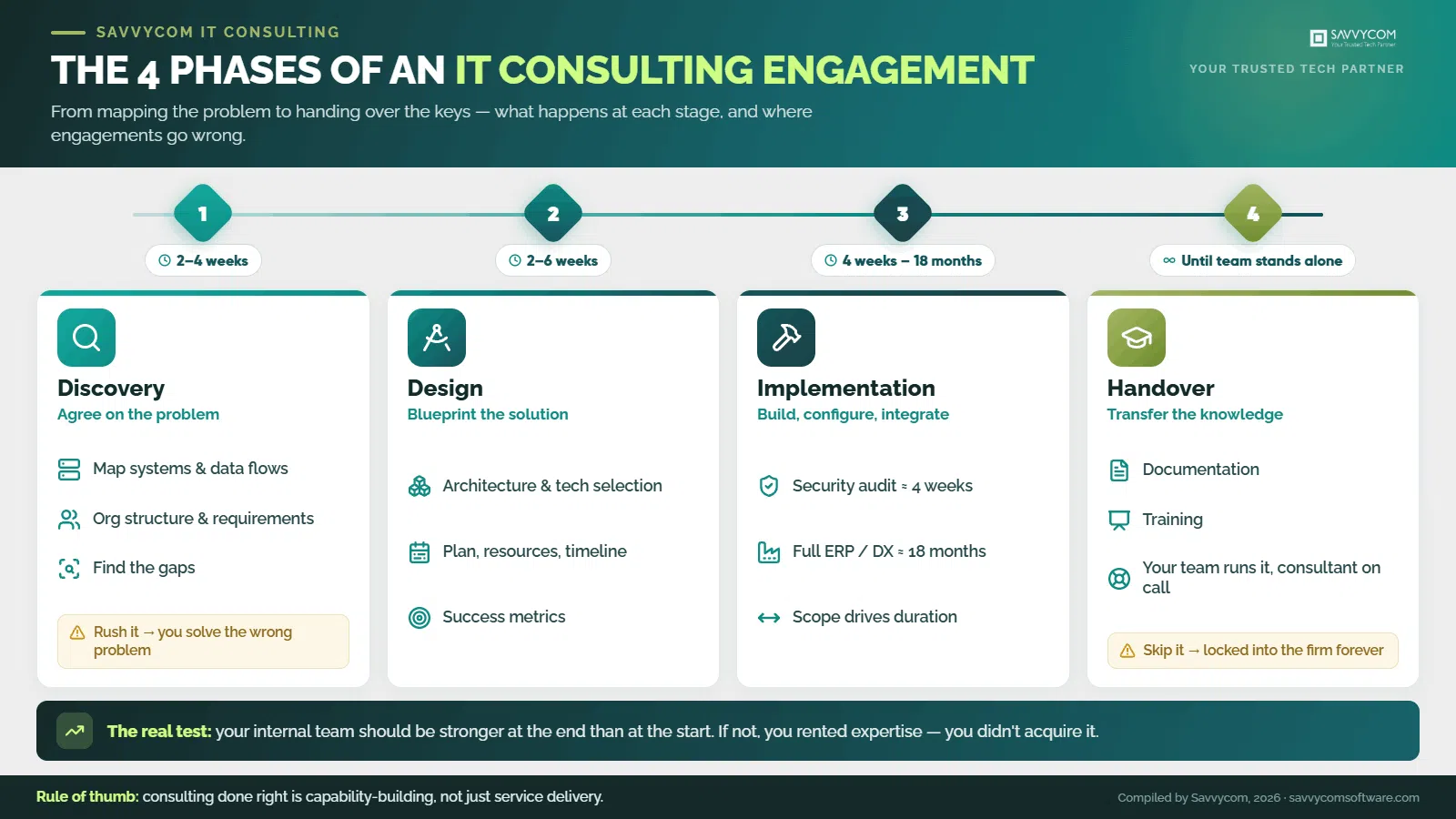
A typical IT consulting engagement moves through four phases: discovery, design, implementation, and handover, with the scope and duration of each phase varying by engagement type.
- Phase 1: Discovery (2 to 4 weeks). The consultant maps the current environment: existing systems, data flows, organizational structure, business requirements, and gaps. Good discovery produces a shared understanding of the problem that both the consultant and the client agree on. Engagements that skip or rush discovery spend the rest of the project solving the wrong problem.
- Phase 2: Design (2 to 6 weeks). The consultant produces a solution design: architecture, technology selection, implementation plan, resource requirements, timeline, and success metrics. For strategy engagements, this is often the final deliverable. For implementation engagements, it is the input to the next phase.
- Phase 3: Implementation (varies widely). The consultant or a delivery team builds, configures, or integrates the solution. Duration varies from 4 weeks for a targeted security audit with remediation to 18 months for a full ERP implementation or digital transformation program.
- Phase 4: Handover and knowledge transfer. The engagement is not complete when the system is built. Documentation, training, and a transition period where internal staff operate the solution with the consultant available are essential. Engagements that skip this phase leave the client dependent on re-engaging the same firm for every change.
Most high-performing organizations treat consulting as a capability-building exercise, not just a service delivery. The internal team should be stronger at the end of an engagement than at the start. If it is not, the organization has rented expertise rather than acquired it.
5. IT consulting service costs in 2026
IT consulting costs $100 to $250 per hour for general work and $300 to $500 or more for specialized fields in the US. Project engagements range from $10,000 for a targeted assessment to several million for enterprise transformation. Vietnam-based delivery runs $25 to $45 per hour, with senior AI and data roles around $55, cutting execution costs by well over half.
| Engagement type | Typical US cost range | Duration | Vietnam-based delivery |
|---|---|---|---|
| Technology assessment / audit | $10,000 – $50,000 | 2 – 6 weeks | $5,000 – $20,000 |
| Cloud migration | $100,000 – $600,000 | 3 – 9 months | $30,000 – $130,000 |
| Custom software development | $150,000 – $2,000,000+ | 3 – 18 months | $50,000 – $700,000+ |
| ERP implementation | $200,000 – $5,000,000+ | 6 – 24 months | $80,000 – $2,000,000+ |
| Digital transformation program | $500,000 – $10,000,000+ | 12 – 36 months | $200,000 – $4,000,000+ |
The offshore cost difference reflects labor rate arbitrage, not quality difference, for execution-heavy work. Strategy consulting and high-level advisory still command premium rates regardless of where the firm is headquartered, because the value is judgment and pattern recognition, not hours of coding or configuration. For the full rate breakdown by engagement model, vendor tier, and the buyer-side costs most estimates miss, see the guide on IT outsourcing costs.
6. What a good IT consulting engagement delivers
A well-run IT consulting engagement delivers three things: a solution that works, documentation that makes the solution maintainable, and a client team that understands what was built and why.
- Working solution: The system, architecture, or strategy does what it was designed to do, meets the success metrics defined in phase two, and integrates with the existing environment without creating new problems.
- Documentation: Architecture diagrams, configuration guides, runbooks, decision logs, and code documentation that enable the internal team to operate and modify the solution without calling the consultant for every change.
- Client capability: The internal team understands the solution well enough to maintain it, troubleshoot it, and extend it. This requires active knowledge transfer during implementation and a structured handover period.
What a poor engagement delivers: a system that works when the consultant is there, no documentation, a client team that cannot explain what was built, and a renewal proposal for ongoing support. Organizations that accept this outcome have converted a one-time consulting engagement into a permanent dependency.
7. IT consulting by industry vertical
IT consulting needs vary significantly by industry, with healthcare, financial services, manufacturing, and government each presenting different regulatory, integration, and transformation requirements.
- Healthcare: Compliance with HIPAA, GDPR, and regional frameworks governs every system. The primary consulting use cases are EHR integration, AI clinical tools, telemedicine platforms, and revenue cycle optimization. Consultants must understand clinical workflows, not just technology.
- Financial services (BFSI): Core banking modernization, regulatory compliance (Basel III, AML/KYC), fraud detection, and AI-driven personalization. The regulatory environment adds validation and audit cycles that extend timelines compared to other industries.
- Manufacturing and logistics: IoT integration, supply chain visibility, warehouse automation, and ERP optimization. Computer vision for quality control and track-and-trace is a fast-growing consulting use case in 2026.
- Government and public sector: Procurement complexity, long timelines, and strict data residency requirements characterize government consulting. The use cases are digital service delivery, legacy system modernization, and cybersecurity.
- Retail and e-commerce: Personalization, demand forecasting, omnichannel integration, and payments infrastructure. Fast-moving and competitive, retail consulting requires speed to deployment alongside technical depth.
8. When does an organization actually need IT consulting?
An organization needs IT consulting when the required expertise does not exist internally at sufficient depth, when the timeline does not permit hiring, when an independent assessment of the current environment is needed, or when a major project requires more capacity and specialized experience than the internal team can provide.
- You need a consultant when: You are planning a technology investment and do not have internal expertise to evaluate the options objectively. You have a defined project (cloud migration, ERP implementation, security audit) that exceeds internal capacity. You need an external perspective on a problem that internal teams are too close to. You have a compliance requirement that demands specialized knowledge.
- You do not need a consultant when: The work is within your team’s existing capability and bandwidth. The problem is operational rather than strategic (call your managed service provider). The project is indefinite and would be better served by a permanent hire.
- Red flags when evaluating a consulting proposal: Scope defined too vaguely to have a fixed price. No knowledge transfer plan. No defined success metrics. Proposals that expand scope immediately after kickoff. References that cannot be verified.
9. How to choose an IT consulting partner
The criteria that separate IT consulting partners who deliver from those who present well are: domain-specific references, a structured discovery process, transparent pricing, a knowledge transfer plan, and post-engagement support.
- Domain-specific references: Ask for references from engagements in your industry and at your scale. General technology expertise without relevant domain experience produces solutions that work technically but fail operationally because the consultant did not understand the clinical, financial, or regulatory context.
- Structured discovery: Partners who offer a paid, bounded discovery phase before committing to a full project scope understand that scope definition is itself a skill. Partners who quote a fixed price for a full engagement before understanding your environment are guessing.
- Transparent pricing: Time-and-materials, fixed-price, and milestone-based pricing each have appropriate use cases. The right partner explains which model fits your engagement and why, rather than defaulting to whichever is most favorable to them.
- Knowledge transfer plan: Ask how the consultant plans to leave your team stronger than they found it. Documentation requirements, shadowing arrangements, and training plans should be in the statement of work, not promised verbally.
- Post-engagement support: The engagement is not over when the system goes live. A 30 to 90 day support period after handover, during which the consulting team is available for questions, is standard in well-run engagements and essential for complex deployments.
10. Frequently asked questions
What does an IT consultant actually do?
An IT consultant assesses the current technology environment, identifies gaps between capability and business requirements, designs solutions, oversees or conducts implementation, and transfers knowledge to the internal team. Specific deliverables vary by engagement type: a strategy engagement produces a roadmap; a cloud engagement produces a migration architecture; a security engagement produces a risk assessment and remediation plan.
How much do IT consulting services cost?
IT consulting costs $100 to $250 per hour for general work and $300 to $500 or more for specialized fields like AI and cybersecurity in the US. Project engagements range from $10,000 for a targeted assessment to several million for enterprise transformation. Vietnam-based delivery runs $25 to $45 per hour for execution-heavy work, with senior AI and data roles around $55.
What are the types of IT consulting services?
The seven main types are: strategy and digital transformation consulting, cloud consulting, cybersecurity consulting, AI and data analytics consulting, ERP and enterprise software consulting, software development and integration consulting, and IT infrastructure and architecture consulting. Most large engagements involve several of these simultaneously.
How do I choose an IT consulting firm?
Evaluate based on domain-specific references (not just general technology experience), a structured discovery process before fixed pricing, transparent engagement models, a defined knowledge transfer plan, and post-launch support. Red flags include vague scope, no references, and proposals that expand immediately after kickoff.
Looking for a Trusted Tech Partner That Delivers Your Measurable Values?
Savvycom provides IT consulting and technology delivery across digital transformation, cloud, AI, and custom software for enterprises in APAC, Japan, South Korea, Australia, and the US. Every engagement starts with a bounded discovery phase that maps scope before any fixed price.
Explore our consulting engagements: Digital Transformation Solutions