Savvycom Logistics Case Study: AI Yard Management in 9 Months
A global logistics provider running large container yards needed to know where every container was without relying on manual records. Savvycom built an AI yard management system with cameras and computer vision over nine months. It reached 95% accuracy in container placement and movement tracking, cut search and retrieval time by 60%, and raised productivity by 35% to 40%.
The client’s yards handle 400 to 500 container movements per day, with over 500 containers stored at once at each site. This is an account of the problems the yard had, how the system works, and what changed. The full project summary is on our portfolio: AI-Powered Yard Management for Global Logistics Operations.
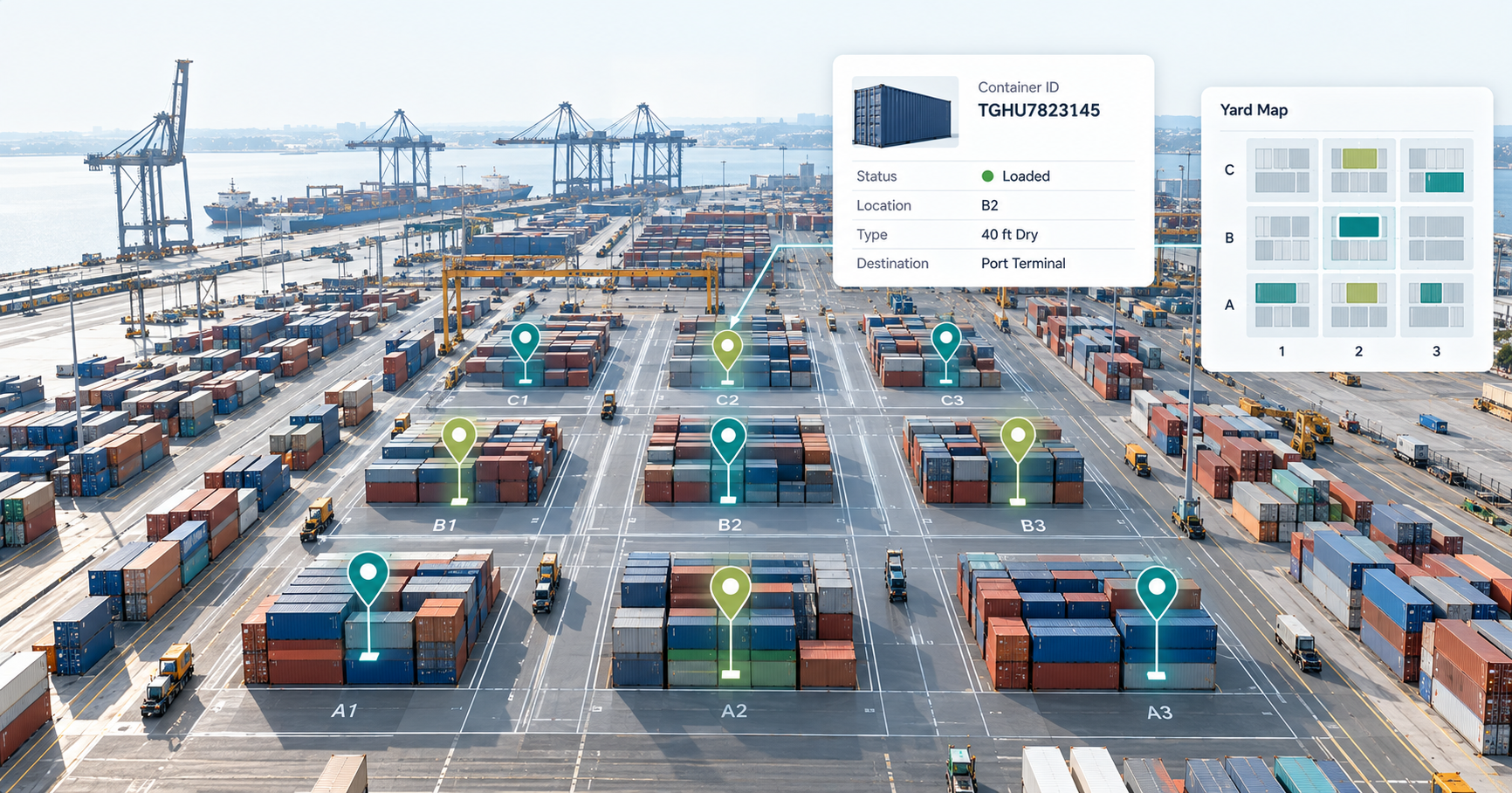
The client’s yards handle 400 to 500 container movements per day, with over 500 containers stored at once. Manual records could not keep up.
| Project at a glance | Detail |
| Client | A global logistics provider (not named) |
| Scale | 400 to 500 container movements per day; over 500 containers stored at once at each site |
| Service | AI platform development |
| Timeline | March 2024 to December 2024 (9 months) |
| Region | Vietnam and global sites |
| Results | 95% tracking accuracy; 60% less search and retrieval time; 35% to 40% higher operational productivity |
1. What Was Going Wrong in the Yard?
The yard had four connected problems: containers were hard to locate, manual records were inconsistent, movements inside the yard went unrecorded, and the daily volume created bottlenecks. The first three were visibility problems, and the fourth made each of them more expensive, because every misplaced container slowed the next move.
- Limited real-time visibility. Staff found it difficult to locate containers, which delayed yard operations.
- No specialized yard management system. Reliance on manual records led to inconsistencies and operational errors.
- Untracked container movements. Internal moves were not recorded, which caused misplacement and lost traceability.
- High operational load. Large daily container volumes created bottlenecks and long handling cycles.
A record that says a container is in one place when it is in another costs time every time someone looks for it. At 400 to 500 movements a day, small gaps in the record add up quickly.
2. How Does the AI Yard Management System Work?
The system combines AI cameras, computer vision, and a digital map of the yard. Cameras identify containers and vehicles at entry and exit, object tracking follows containers across the yard, and a live 2D map shows each container’s position and status. Staff search and verify placement from dashboards instead of paper records.
Camera Recognition at Entry and Exit
AI cameras at the entry and exit points automatically recognize container IDs, trailer IDs, and truck license plates. This replaces manual data entry at the gate, which is where many yard records start. A record that begins correctly is far easier to keep correct as the container moves through the yard.
Real-Time Tracking and the 2D Yard Map
Object detection and tracking monitor container movements across the yard, and a 2D digital map shows the exact position and status of each container in real time. Internal moves, which were previously unrecorded, now appear on the map as they happen, which restores the traceability the client had lost.
Digital Move Orders Validated by AI
Move orders are digital, and the system validates container placement against what the cameras detect. If a container is not where the order says it should be, the mismatch is visible at the time of the move, not days later when someone searches for it. This check is what supports the placement accuracy figure.
Operational Dashboards
Operational dashboards let staff search for any container instantly, monitor dwell time, and see operational insights for the yard. Search is the task that used to consume the most time, so a fast, reliable search is where yard teams notice the change first, and dwell time shows where containers wait longest.
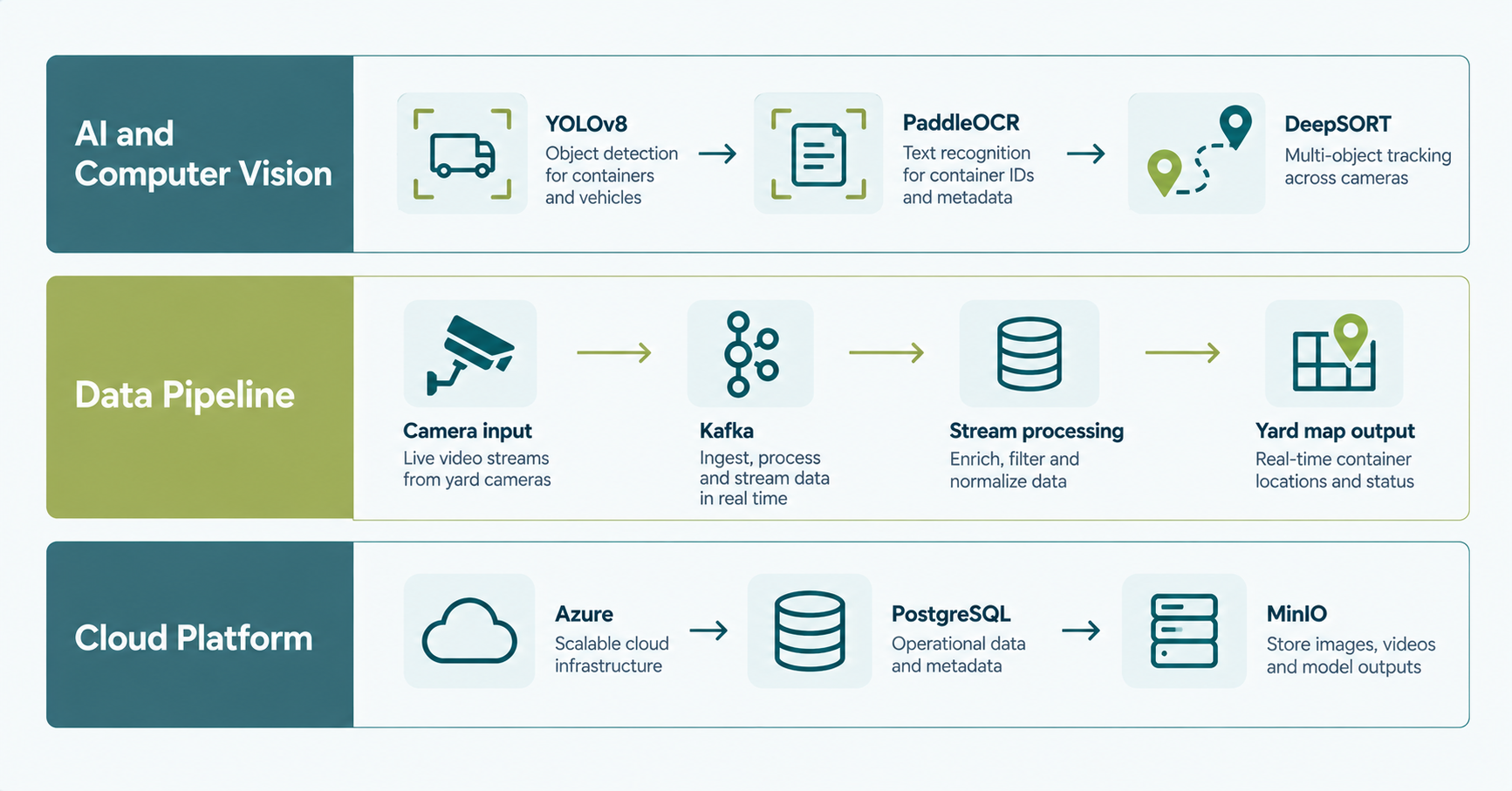
The system layers computer vision (YOLOv8, PaddleOCR, DeepSORT), a Kafka streaming pipeline, and Microsoft Azure cloud services to update the yard map in real time.
3. What Technology Powers the System?
The stack combines computer vision models, streaming data, and cloud services. YOLOv8, PaddleOCR, and DeepSORT handle detection, text reading, and tracking; Kafka moves events between services, PostgreSQL and MinIO store data, and the system runs on Microsoft Azure. Python and .NET provide the backend, with REST APIs for integration.
- AI and computer vision. YOLOv8, PaddleOCR, DeepSORT
- Backend and services. Python, .NET
- Data and storage. PostgreSQL, MinIO
- Streaming and monitoring. Kafka, Prometheus
- Integration. RESTful APIs
- Cloud platform. Microsoft Azure
In general terms, YOLOv8 detects objects such as containers and vehicles in camera frames, PaddleOCR reads text such as container IDs and plate numbers, and DeepSORT keeps the identity of a moving object consistent from frame to frame. Kafka carries the stream of detection events so the map and dashboards update in real time.
4. What Did the Project Deliver?
The system delivered measurable gains in accuracy, speed, and productivity. It reached 95% accuracy in container placement and movement tracking, cut container search and retrieval time by 60%, and increased overall operational productivity by 35% to 40%. The client also saw fewer manual errors and fewer misplaced containers.
- 95% accuracy in container placement and movement tracking.
- 60% reduction in container search and retrieval time.
- 35% to 40% increase in overall operational productivity.
- Fewer manual errors and less misplacement. The record does not give a figure for this result.
One caveat on the numbers: they describe this client’s yards, volumes, and starting point, measured against a manual process. A yard with different volumes, layouts, or camera coverage should treat them as a reference point, not a forecast.
5. What Does This Project Tell You About Yard Visibility?
Yard visibility depends on recording every move, not only arrivals and departures. In this project the gains came from three design choices: capturing identity automatically at the gate, tracking movements inside the yard, and validating placement when a move happens. Each removes a place where a manual record could drift from reality.
The second lesson is about search. Locating a container is the daily task that consumes the most time in a yard, and a 60% reduction in search and retrieval time comes from a live map and instant search, not from faster staff. The third is scope: the build took nine months because it combined computer vision, streaming data, and a map interface that staff had to trust.