What Is a Quality Control System? How It Works in 2026
Every manufacturer has a quality control system, whether they designed one or not. The undesigned version looks like this: defects found by customers instead of inspectors, rework absorbed silently into costs, and nobody able to say which production step the problem came from. A designed quality control system is the opposite: defined standards, inspection at chosen points, a feedback loop that fixes causes rather than symptoms, and records that let you prove all of it. This guide explains how the designed version works and what it takes to run one.
1. What is a quality control system?
The QA and QC distinction matters in practice. Quality assurance asks “how do we build the process so defects are unlikely?”; quality control asks “did this specific batch, part, or release meet the standard?”. A mature operation runs both, but they need different tools, different checkpoints, and often different owners. In manufacturing, a QC system spans incoming material inspection, in-process checks, and final product testing. In software and services, the same logic applies to code review gates, automated test suites, and service delivery audits.
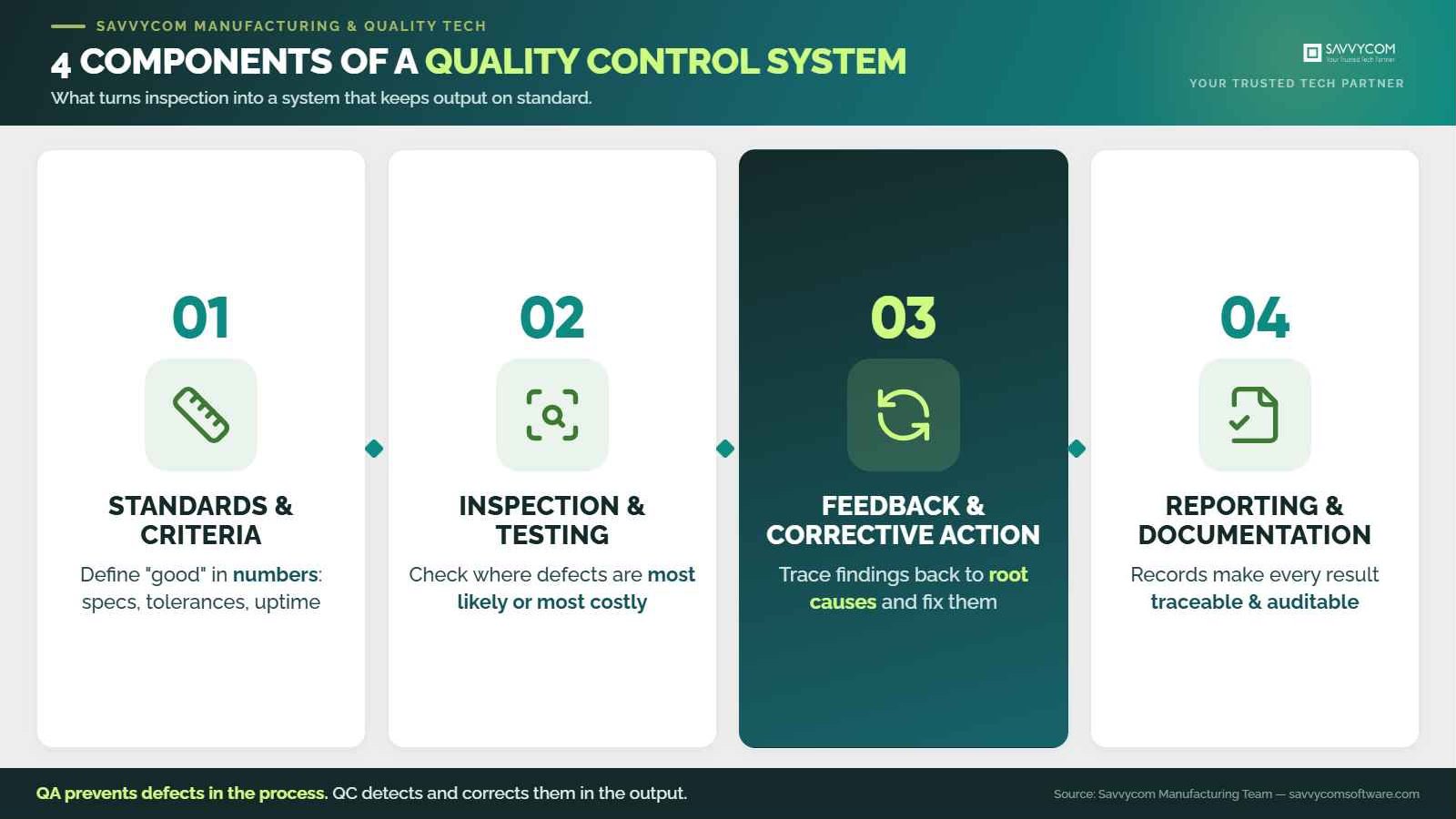
2. What are the components of a quality control system?
- Standards and acceptance criteria. Everything starts with a measurable definition of quality. In pharmaceuticals that means meeting FDA specifications; for a SaaS platform it might mean 99.99 percent uptime; on a production line it is tolerance ranges per component. Frameworks such as ISO 9001 give the structure, but the criteria themselves must come from your product and your customers’ expectations. Vague standards produce arguments at the inspection station; numeric ones produce decisions.
- Inspection and testing protocols. Checks are placed deliberately across the lifecycle: incoming materials (does the steel meet the durability spec?), in-process quality control at stages where errors compound, and final checks before release. The placement question matters more than the volume of checks: inspecting everything everywhere is unaffordable, so effective systems concentrate on the points where a defect is most expensive to let through.
- Feedback and corrective action. Finding a defect is half the job. The system earns its keep when findings flow back to root causes: a supplier lot rejected, a machine recalibrated, a process step redesigned. Without this loop, inspection just sorts bad output from good output forever, at your expense.
- Reporting and documentation. Test reports, inspection logs, and corrective action records make quality traceable, which is what audits, customer claims, and product recalls all depend on. In regulated industries such as pharmaceuticals and food, documentation is not overhead; it is the compliance evidence itself, as frameworks like HACCP make explicit.
3. Why is a quality control system important?
- Cost of poor quality. A defect caught at incoming inspection costs the price of a returned lot. The same defect caught after assembly costs rework; caught by the customer, it costs returns, support time, and trust. The economics of QC are the economics of catching problems at the cheapest possible point.
- Customer retention. B2B buyers in particular rarely announce quality dissatisfaction; they quietly qualify a second supplier. Consistency, not occasional excellence, is what keeps the reorder coming.
- Regulatory compliance. Healthcare, food production, automotive, and aerospace operate under frameworks where the quality system is inspected, not just the product. A documented QC system is the ticket to operate.
4. How does a quality control system work in manufacturing?
The software stack is where QC has changed most in the last decade. Statistical process control shifts the game from detecting defects to detecting drift: control charts flag a process moving toward its tolerance limits while output is still good, which is the cheapest possible moment to intervene. Computer vision systems inspect every unit at line speed instead of sampling, catching surface and assembly defects human inspectors miss under fatigue. And integration with the manufacturing execution system is what makes traceability real: when quality results live in the same system as production events, “which lots are affected?” becomes a query instead of a week of archaeology. The results then need to reach the people running the line, which is where a shop floor production dashboard earns its place, showing quality metrics next to output metrics in real time. This overview of manufacturing operations software maps how a QMS connects to MES and ERP.
5. What are the best practices for running a quality control system?
- Define clear, measurable objectives. Decide whether the system is targeting defect rates, compliance, customer claims, or all three, and attach numbers. A QC system without KPIs becomes a paperwork ritual within a year.
- Prioritize the critical stages. Map where defects actually occur and where they cost most, then concentrate inspection there. In software delivery the equivalent is code review and automated testing at the merge gate rather than manual testing at the end.
- Automate where software wins. Vision inspection, SPC monitoring, and automated test suites outperform manual checks on consistency and fatigue. This is where a development partner earns its place: Savvycom builds these systems, from AI-based visual inspection to ERP-integrated quality reporting, for manufacturers that have outgrown manual QC.
- Train the workforce. The system is operated by people. Inspectors need to know the criteria, operators need to know what triggers a stop, and everyone needs to know where findings go. Skipping this step is the most common reason well-designed systems underperform.
- Monitor the system, not just the product. Review defect trends, false-reject rates, and audit findings quarterly. A QC system that never changes is measuring yesterday’s failure modes.
Frequently asked questions
What role does technology play in modern quality control?
Technology such as AI, IoT, and blockchain enhances accuracy, enables real-time monitoring, and improves traceability, making quality control more efficient and reliable.
Can small businesses implement quality control systems effectively?
Yes, with scalable tools and clear objectives, small businesses can adopt affordable quality control systems that improve product quality and operational efficiency.
Related reading
- Statistical Process Control in Manufacturing
- MES in Manufacturing: What It Is and How It Works
- Best ERP Systems for Manufacturing
Looking for a Trusted Tech Partner That Delivers Your Measurable Values?
Savvycom builds quality and manufacturing software across APAC, Japan, South Korea, Australia, and the US, from AI-based visual inspection and SPC monitoring through MES and ERP integration, so quality data drives decisions instead of filling binders.
Explore the engagement model: Manufacturing Solutions