What Is an SRM System? A Guide for Procurement Teams
Most procurement teams manage suppliers the way they always have: contact details in one spreadsheet, contracts in a shared drive, performance complaints in someone’s inbox. That works until it does not, usually the day a key supplier fails and nobody saw the warning signs scattered across those three places. An SRM system exists to put supplier information, performance, risk, and contracts in one structure, so the relationship is managed on data instead of memory. This guide explains what an SRM system is, what the software actually does, and how to decide whether to buy one or build one.
1. What is an SRM system?
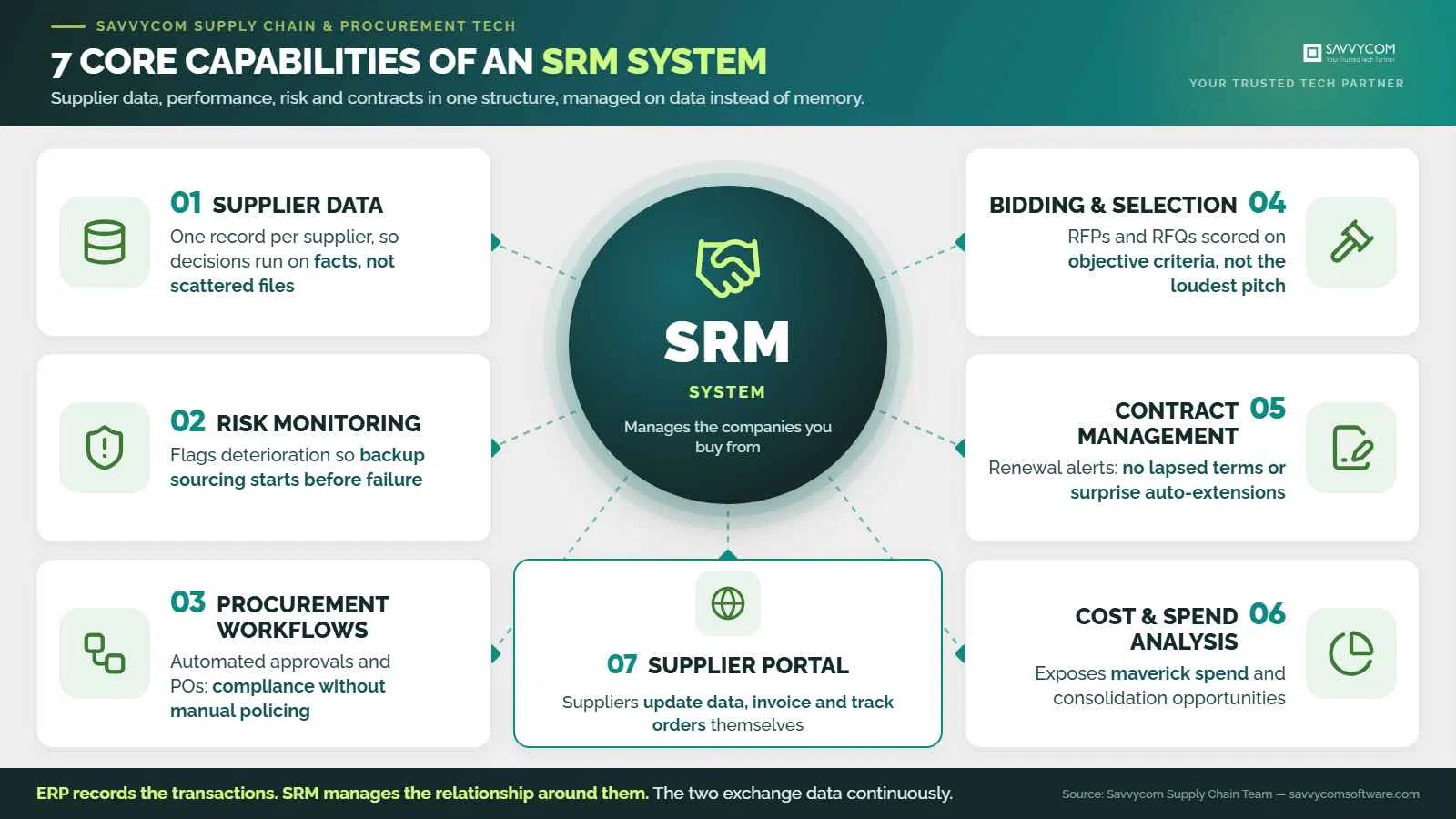
One clarification worth making, because the acronym is crowded: SRM here means supplier relationship management, the procurement discipline. The same three letters also name a type of electric motor and a storage protocol, which is why searching the term brings up unrelated results. In a business context, SRM is the supplier-side mirror of CRM: where a CRM manages the companies that buy from you, an SRM manages the companies you buy from.
The discipline matters because supplier relationships fail quietly. A well-run SRM practice catches financial deterioration before a supplier misses deliveries, keeps contract renewals from lapsing into unfavorable terms, and gives strategic suppliers a reason to bring you their innovations first. The software makes that practice repeatable at the scale of hundreds of suppliers, where spreadsheets stop working.
2. Why does managing supplier relationships matter?
- Risk and continuity. Disruptions from geopolitical events, insolvency, or capacity problems rarely arrive without warning signs. Structured monitoring turns those signs into time to diversify sourcing or activate a backup supplier.
- Cost efficiency. Savings come less from squeezing unit prices than from eliminating friction: consolidated purchasing, automated invoicing, and fewer emergency orders at premium prices.
- Collaboration and innovation. Suppliers often see new materials, components, and methods before their customers do. The suppliers you treat as partners bring those to you first; the ones you treat as vendors bring them to your competitors.
- Strategic alignment. When supplier objectives and service levels are explicit and reviewed, the supply base evolves with the business instead of lagging it.
3. What are the four types of external purchases?
- Direct goods. Raw materials, components, and finished products used in production: the steel, batteries, and chips an automotive manufacturer buys. These suppliers affect your product directly, so they get the deepest relationship investment.
- Direct services. Services contributing to production or product development: outsourced engineering, specialized manufacturing, process consulting.
- Indirect goods. Items the business runs on but the product does not contain: IT equipment, office supplies, maintenance tools. Cost control matters more than partnership here.
- Indirect services. Supporting functions such as HR services, legal counsel, and marketing. Managed for value and compliance rather than co-development.
The categorization is what keeps SRM affordable: strategic partnership effort goes to the direct suppliers who can stop your production, while indirect categories get streamlined, largely automated handling.
4. What does SRM software actually do?
|
Capability |
What it does |
Why it matters |
|
Supplier data management |
One record per supplier: profiles, certifications, performance history, financials |
Decisions and negotiations run on facts instead of scattered files |
|
Risk monitoring |
Tracks financial health, delays, compliance, and external signals; flags deterioration |
Backup sourcing starts before the failure, not after |
|
Procurement workflows |
Automates requisition, approvals, and purchase order tracking |
Policy compliance without manual policing; fewer errors and delays |
|
Bidding and selection |
Runs RFPs and RFQs, scores bids on predefined criteria |
Selection on value and objective data, not the loudest sales pitch |
|
Contract management |
Stores contracts, tracks obligations, alerts on renewals and milestones |
No lapsed renewals, missed deliverables, or surprise auto-extensions |
|
Cost and spend analysis |
Analyzes spend patterns, maverick purchases, and total cost of ownership |
Consolidation and negotiation opportunities become visible |
|
Supplier portal |
Suppliers update data, submit invoices, and track orders themselves |
Less admin load on procurement, more transparency for both sides |

An SRM system in daily procurement work
5. How does an SRM system fit your existing stack?
Integration is where SRM projects succeed or fail. Spend data has to flow in from the ERP for the analytics to mean anything, and approved supplier records have to flow back so purchasing happens against clean data. In manufacturing and logistics environments, the same supplier records feed the wider supply chain management system, where supplier lead times and reliability drive planning. And because ERP landscapes vary wildly, from modern cloud suites to systems a decade past their last upgrade, the integration design deserves more scrutiny than the feature checklist when evaluating any SRM platform; our guide to ERP systems for manufacturing covers that side of the stack.
6. What are the best practices for supplier relationship management?
- Value mapping. Score suppliers on quality, innovation, and reliability, not just price, then direct partnership effort at the top of the list. Treating all suppliers equally means underinvesting in the critical ones.
- Spend optimization. Use the data to find maverick spending and consolidation opportunities. The discount you never negotiated because purchases were scattered across three departments is the most common finding.
- Continuous risk monitoring. Annual supplier reviews miss everything that happens in between. Continuous indicators with thresholds and owners are what make risk management real.
- Top-down commitment. When leadership treats supplier relationships as strategic, cross-functional cooperation follows. When SRM is delegated to a procurement tool nobody sponsors, it becomes shelfware within a year.
7. Should you buy or build an SRM system?
The honest default is buy: mature SRM platforms cover the common cases well, and most organizations’ supplier workflows are less unique than they believe. The build case appears at the edges, and in our delivery work at Savvycom it is almost always the integration edge: a manufacturer whose ERP predates modern APIs, a distributor whose supplier ecosystem runs on regional formats no global vendor supports, or a company whose supplier scoring logic genuinely is proprietary advantage. In those cases a custom SRM layer built around the existing landscape beats forcing the landscape to fit a platform.
Frequently asked questions
What does an SRM system do?
An SRM system centralizes everything about your suppliers: master data, contracts, performance scores, risk signals, and sourcing events. Instead of supplier information scattered across spreadsheets and inboxes, procurement teams get one place to evaluate, negotiate with, and monitor every vendor relationship.
Is an SRM system the same as a CRM?
No, they mirror each other. A CRM manages relationships with the people who buy from you; an SRM manages relationships with the companies you buy from. The workflows differ accordingly: CRM revolves around pipeline and sales stages, SRM around sourcing, contracts, supplier performance, and risk.
What is the difference between SRM and ERP?
An ERP records transactions with suppliers: purchase orders, invoices, payments. An SRM manages the relationship around those transactions: supplier selection, scoring, risk, and collaboration. Most SRM systems integrate with the ERP rather than replace it, pulling spend data in and pushing approved suppliers back.
Who needs an SRM system?
Any organization managing more than a few dozen active suppliers, especially in manufacturing, retail, and logistics where supplier performance directly affects delivery. Below that scale, a disciplined spreadsheet usually suffices; the system pays off when supplier count, risk exposure, or compliance requirements outgrow manual tracking.
Should you buy or build SRM software?
Buy when standard procurement workflows fit your process; platforms cover the common cases well. Build custom when supplier workflows are your competitive edge, when integration with legacy ERP systems is complex, or when regional requirements (compliance, language, supplier ecosystems) defeat off-the-shelf configuration.
Related reading
- Supply Chain Management System: Features, Architecture, and How It Works
- Best ERP Systems for Manufacturing
- Supply Chain Visualization: Why It Matters
Looking for a Trusted Tech Partner That Delivers Your Measurable Values?
Savvycom builds procurement and supply chain software across APAC, Japan, South Korea, Australia, and the US, from custom SRM layers and supplier portals through ERP integration, so supplier decisions run on data your whole organization can see.
Explore the engagement model: ERP Solutions