Supply Chain Management System: Features, Architecture, and How It Works (2026)
A supply chain management system (SCMS) is software that plans, executes, monitors, and optimizes the flow of goods, information, and money from raw material sourcing through production and delivery to the end customer. It connects the organizations, processes, and data that would otherwise operate in silos across procurement, manufacturing, warehousing, and distribution.
Supply chain management software has been a top enterprise technology investment for years, and in 2026 it is undergoing the most significant architectural shift since the move to cloud. Gartner identified agentic AI, physical AI, and polyfunctional robots among the top supply chain technology trends for 2026, describing a shift toward intelligent, self-directed, and accountable systems that operate across digital and physical environments (Gartner, June 2026). This means modern SCMS is no longer a system of record for supply chain activity. It is becoming a system of action.
This guide covers what a supply chain management system is, how it is structured, what its core features are, and how the four types and five stages of SCM map to the software that supports them. For the broader context of logistics software, see the guide on logistics software development.
1. What is a supply chain management system?
savvycom-scms-explained
A supply chain management system is software that integrates and automates the planning, execution, and monitoring of supply chain activities, connecting procurement, production, inventory, warehousing, transportation, and demand planning into a unified operational view.
The defining characteristic is integration. Before SCMS, each function in the supply chain ran its own system: procurement had one database, the warehouse had another, transportation planned separately, and the only way to get an end-to-end view was to pull reports from each system and reconcile them manually. A supply chain management system replaces that fragmented picture with shared data and connected workflows.
The distinction between SCM software and adjacent systems matters. An ERP system manages core business functions (finance, HR, procurement) and typically includes basic inventory and order management. A supply chain management system goes deeper into the operational layer: demand forecasting, network design, transportation optimization, warehouse execution, and supplier collaboration. Most large organizations run both, with the SCMS feeding operational data back into the ERP.
SCMS vs ERP vs standalone logistics tools
| System | Primary function | Supply chain depth | Relationship |
|---|---|---|---|
| ERP (SAP, Oracle) | Core business operations: finance, HR, procurement | Basic inventory and order management | SCMS integrates with ERP for financial and procurement data |
| SCMS (standalone) | End-to-end supply chain planning and execution | Deep: demand, supply, transport, warehouse, collaboration | Can overlay or replace ERP logistics modules |
| TMS (standalone) | Transportation planning and execution | Deep transport only | Component of SCMS or standalone module |
| WMS (standalone) | Warehouse operations | Deep warehouse only | Component of SCMS or standalone module |
2. The 4 types of supply chain management
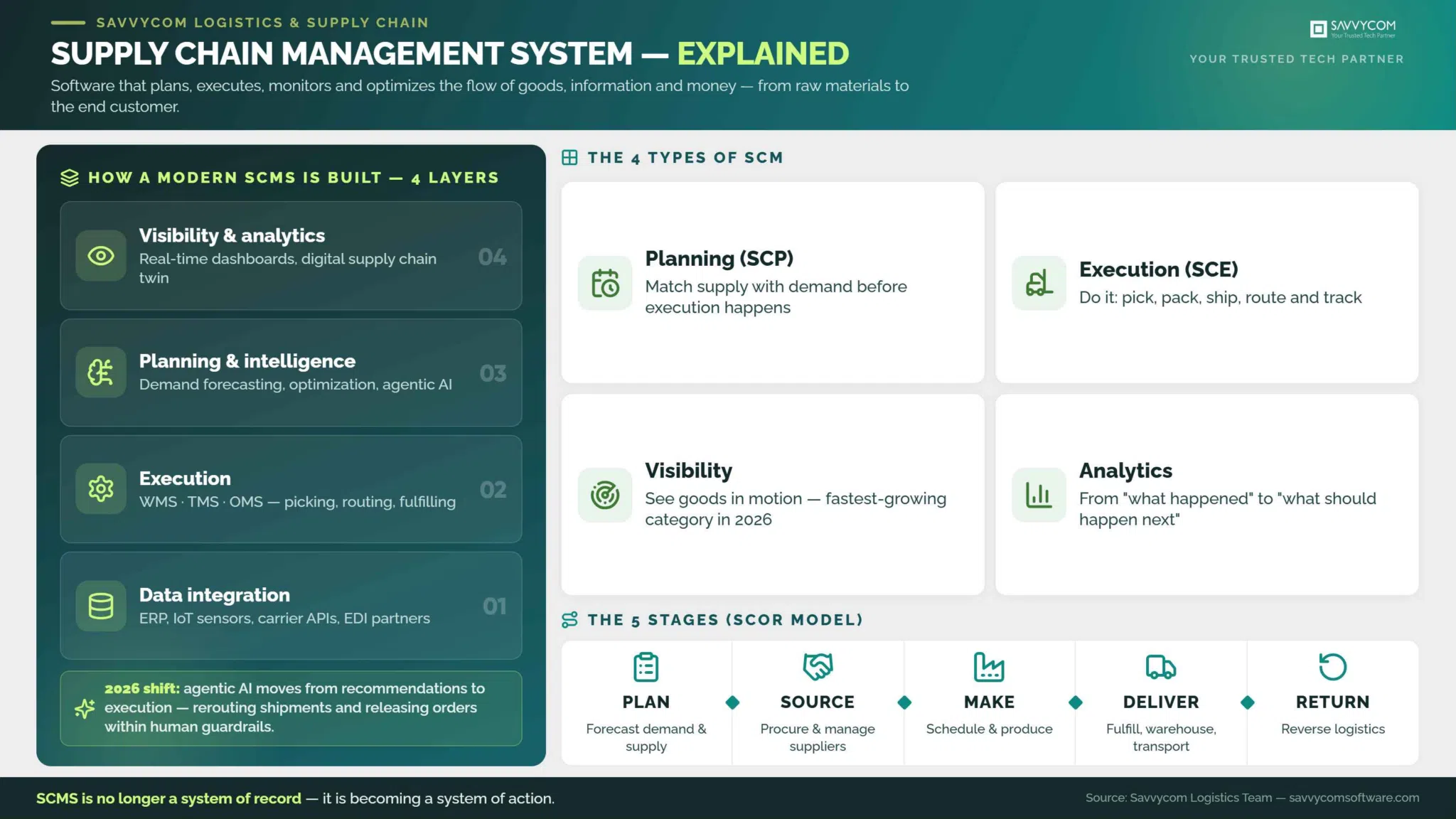
The four types of supply chain management are supply chain planning (SCP), supply chain execution (SCE), supply chain visibility, and supply chain analytics. Each type has dedicated software, and modern platforms increasingly combine all four.
Supply Chain Planning (SCP)
SCP systems handle demand forecasting, supply planning, inventory optimization, production scheduling, and sales and operations planning (S&OP). The goal is to match supply with demand before execution happens. Gartner tracks this category in its Magic Quadrant for Supply Chain Planning, where recent editions have placed Blue Yonder, o9 Solutions, and SAP among the Leaders. The defining 2026 shift: demand forecasting, anomaly detection, and dynamic safety-stock calculation have moved from premium features to standard capabilities, with competition shifting to which vendors can operationalize agentic AI within the planning workflow.
Supply Chain Execution (SCE)
SCE systems execute the plans that SCP produces. They include warehouse management systems (WMS), transportation management systems (TMS), order management systems (OMS), and manufacturing execution systems (MES). Where SCP is about deciding what to do, SCE is about doing it: picking, packing, shipping, routing, and tracking. The scale of the execution layer is what surprises most first-time buyers. In one Savvycom yard management build for a global logistics operator processing 400 to 500 container movements per day, the execution layer combined YOLOv8 computer vision with Kafka real-time streaming so that gate events, crane assignments, and yard positions updated as they happened rather than in batches; the full deployment pattern is covered in Savvycom’s research whitepaper on Operational AI in Logistics.
Supply Chain Visibility
Visibility platforms aggregate data across planning and execution systems, carrier tracking, IoT sensors, and partner networks to provide a real-time, end-to-end view of goods in motion. This is the fastest-growing SCM category in 2026, driven by the need to detect and respond to disruptions before they become costly. Visibility is distinct from execution: it does not direct warehouse operations but provides the observational layer that makes intelligent decisions possible across all other SCM types.
Supply Chain Analytics
Analytics systems turn supply chain data into operational and strategic insights: network design optimization, supplier performance scoring, total cost modeling, and sustainability measurement. The 2026 shift is from retrospective analytics (what happened) to prescriptive analytics (what should happen next). Gartner identifies AI-driven analytics and digital supply chain twins (real-time digital replicas of the physical supply chain) as among the top trends shaping this category.
3. The 5 stages of supply chain management
The five stages of supply chain management are plan, source, make, deliver, and return. These correspond to the SCOR (Supply Chain Operations Reference) model framework maintained by ASCM (Association for Supply Chain Management), and each stage has dedicated software capabilities.
- Plan: Demand forecasting, supply planning, inventory optimization, and S&OP. The planning stage determines what to produce or procure, when, in what quantity, and from where. SCMS tools here include advanced planning and scheduling (APS) software and demand planning modules.
- Source: Supplier selection, procurement, purchase order management, supplier performance management, and contract management. The sourcing stage covers the upstream supply chain. A dedicated supplier relationship management system, along with supplier collaboration portals and risk management tools, supports this stage.
- Make: Production scheduling, manufacturing execution, quality management, and capacity planning. The make stage translates demand plans into production orders. Manufacturing execution systems (MES) and production planning tools support this stage.
- Deliver: Order management, warehouse management, transportation management, last-mile delivery, and customer order fulfillment. This is the most visible part of the supply chain from the customer perspective and the most operationally complex in terms of real-time data requirements.
- Return: Reverse logistics, returns authorization, refurbishment, and disposal. Returns management has grown sharply in importance with e-commerce; efficient returns processing directly affects customer experience and unit economics.
4. Is SAP a supply chain management system?
SAP is one of the leading supply chain management platforms, but it is primarily an ERP system that includes comprehensive supply chain modules: SAP IBP for planning, SAP Extended Warehouse Management for warehouse operations, and SAP Transportation Management.
For organizations already running SAP, these modules offer deep integration with the broader ERP. For organizations evaluating best-of-breed SCM, standalone platforms like Blue Yonder, o9, and Manhattan Associates offer deeper planning and execution capability in their respective domains.
The more useful question than “is SAP an SCMS?” is “which SCM approach fits this organization?” The main trade-off is integration depth versus functional depth. An SAP-based SCMS integrates natively with SAP finance, procurement, and HR data. A best-of-breed SCMS typically requires more integration work but offers more advanced planning algorithms, richer visibility features, or deeper execution capability in areas like transportation or last-mile delivery.
5. Supply chain management system architecture
A modern SCMS follows a layered architecture with four tiers: data integration (ingesting from ERP, IoT, and partner systems); planning and intelligence (demand forecasting, optimization models); execution (WMS, TMS, and OMS); and visibility and analytics (real-time dashboards, digital twin, and performance reporting).
Data integration layer
The foundation of any SCMS is the ability to ingest data from disparate sources: ERP systems (SAP, Oracle), IoT sensors and RFID devices, carrier APIs, EDI partners (EDIFACT, ANSI X12), e-commerce platforms, and third-party logistics providers. Real-time streaming infrastructure (Apache Kafka) handles high-velocity event data from sensors, devices, and operational systems. The quality and speed of data at this layer determines the quality of every decision made above it.
Planning and intelligence layer
The planning layer runs demand forecasting models, supply optimization algorithms, and increasingly agentic AI that can detect disruptions and propose or execute corrective actions. Gartner’s 2026 trend analysis specifically identifies agentic AI as moving beyond recommendations to execution, with software agents capable of rerouting shipments, re-sequencing warehouse tasks, and releasing production orders within human-defined guardrails. This is the foundational architecture of the autonomous supply chain.
Execution layer
The execution layer handles real-time operational decisions: warehouse task direction, transportation routing, order fulfillment routing, and production sequencing. It communicates bidirectionally with physical operations (conveyor systems, mobile devices, and robotics) and feeds status events back into the visibility layer. Modern cloud-native execution systems use microservices architecture, enabling individual modules (WMS, TMS, OMS) to be updated or scaled independently without affecting the whole platform.
Visibility and analytics layer
The visibility layer aggregates operational events into a real-time picture of the supply chain: where shipments are, what inventory levels are, where exceptions have occurred, and what the projected impact of those exceptions is. Digital supply chain twins, a Gartner-identified 2026 trend, create a real-time digital replica of the physical supply chain that enables simulation and scenario planning against live data, rather than historical reports.
Integration standards and interoperability
A supply chain management system does not operate alone. It must integrate with ERP, finance, procurement, manufacturing, and external partners. The technical standards that enable this include EDI (EDIFACT internationally, ANSI X12 in North America) and GS1 standards for product identification and event tracking (EPCIS). Cloud-native platforms expose REST APIs; legacy integrations often require middleware to bridge EDI and modern API formats.
6. Frequently asked questions
What are the 4 types of SCM?
The four types of supply chain management are: supply chain planning (demand forecasting, inventory optimization, S&OP), supply chain execution (warehouse management, transportation, order fulfillment), supply chain visibility (real-time tracking, disruption detection, end-to-end monitoring), and supply chain analytics (network design, performance measurement, digital supply chain twins). Modern platforms increasingly combine all four.
What are the 5 stages of SCM?
The five stages of supply chain management are plan (demand forecasting and supply planning), source (procurement and supplier management), make (production scheduling and manufacturing execution), deliver (order management, warehousing, and transportation), and return (reverse logistics and returns management). These correspond to the SCOR model framework maintained by ASCM.
Is SAP a SCM system?
SAP is primarily an ERP system that includes comprehensive supply chain modules, including SAP IBP for planning, SAP Extended Warehouse Management, and SAP Transportation Management. For organizations already running SAP ERP, these modules offer deep native integration. For best-of-breed SCM capability, standalone platforms like Blue Yonder, o9 Solutions, and Manhattan Associates offer deeper planning and execution functionality in their respective domains.
What is the difference between SCM software and ERP?
ERP systems manage core business functions (finance, HR, procurement) and include basic inventory and order management. Supply chain management software goes deeper into the operational supply chain layer: advanced demand forecasting, network optimization, real-time visibility, transportation management, and warehouse execution. Most large organizations run both, with the SCMS feeding operational data into the ERP for financial recording.
Going deeper: for how these systems are actually scoped, built, and integrated, including the six core system types, the development process, and realistic cost ranges, see the complete guide on logistics software development. For how operational AI is deployed inside supply chain execution, from yard management to real-time visibility, see Savvycom’s research whitepaper on Operational AI in Logistics.