What Should Enterprise Leaders Ask Before Partnering in Vietnam? Insights from the Australian Industry Group Webinar
For enterprises weighing a technology partner in Vietnam, the due diligence that matters has moved beyond technical skill to structure, culture and partner fit.
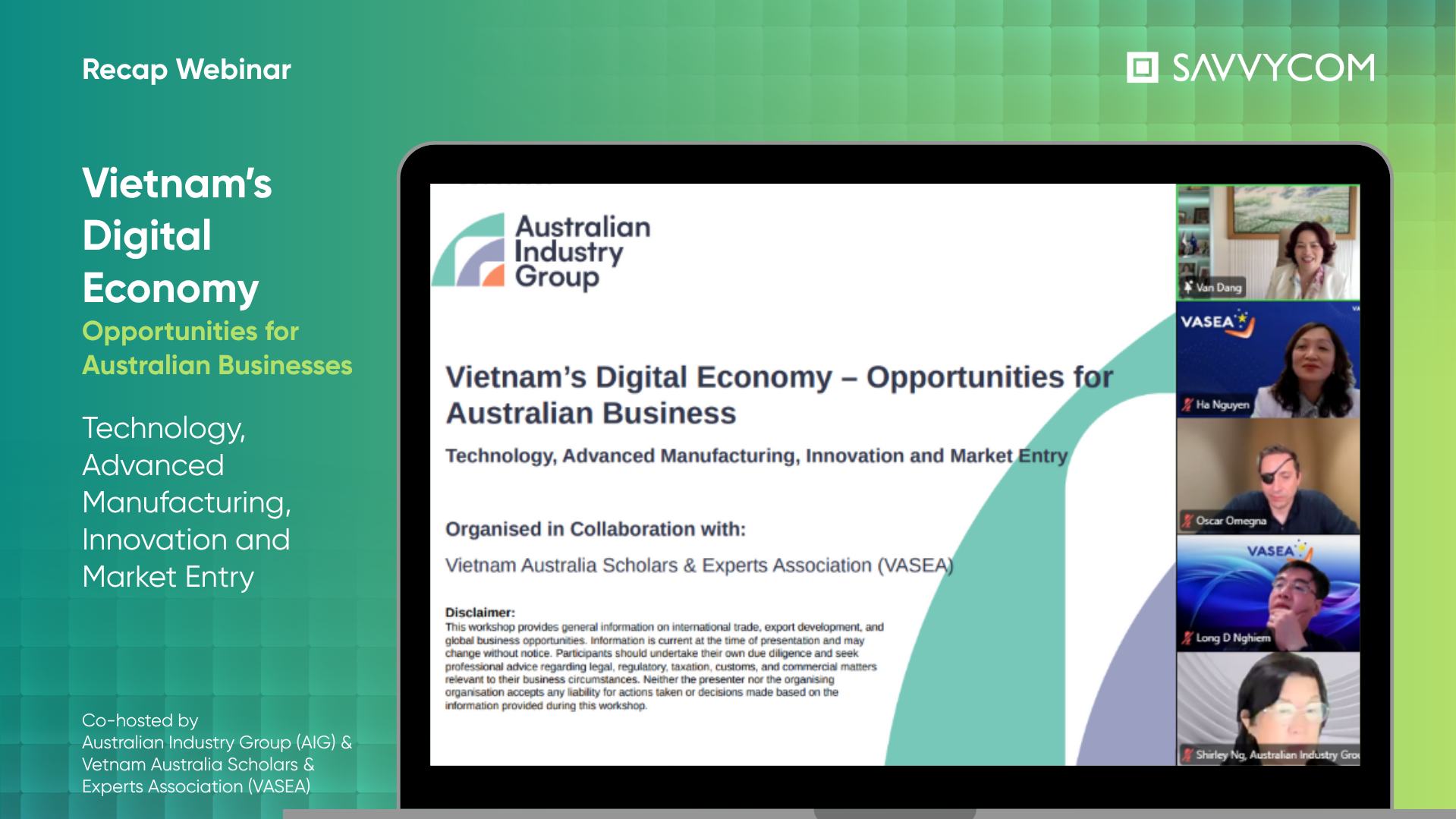
That was the shared conclusion of the Australian Industry Group (AIG) webinar “Australia-Vietnam Business Opportunities: Technology, Advanced Manufacturing, Innovation and Market Entry“, co-hosted online with the Vietnam-Australia Scholars and Experts Association (VASEA) on September 24, 2026.
As Vietnam’s technology, manufacturing and innovation sectors expand, the session set out to help Australian businesses move from opportunity to execution. Speakers included Prof. Long Nghiem, President of VASEA; Mr. Duong Viet Hoang of the Department of Digital Technology and Artificial Intelligence, Vietnam’s Ministry of Science and Technology; Ms. Ha Nguyen, Vice President of VASEA and Managing Director of Advanced Partners; Mr. Oscar Omegna, Founder and Managing Director of The Improbability Company; and Ms. Van Dang, our Founder and CEO, who shared our perspective on cross-border collaboration.
 Capability is the entry ticket, not the differentiator
One point ran through the session: the question facing Australian businesses has shifted. With global technology leaders such as NVIDIA, Qualcomm and Marvell already building engineering and AI teams in Vietnam, capability is no longer in doubt. What matters now is whether a partner can own the whole business problem and deliver it at scale.
“The question is no longer capability. It is how the two sides actually work together.”
Ms. Van Dang, Founder and CEO, Savvycom
The economic case points the same way. The opportunity is capability matching rather than simple market entry: Vietnam recorded US$38.4 billion in registered foreign direct investment in 2025, and the strongest openings sit where the two economies overlap, from AI and digital to advanced manufacturing, clean energy and professional services.
Structure decides what you can control, move and exit
The government perspective set out clearer ground for AI. Vietnam’s Law on Artificial Intelligence (Law No. 134/2025/QH15), in effect since March 1, 2026, sorts AI systems into three risk tiers. Providers classify their own systems before deployment, and low-risk systems, which cover most current applications, need no prior approval.
On the investment side, the advice centered on structural decisions that are hard to fix later. In Vietnam, percentage ownership does not equal practical control, how money enters the country determines how it can leave, and intellectual property should be protected before it is commercialized under a first-to-file system. Boards were urged to settle five questions before entering: who owns the Vietnamese business, how money will enter, how it will come back out, who controls the IP, and what happens on a sale, scale-up or exit. The core message was to structure the entry with the exit in mind.
Culture: The Assumptions That Become Self-Fulfilling
The Australian business showcase, drawn from a team largely based in Can Tho, challenged two assumptions that still shape many cross-border teams: that Vietnamese staff are quiet, respectful and follow, and that Australians know better and lead. Acting on them creates a self-fulfilling prophecy. Managers withhold context and authority, people wait for instructions, and the waiting is read as confirmation.
“Culture deserves understanding. Quiet is not weakness. Loud is not leadership.”
Mr. Oscar Omegna, Founder and Managing Director, The Improbability Company
The remedy is to change the conditions: work together on the ground, connect the local team with customer decision-makers, welcome questions and corrections, and give local partners meaningful responsibility.
The Savvycom 4Cs: A Partner Checklist Beyond Capability
At Savvycom, we brought these points together in a 4Cs checklist for choosing a partner in Vietnam.
- Capability is the baseline: security, compliance and scalability from day one, with proven results rather than capability slides.
- Communication is where trust is built, through a partner that asks questions and raises problems early.
- Commitment means ownership of the business problem, not just the task.
- Collaboration means one team rather than two, with clear owners on both sides and a willingness to start small and scale as trust grows.
We apply the same logic in delivery. When an Australian client’s growth outpaced its delivery, our fintech software development work started with outcomes and ended with capacity: priorities set with the client’s product leaders, then a standardized workflow for predictable releases, and only then engineering capacity scaled to the roadmap.
Looking ahead
These questions carry more weight in AI work, where a partner must understand the business problem and the data behind it, not just the specification. We will take these questions to the Vietnam-Australia Digital Technology & AI Forum in Hanoi on October 12, 2026
For enterprise leaders, the practical next step is to test a Vietnam partner on how it works, not only on what it can build.
About Savvycom
Established in 2009, we are an AI-driven multinational technology company with a presence across a number of international markets. We provide AI and digital transformation solutions for enterprises in the banking and finance, healthcare, education, manufacturing and retail sectors.
For further information about our AI solutions, please visit: savvycom.ai