AI-Driven Digital Transformation: Real Enterprise Use Cases (2026)
AI has moved from the strategy layer of digital transformation to the execution layer. The question in 2026 is no longer whether AI belongs in a transformation program but which specific applications are generating measurable operational change and which remain pilots that have not yet crossed the threshold into production value.
The use cases with the clearest evidence are the ones where AI is applied to structured, well-defined problems with abundant data: document processing, transaction automation, demand forecasting, predictive maintenance, and clinical decision support. The use cases with more variable results are broader operating-model redesigns where AI is one component of a complex organizational change.
This guide covers how AI is being applied in enterprise digital transformation across BFSI, healthcare, logistics, and manufacturing, with production outcomes where documented. For the strategy and roadmap layer that precedes AI deployment, see the guides on digital transformation strategy and digital transformation roadmap.
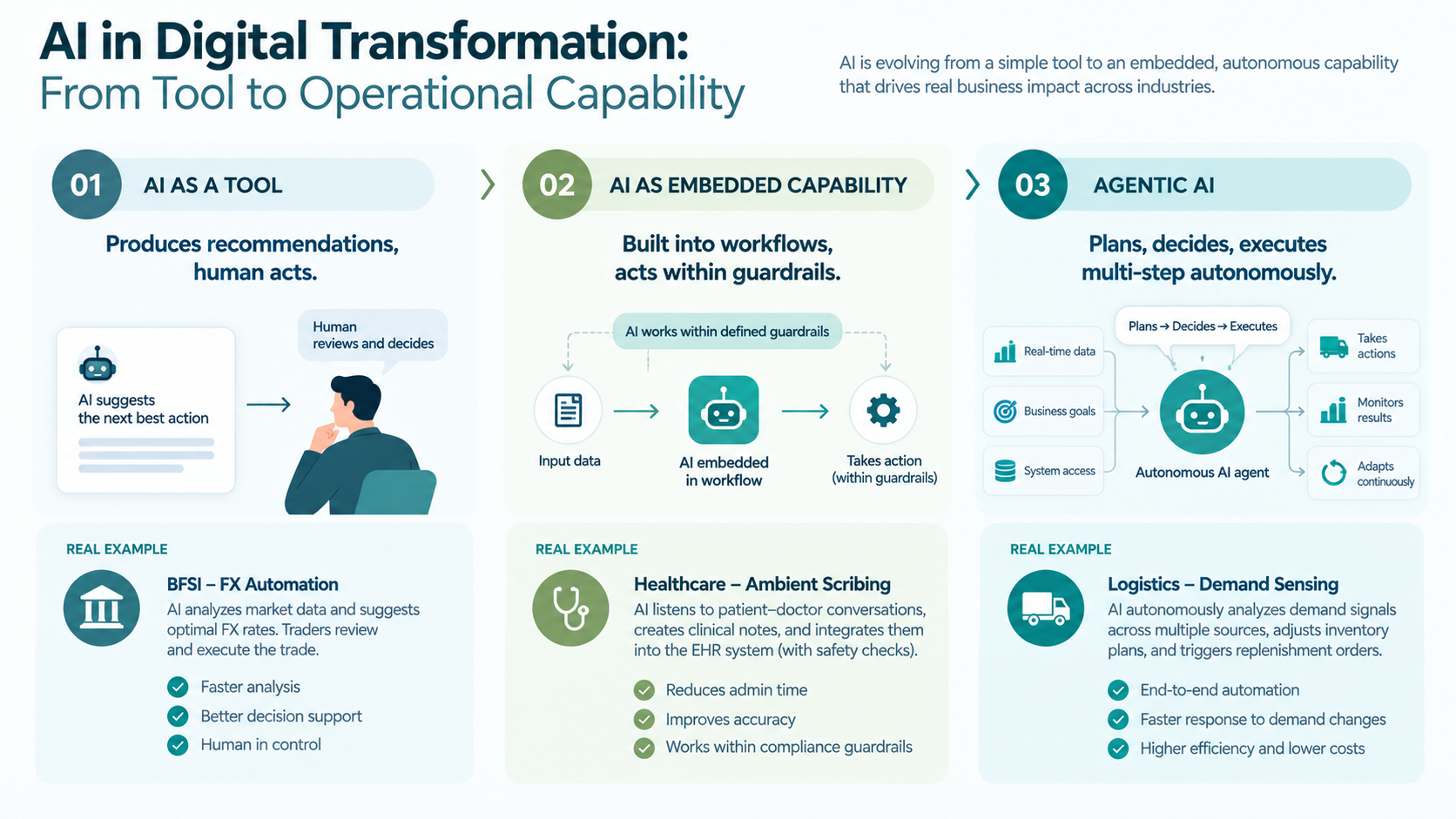
AI in digital transformation: the progression from AI as a tool to agentic AI that plans, decides, and executes
1. How is AI used in digital transformation?
AI accelerates digital transformation by automating decisions and workflows that previously required human intervention at each step. In operational terms, this means replacing manual document processing with AI extraction, replacing human-reviewed exception queues with AI-prioritized alerts, and replacing periodic planning cycles with continuous AI-driven sensing and response.
The distinction that matters for digital transformation is between AI as a tool (a model that produces a recommendation) and AI as an operational capability (a system that acts on that recommendation within defined guardrails). Most AI deployments in 2023 and 2024 were tools. The transformations producing measurable operational change in 2026 are those where AI is embedded in the workflow, not adjacent to it.
Gartner named agentic AI among the top enterprise technology trends for 2026, describing systems that can plan, decide, and execute across multi-step workflows without human approval at each step. In financial services, this is an FX automation agent that detects a rate event, calculates settlement exposure, and executes a hedge within defined parameters. In logistics, this is a supply chain agent that detects a shipment delay, evaluates alternative inventory sources, and releases a transfer order. In healthcare, this is a revenue cycle agent that detects a likely claim denial, corrects the documentation, and resubmits without waiting for a coder.
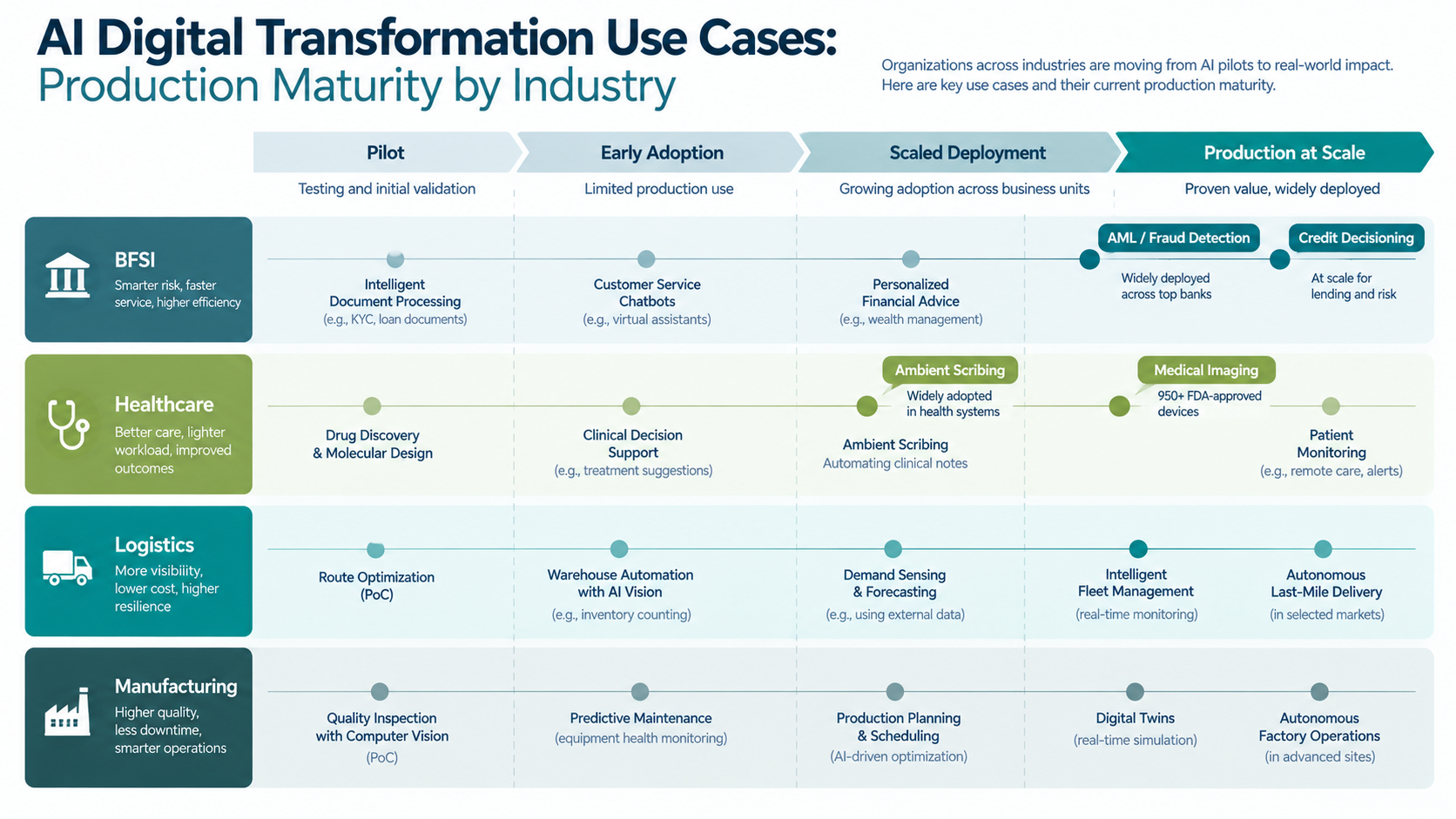
AI digital transformation use cases mapped by production maturity across BFSI, healthcare, logistics, and manufacturing
2. AI digital transformation use cases by industry and function
AI transformation use cases cluster by industry because the data environments, regulatory constraints, and workflow structures that determine what AI can do are industry-specific.
| Industry | Use case | AI approach | Production maturity |
| BFSI | FX and treasury automation | Multi-agent orchestration (GPT-4o, LangGraph) | Production: South Korea deployments |
| BFSI | Credit decisioning | Gradient boosting on structured financial data | Production: widespread, regulated |
| BFSI | AML and fraud detection | Anomaly detection, graph neural networks | Production: standard at large institutions |
| Healthcare | Clinical documentation (ambient) | LLM speech-to-text + structured notes | Production, scaling rapidly |
| Healthcare | Diagnostic imaging AI | CNNs: 950+ FDA-cleared devices | Production at scale |
| Healthcare | Revenue cycle automation | AI coding, denial prediction, prior auth | Production: ROI within months |
| Logistics | Yard and container management | Computer vision (YOLOv8, PaddleOCR), Kafka | Production: global operator |
| Logistics | Demand forecasting | Gradient boosting, LSTM, foundation models | Production: leading operators |
| Manufacturing | Predictive maintenance | OBD telematics + ML failure prediction | Production: automotive, heavy industry |
| Manufacturing | Quality control (CV) | CNN defect detection from camera feeds | Production: electronics assembly |
| Cross-sector | Document intelligence | LLM + OCR extraction pipelines | Production: healthcare, legal, BFSI |
3. AI transformation in financial services: use cases and outcomes
Financial services is the highest-velocity sector for AI-driven transformation in 2026, driven by the combination of structured data abundance, high-value decision frequency, and competitive pressure from fintech entrants.
FX and treasury operations automation
Manual foreign exchange operations involve high-frequency, time-sensitive decisions with significant financial exposure at each step: rate monitoring, exposure calculation, settlement sequencing, and compliance documentation. Multi-agent AI systems orchestrate these decisions within compliance boundaries, replacing human coordinators on the routine decision chain while escalating only genuine exceptions.
A financial services enterprise in South Korea deployed a five-agent AI platform on GPT-4o and LangGraph, coordinating agents across user management, FX rate handling, settlement, exchange, and transaction processing. Over the three-month build and deployment, processing time dropped 60% against the client’s manual baseline, and operational efficiency improved 40%. The compliance architecture was designed first, with every decision boundary mapped against South Korean financial data regulations before model development began.
Credit decisioning and lending automation
AI credit models process loan applications, score creditworthiness, and make approval recommendations in seconds rather than days. For mass-market consumer lending, this replaces manual underwriting for straightforward applications while routing edge cases to human review. BCG documented agentic AI delivering more than 50% productivity gains in retail lending in 2026 as banks moved from AI-assisted decisioning to AI-executed decisioning within defined risk parameters.
AML and fraud detection
Anti-money laundering monitoring and fraud detection were early AI success stories in financial services because the problem is precisely the type AI handles well: pattern recognition at high volume across structured transaction data. Graph neural networks identify network relationships between accounts that linear models miss. Anomaly detection flags transactions that deviate from established behavioral baselines. These systems are now standard infrastructure at large institutions, with the differentiation shifting to how quickly they can adapt to new fraud patterns without false positive rates that disrupt legitimate customers.
4. AI transformation in healthcare: clinical and operational use cases
Healthcare AI transformation divides into two tracks: operational AI (administrative automation, revenue cycle, scheduling) delivers measurable ROI within months; clinical AI (diagnostic support, treatment planning) delivers documented outcomes over longer deployment periods with higher governance requirements.
Ambient clinical documentation
Ambient scribing is the fastest-deploying healthcare AI application in 2026. AI listens to the clinical encounter and generates structured documentation automatically, recovering 1 to 2 hours per physician per day from after-hours charting. McKinsey identified ambient scribing as nearing an inflection point in January 2026, with adoption accelerating rapidly across large health systems.
AI document intelligence for healthcare operations
Clinical and administrative documents: referral letters, insurance forms, lab reports, and discharge summaries. These arrive in unstructured formats that require manual data entry to process. AI document intelligence pipelines extract and structure this data automatically. An AI document intelligence deployment by Savvycom for a US healthcare provider significantly reduces manual data entry for clinical and administrative workflows, with HIPAA-compliant architecture built into the pipeline from the start.
Revenue cycle AI
Prior authorization, medical coding, claim scrubbing, and denial management consume significant administrative costs in healthcare. AI applied to the revenue cycle automates the structured portions of each workflow: coding AI reduces denial rates by ensuring accurate code assignment at the point of documentation; prior authorization AI submits and tracks routine requests automatically; and denial prediction AI flags likely rejections before submission. These use cases generate measurable financial ROI within the first year, making them the most common starting point for healthcare AI programs.
5. AI transformation in logistics and manufacturing
Logistics and manufacturing share a common AI transformation pattern: the highest-value applications are those that bring intelligence to physical operations, connecting sensor data, computer vision, and operational systems to produce real-time decisions that previously required human observation and judgment.
Computer vision for yard and container management
Container yards processing hundreds of movements per day are data-rich environments where traditional human-operated tracking creates throughput constraints and accuracy gaps. A global logistics operator Savvycom worked with deployed a yard management system combining YOLOv8 computer vision and PaddleOCR to read container IDs and ISO codes from camera feeds, DeepSORT for tracking continuity across frames, and Kafka for real-time event streaming. Against the pre-deployment manual baseline: container identification accuracy reached 95%, container search time dropped 60%, and yard throughput improved 35 to 40% over the nine-month build period (March to December 2024).
AI-driven demand forecasting and inventory optimization
Demand forecasting was one of the earliest supply chain AI applications and remains one of the most consistently deployed. ML models trained on sales history, promotional calendars, and external signals produce SKU-level forecasts that reduce both stockouts and overstock. Gartner identified AI demand sensing as a core supply chain capability shift for 2026. Leading operators using o9 Solutions, Blue Yonder, or custom AI forecasting systems report 10 to 20 percentage point improvements in forecast accuracy for high-variability products.
Predictive maintenance for industrial equipment
Industrial equipment generates telematics data that AI maintenance models use to predict failure before it causes downtime. The transformation element is not the ML model itself but the operational workflow change: shifting from calendar-based maintenance schedules to condition-based maintenance triggered by the model’s failure probability estimates. Manufacturing operators consistently document downtime reduction and maintenance cost savings, though the specific figures vary significantly by equipment type and maintenance baseline.
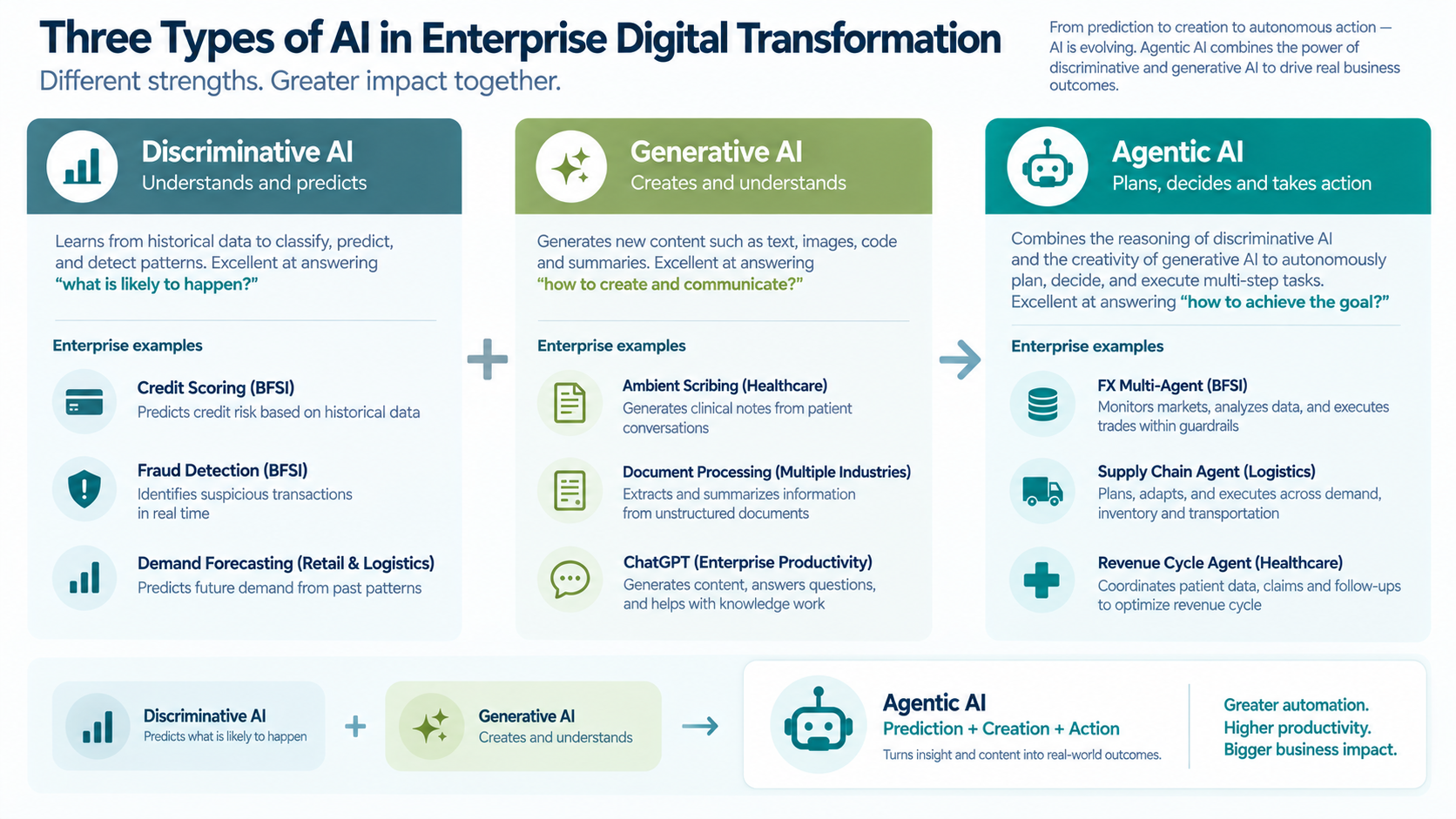
Three AI types driving enterprise digital transformation: discriminative, generative, and agentic AI
6. What type of AI is used in digital transformation, and does ChatGPT qualify?
Three AI types drive enterprise digital transformation: discriminative AI (classification and prediction from structured data), generative AI (content generation, document processing, and code generation), and agentic AI (multi-step autonomous decision and action). ChatGPT is a generative AI. It is one component of transformation programs but not the dominant type for most enterprise use cases.
Discriminative AI, specifically gradient boosting, neural networks, and ensemble methods, is the most widely deployed AI type in enterprise transformation. It powers credit decisioning, fraud detection, demand forecasting, predictive maintenance, and clinical risk scoring. These applications require calibrated probability outputs and high accuracy on structured data.
Generative AI (large language models including GPT-4o, Claude, and Gemini) powers document processing, ambient scribing, code generation, customer service automation, and increasingly the language interface layer of multi-agent systems. For enterprise document processing, generative AI combined with OCR and extraction pipelines is delivering the fastest production deployment of any AI category in 2026.
Agentic AI combines both: LLMs provide reasoning and natural language capabilities; discriminative models provide calibrated predictions; and orchestration frameworks (LangGraph, AutoGen) coordinate agents across multi-step workflows. The FX operations case above is agentic: five specialized agents coordinate across decision domains within compliance boundaries. Gartner describes this as the shift from AI that recommends to AI that executes.
7. How enterprise leaders approach AI-driven transformation
The pattern across AI transformations that deliver measurable outcomes is consistent: start with a use case that has clean data and a defined decision, prove value in a bounded pilot, then scale with the organizational change that makes the AI output actionable.
Define the decision, not the technology
The most common failure mode is starting with “we want to use AI” rather than “we want to automate this decision or workflow.” The decision definition determines the data requirements, model type, and workflow redesign needed before any technical work begins.
Data readiness before model development
AI produces outputs only as good as the data it is trained and run on. Financial services firms with decades of structured transaction data can deploy credit AI faster than manufacturers whose equipment data is stored in disconnected maintenance logs. The data readiness assessment is the first investment, not the model.
Compliance architecture before deployment
In regulated industries (BFSI, healthcare, and government), the compliance architecture that governs how AI can be used, what decisions it can make, and what data it can process must be defined before the technical build. Retrofitting compliance after deployment is consistently more expensive than designing for it first.
Workflow integration before scale
AI that produces recommendations without a defined workflow for acting on them generates alerts rather than outcomes. The FX case succeeded because the agent architecture was designed around the settlement workflow, not added to it. The healthcare document pipeline succeeded because the extracted data connected to downstream clinical and billing systems.
8. Frequently asked questions
Looking for a Trusted Tech Partner That Delivers Your Measurable Values?
Savvycom builds AI-powered digital transformation programs across BFSI, healthcare, logistics, and manufacturing for clients in APAC, Japan, South Korea, Australia, and the US. Production deployments include multi-agent FX automation, AI yard management, and healthcare document intelligence.
Explore AI transformation engagements: Digital Transformation Solutions