Digital Transformation Checklist: 6 Phases and the KPIs That Tell You If It’s Working (2026)
A digital transformation checklist is a phase-by-phase framework covering readiness assessment, leadership alignment, technology selection, integration, change management, and KPI tracking. It gives enterprises a structured way to plan and execute transformation without losing momentum between pilots and production.
The need for structure is not optional. 89% of large companies globally have a digital and AI transformation underway, but they have captured only 31% of the expected revenue lift and 25% of the expected cost savings (McKinsey). The gap is rarely budget or ambition. It is sequence: teams buy technology before auditing processes, launch pilots without defining success metrics, and underinvest in the change management that decides whether people use what was built.
This guide gives you the checklist across six phases, an interactive tracker to work through it, and the KPIs that show whether each phase is actually working.
1. What does a digital transformation checklist actually need to cover?
An effective digital transformation checklist covers four dimensions in a defined sequence: people, process, technology, and data. Most checklists that fail do so because they treat the technology layer in isolation, digitizing broken workflows instead of fixing them first and leaving adoption to chance.
Technology without process redesign installs software on top of broken workflows. Process redesign without change management produces documented improvements that staff revert from within six months. Data infrastructure without governance produces analytics nobody trusts. The six-phase framework below sequences all four dimensions, and each phase has defined actions you can tick off as you complete them.
2. The six-phase checklist: from readiness audit to sustained operation
The six phases must run in sequence, because each phase builds directly on the outcomes of the last. Skipping or compressing earlier phases is what produces the integration failures and adoption gaps that stall transformations later.
Your checklist progress: 0 / 37
Tick items as you complete them. Progress is saved in your browser, so you can come back anytime.
Phase 1: Readiness assessment
Phase 2: Strategy and leadership alignment
Phase 3: Technology selection and vendor evaluation
Phase 4: Implementation and integration
Phase 5: Change management and adoption
Phase 6: Measurement, optimization, and sustained operation
3. Which KPIs actually measure digital transformation progress?
The KPIs that matter in digital transformation are outcome metrics: operational efficiency, adoption rates, cost impact, customer experience, data quality, and revenue contribution. Activity metrics like the number of tools deployed, budget utilization, or training sessions completed measure inputs, not whether the business is actually changing.
|
KPI category |
Metric to track |
What it tells you |
Target benchmark |
|---|---|---|---|
|
Operational efficiency |
Process cycle time before vs. after |
Whether workflows are actually faster post-transformation |
Set the baseline in Phase 1; target quarter-over-quarter improvement against it |
|
Cost impact |
IT cost as % of revenue |
Whether technology investment is improving unit economics |
Trending down year-over-year |
|
Employee adoption |
Active users / licensed users ratio |
Whether staff are actually using new tools |
80%+ active adoption within 6 months of rollout |
|
Customer experience |
NPS, CSAT, digital channel share |
Whether the transformation is improving how customers interact |
Digital channel share trending up quarter over quarter |
|
Data quality |
% records meeting completeness threshold |
Whether data infrastructure can support AI and analytics |
95%+ completeness on mission-critical data fields |
|
Revenue impact |
Revenue from digitally-enabled channels |
Whether transformation is creating new growth, not just efficiency |
Measurable contribution within 18–24 months |
Lock KPI selection in Phase 2, before implementation begins. Metrics defined after deployment get selected to match what was achieved, not what was needed.
4. Why do most digital transformation initiatives fail to scale?
The most common failure modes in digital transformation are not technology failures. They are sequencing, governance, and change management failures that look like technology problems by the time they surface.
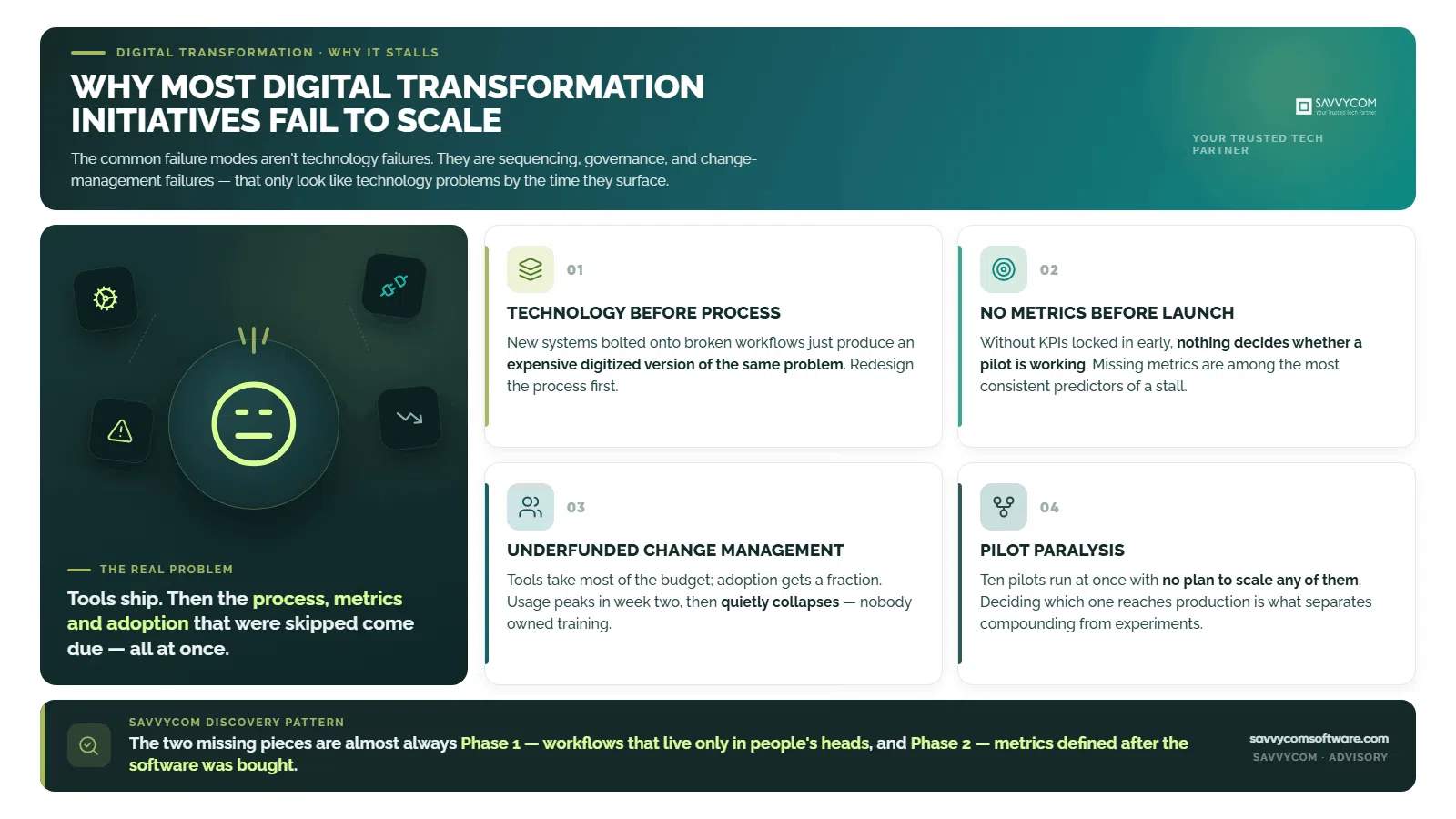
- Technology before process: Deploying new systems on top of broken or undocumented workflows produces expensive digitized versions of the original problems. Process redesign must precede or run in parallel with technology selection, not follow it.
- No success metrics before launch: Without KPIs locked in Phase 2, there is no mechanism for deciding whether a pilot is working. The value-capture gap in the McKinsey data cited above is the aggregate result: programs everywhere, returns captured almost nowhere. Missing metrics are among the most consistent predictors of a stall.
- Underfunded change management: Technology implementation absorbs most of the budget while adoption gets a fraction of what it needs. The pattern is predictable: tools ship, usage peaks in week two, then quietly collapses because nobody owned training, communication, or feedback.
- Pilot paralysis: A phased approach is correct. Running ten pilots simultaneously with no plan to scale any of them is not. Deciding which pilot goes to production, and when, separates programs that compound from a long list of experiments with no enterprise impact.
A pattern from Savvycom’s discovery work with enterprise clients confirms the sequencing point: in most engagements, the two items that turn out to be missing are the ones from Phase 1 and Phase 2 of this checklist. Workflows exist only in people’s heads, not in documentation, and success metrics were either never defined or defined after the software was already bought. Neither gap is visible until integration starts, which is exactly why the checklist order matters.
5. How do you keep the transformation on track after the pilot phase?
Sustaining momentum after early pilots requires a governance cadence that separates outcome measurement from project management, and a deliberate plan for embedding change before the transformation team disbands.
- Monthly outcome reviews separate from project status meetings. Project status tracks what is happening. Outcome reviews ask whether the business results defined in Phase 2 are arriving. Running only the first produces well-managed projects that do not change the business.
- Staged transfer of change ownership to operational teams. A transformation that stays dependent on a central program office will not survive the program’s end. Each deployed capability needs a named owner in the operational team, accountable for adoption and improvement, before the transformation team moves on.
- A documented feedback and adaptation mechanism. Regulations change, customer behavior changes, technology improves. Build the expectation of ongoing adaptation into the governance model from the start, not as a response to problems.
6. Frequently asked questions
6.1 What is the first step in a digital transformation checklist?
A focused transformation of one business function typically delivers measurable results within 6 to 12 months, while enterprise-wide programs run 2 to 5 years in phases. The variable that most affects the timeline is the quality of the Phase 1 readiness assessment; compressing it leads to scope expansion later. The five core steps are: assess readiness, align leadership and define outcomes, select and pilot technology, implement and integrate, and measure results against defined KPIs. Some frameworks expand to six or seven phases by separating change management and sustained operation. The sequence matters more than the count. The seven pillars most commonly referenced are strategy and leadership, customer experience, people and culture, process optimization, technology and innovation, data and analytics, and governance and compliance. They run in parallel across every phase, and successful transformation requires progress on all seven, not excellence in one. Track employee adoption rate first: the ratio of active users to licensed users on each new tool, measured weekly for the first six months. Adoption is the leading indicator for every other KPI. If adoption is low, efficiency, cost, and revenue metrics will not move regardless of implementation quality.
How long does digital transformation typically take?
What are the 5 steps of digital transformation?
What are the 7 pillars of digital transformation?
Which KPI should organizations track first in a digital transformation program?
Next step
A checklist tells you what to do; a strategy tells you why and in what order for your specific business. If you are building that layer now, the natural next read is the guide on digital transformation strategy.