10 Benefits of AI in Healthcare (2026): Evidence and Applications
AI delivers measurable value across clinical, operational, and research workflows in healthcare. The most established benefits include improved diagnostic accuracy, earlier disease detection, operational efficiency, accelerated drug discovery, personalized treatment, reduced administrative burden, clinical decision support, remote patient monitoring, supply chain optimization, and population health management. Most of these applications are now supported by peer-reviewed evidence and real-world deployment at scale.
AI adoption in healthcare has moved from pilot to production across most of these domains. The FDA had cleared more than 950 AI-enabled medical devices as of early 2026, the majority in radiology and cardiology. Health systems across the US, Europe, and increasingly APAC are deploying AI for clinical documentation, diagnostic support, and operational automation at scale. The evidence base is maturing: systematic reviews and randomized controlled trials are replacing proof-of-concept studies for the most established use cases.
This guide covers each benefit with the supporting evidence and the real-world application, followed by an honest assessment of the limitations. For how AI is applied in specific healthcare workflows, see the guide on big data in healthcare.
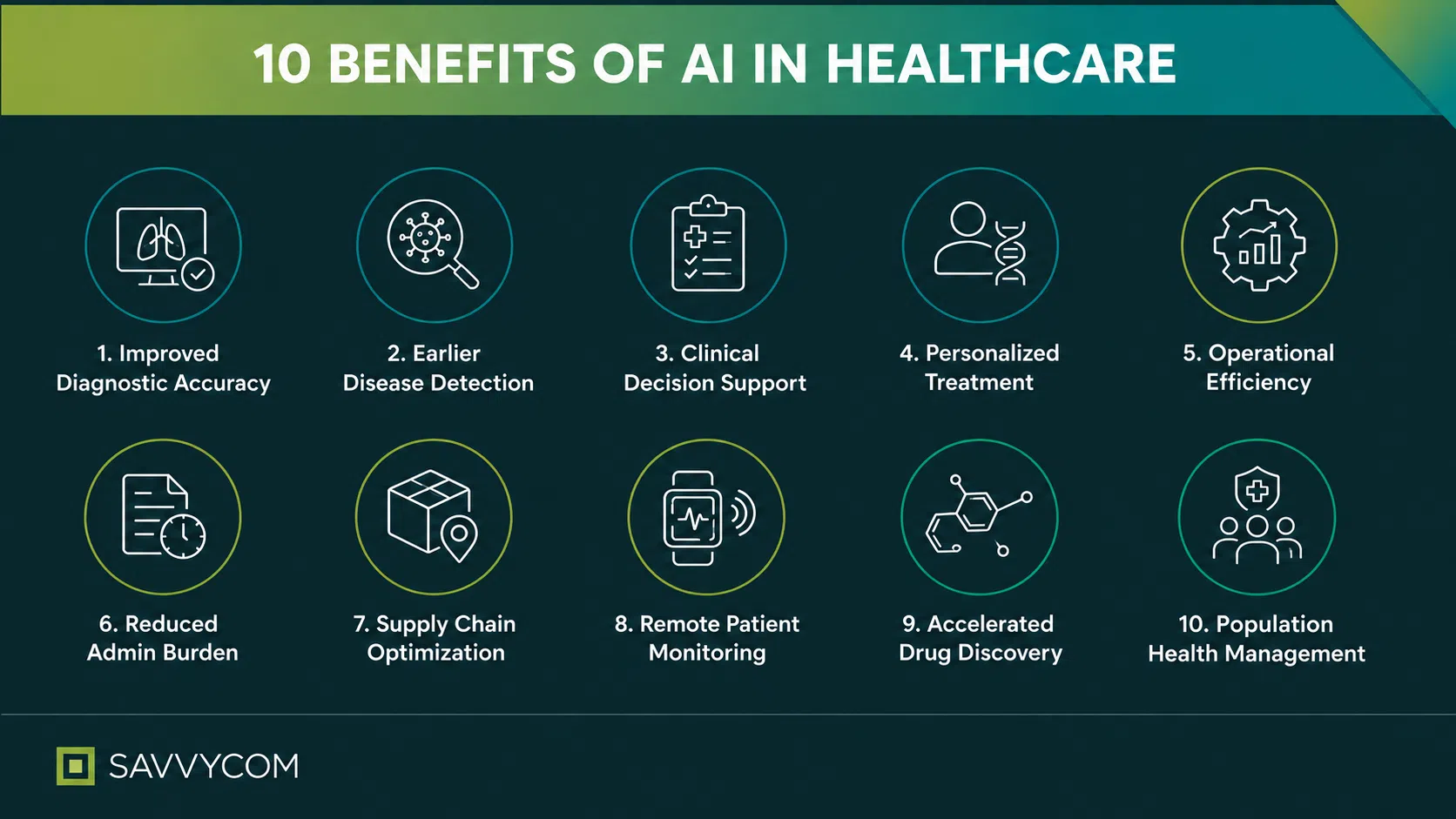
10 evidence-backed benefits of AI in healthcare, grouped by clinical, operational, and research impact
When Savvycom’s delivery team handed over an AI document platform to a U.S. healthcare organization, the number that mattered was not model accuracy. It was that manual data entry across clinical and billing workflows had dropped by more than half. That is what the benefits of AI in healthcare look like in practice: not a smarter algorithm, but hours of human work returned to patient care.
1. The 10 benefits of AI in healthcare: evidence and applications
Each of the ten benefits below is supported by peer-reviewed research or documented clinical deployment. The evidence quality varies: some benefits (diagnostic imaging AI, ambient documentation) have controlled trial evidence; others (population health management, drug discovery) are supported by observational data and early deployment results.
Improved diagnostic accuracy
AI models trained on medical imaging data match or exceed specialist performance on specific diagnostic tasks in controlled studies. Convolutional neural networks detect diabetic retinopathy from fundus photographs with sensitivity and specificity comparable to ophthalmologists (Gulshan et al., JAMA 2016; replicated across multiple subsequent studies). AI-assisted pathology, detecting cancer cells in biopsy slides, has demonstrated accuracy improvements in colorectal cancer and lymph node metastasis detection. FDA-cleared AI imaging tools number in the hundreds; most function as a first-pass screening layer that flags findings for radiologist review.
Earlier disease detection
AI temporal pattern recognition detects disease onset before clinical thresholds are reached. Sepsis prediction models analyze real-time vital signs, laboratory values, and medication patterns to identify sepsis risk hours before clinical criteria are met, enabling earlier antibiotic administration when outcomes are most responsive. AI models for atrial fibrillation detection from ECG waveforms, early Alzheimer’s detection from neuroimaging, and early-stage lung cancer detection from low-dose CT have all demonstrated earlier detection than standard clinical workflows.
Operational efficiency
AI drives measurable operational improvement across scheduling, staffing, and patient flow. Predictive models for ED patient volume, surgical suite utilization, and bed demand allow health systems to staff proactively rather than reactively. AI-powered prior authorization automation reduces the 15 to 25 minutes per case that manual authorization consumes. Revenue cycle AI (coding accuracy, denial prediction, claim scrubbing) directly improves financial performance while reducing administrative staff burden.
Accelerated drug discovery
AI has materially shortened the early stages of drug discovery. AlphaFold 2 (DeepMind) predicted the 3D structure of nearly every known protein, a problem that had challenged structural biology for decades, and made the results freely available. Generative AI models design novel drug candidates that bind to specific protein targets faster than traditional high-throughput screening. Insilico Medicine used AI to identify a novel candidate for idiopathic pulmonary fibrosis that entered Phase II clinical trials in 2023. The end-to-end drug development timeline has not shortened significantly, but the discovery and preclinical phases have accelerated substantially.
Personalized treatment
AI enables treatment selection based on individual patient characteristics rather than population averages. In oncology, AI models trained on genomic profiles, treatment histories, and biomarker data predict treatment response for specific therapies in individual patients, supporting precision oncology decisions. In psychiatry, AI models are being evaluated to predict medication response in depression and schizophrenia based on imaging and genetic markers. Personalized dosing algorithms for anticoagulants and immunosuppressants have demonstrated improved outcomes in transplant and cardiac care.
Reduced physician administrative burden
Ambient clinical documentation is one of the highest-adoption AI applications in healthcare in 2026, recovering 1 to 2 hours per physician per day from after-hours charting. AI listens to the patient-provider conversation and generates structured clinical notes automatically. Medscape’s 2025 physician survey reported 54% burnout rates among US physicians; documentation burden is consistently cited among the top contributing factors. Ambient scribing addresses the root cause directly in a way that most prior EHR efficiency initiatives did not.
Clinical decision support
AI clinical decision support provides real-time guidance at the point of care: drug interaction alerts, dosing recommendations, care protocol adherence prompts, and diagnostic differential support. Unlike earlier rule-based decision support (which generated alerts for every deviation, producing alert fatigue), AI-powered decision support is context-aware: it surfaces recommendations when they are clinically relevant and suppresses them when they are not. The challenge remains calibrating sensitivity: too many alerts restore the fatigue problem; too few miss the intervention opportunities that justify the system.
Remote patient monitoring at scale
AI makes remote patient monitoring operationally feasible at scale by filtering continuous data streams from wearables and home monitoring devices down to the subset that requires clinical response. Without AI filtering, a nurse managing 200 RPM patients would receive thousands of daily data points and alarms. With AI filtering, they receive the subset where the pattern indicates clinical risk. Chronic disease management for heart failure, COPD, diabetes, and hypertension has demonstrated readmission reduction in multiple studies when RPM is combined with AI-driven alert management and defined clinical response protocols.
Supply chain and resource optimization
Hospital supply chains carry significant waste and inefficiency: expired medications, unused surgical supplies, and mismanaged inventory represent billions in annual costs across large health systems. AI demand forecasting applied to pharmaceutical and surgical supply purchasing reduces expiration waste and stockout events. Predictive maintenance AI on critical medical equipment (MRI machines, ventilators, infusion pumps) reduces unplanned downtime. Operating room scheduling optimization AI improves surgical suite utilization and reduces case delays.
Population health management
AI risk stratification across large patient populations identifies high-risk cohorts for proactive care management intervention before they generate high-cost utilization events. Health systems and payers use AI to analyze claims and clinical and social determinant data to prioritize care management resources toward the patients most likely to benefit from intervention. This is the transformation enabler for value-based care: the shift from fee-for-service to outcomes-based reimbursement requires population-level analytics that fee-for-service operations were never built to produce.
2. What are the 10 most common applications of AI in healthcare?
The 10 most widely deployed AI applications in clinical and operational healthcare settings in 2026 are medical imaging analysis, clinical documentation (ambient scribing), sepsis and deterioration prediction, drug interaction checking, prior authorization automation, patient scheduling optimization, revenue cycle coding, readmission risk prediction, remote patient monitoring alert management, and diagnostic chatbots for patient triage.
| Application | Deployment maturity | Primary benefit | FDA / regulatory status |
| Medical imaging analysis | Production at scale | Diagnostic accuracy + radiologist efficiency | 950+ FDA-cleared devices (2026) |
| Ambient clinical documentation | Production, growing rapidly | 1–2 hrs/physician/day recovered | Software tool; EHR integration |
| Sepsis / deterioration prediction | Production at large health systems | Earlier intervention, mortality reduction | EUA/FDA clearance varies |
| Drug interaction checking | Standard in clinical systems | Medication safety | Integrated in EHR/pharmacy |
| Prior authorization automation | Production, growing | 15–25 min/case admin saving | Payer infrastructure |
| Patient scheduling optimization | Production | ED/OR throughput, reduced no-shows | Operational software |
| Revenue cycle AI coding | Production | Coding accuracy, denial reduction | Operational software |
| Readmission risk prediction | Production at health systems | Targeted post-discharge care | Clinical decision support |
| RPM alert management | Production | Scalable chronic disease monitoring | Integrated with cleared RPM devices |
| Patient triage chatbots | Production (varies) | After-hours triage, ED diversion | Symptom checker category |
3. What are the 5 advantages and 5 disadvantages of AI in healthcare?
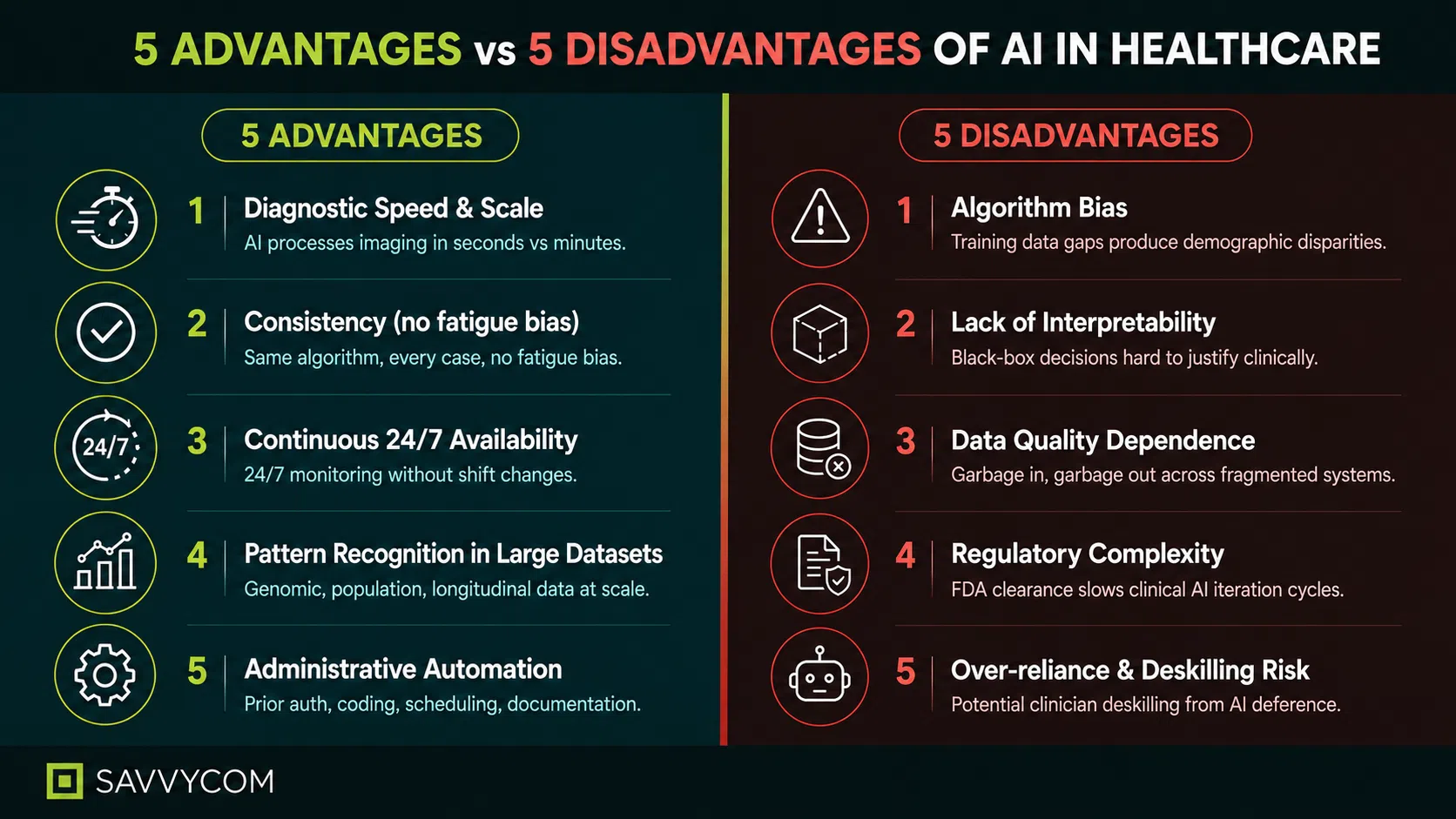
Five advantages and five disadvantages of AI in healthcare based on peer-reviewed evidence
AI in healthcare offers five clear advantages: diagnostic speed and scale, consistency and reduced human error, availability across time zones, pattern recognition in large datasets, and administrative burden reduction. The five primary disadvantages are algorithm bias, lack of interpretability, data quality dependence, regulatory complexity, and the risk of over-reliance displacing clinical judgment.
Five advantages
Diagnostic speed and scale
AI can process a chest radiograph in seconds; a radiologist takes minutes. AI can screen an entire population for diabetic retinopathy; a specialist can only see patients one appointment at a time. The scaling properties of AI are a genuine structural advantage in healthcare systems with specialist shortages.
Consistency
AI applies the same algorithm to every case. It does not have tired nights, cognitive biases shaped by recent memorable cases, or variable performance across high-volume and low-volume conditions. For structured, well-defined tasks, AI consistency is a real clinical advantage.
Continuous availability
AI-powered monitoring operates 24 hours a day without fatigue. For applications like ICU monitoring, sepsis detection, and RPM alert management, continuous operation without shift changes or cognitive load is a material benefit over purely human oversight.
Pattern recognition in large datasets
AI identifies patterns across datasets too large for human analysis: genomic sequences, population-level claims data, and longitudinal EHR histories across millions of patients. These patterns are genuinely not accessible through unaided human review.
Administrative automation
Prior authorization, clinical coding, scheduling optimization, and documentation generation represent substantial administrative costs. AI-driven automation in these domains produces measurable efficiency gains with well-understood ROI.
Five disadvantages
Algorithm bias
AI models trained on data that underrepresents certain demographic groups produce results that perform differently across populations. Documented examples include pulse oximetry algorithms that perform less accurately on patients with darker skin tones and dermatology AI trained predominantly on lighter skin.
Lack of interpretability
Many high-performing AI models cannot explain why they reached a particular conclusion in terms a clinician can evaluate and challenge. This creates clinical governance challenges: acting on a flag the clinician cannot understand requires trust that is difficult to justify clinically or legally.
Data quality dependence
AI model outputs are only as good as the data they are trained and run on. Clinical data in most healthcare organizations is incomplete, inconsistently coded, and fragmented across multiple systems. Models trained on high-quality academic data may perform poorly in community hospitals with different documentation practices.
Regulatory complexity
FDA clearance for AI-enabled medical devices is a significant process. As AI models update with new training data, whether the update constitutes a new device requiring new clearance is a regulatory question the FDA is still developing guidance on. This slows the iteration cycle for clinical AI tools.
Over-reliance and deskilling
Clinical concern exists that over-reliance on AI tools may reduce the diagnostic and interpretive skills of clinicians who routinely defer to AI recommendations. The appropriate human-in-the-loop model for each AI application is an open clinical and governance question.
4. AI in healthcare: APAC deployment context
Healthcare AI deployment in APAC presents specific advantages and constraints compared to the US and European contexts that dominate most published research. Specialist shortages in rural and regional areas are more acute, making AI diagnostic support more impactful. Regulatory frameworks (APPI, PIPA, PDPA) add compliance requirements that shape permissible architectures for patient data.
Two APAC-relevant deployment contexts illustrate how the benefits above translate into production:
AI document intelligence for US healthcare
An AI pipeline that extracts and structures clinical and administrative data from unstructured documents, built by Savvycom for a US healthcare provider, significantly reduces manual data entry for clinical and administrative workflows. The architecture was designed compliance-first under HIPAA, with de-identification built into the pipeline.
Mental health chatbot for Vietnamese market
A conversational AI mental health support platform achieving over 20,000 daily active users and 90% user satisfaction, demonstrating that AI-assisted mental health tools can achieve consumer-scale adoption in APAC markets where specialist access is limited.
Both deployments reflect a consistent pattern in APAC healthcare AI: The technology performs as designed; the work that determines success is the compliance architecture, the workflow integration, and the data infrastructure. These are not AI problems. They are healthcare system design problems that shape how AI value is captured.
5. Where AI in healthcare delivers the most consistent value
The benefits of AI in healthcare are real and documented, but they are not evenly distributed. AI delivers the most consistent value in structured, well-defined tasks with abundant training data: radiology, pathology, medication management, and administrative automation. It delivers less consistent value in complex, multi-factorial clinical decisions where the relevant context is not fully captured in structured data.
The most consistent return comes from administrative AI: ambient documentation, prior authorization automation, revenue cycle coding, and scheduling optimization. These use cases have well-defined inputs and outputs, large training datasets from routine operations, and measurable ROI that is realized within months of deployment. They also carry lower clinical risk than diagnostic AI, which reduces the regulatory and governance burden.
The highest-potential but highest-variance category is clinical AI: diagnostic imaging, clinical decision support, and personalized treatment. The evidence base is strong for specific, narrow tasks (diabetic retinopathy screening, sepsis prediction in defined patient populations). The evidence is weaker for broad clinical judgment tasks, and the real-world performance of AI models often falls below controlled-study performance when deployed in clinical environments with less clean data and more operational complexity.
For healthcare organizations evaluating AI investment, the practical guidance is: start with administrative use cases where ROI is measurable and risk is manageable, use the evidence and organizational capability built there to inform clinical AI deployment decisions, and design every deployment with a measured baseline, defined clinical workflow integration, and governance structure for model monitoring.
Which healthcare departments see the most AI impact?
Four departments consistently report the highest measurable impact from AI deployment: radiology, emergency medicine, revenue cycle management, and population health. Each sees impact for a different reason, ranging from cleaner, more standardized data in administrative functions to higher-stakes clinical decisions in emergency and radiology workflows, which is why rollout sequencing matters as much as the technology choice itself.
|
Healthcare Department |
Key AI Applications & Impact |
|---|---|
|
Radiology |
AI triage, automated measurements, and incidental finding detection as standard workflow components. |
|
Emergency Medicine |
Real-time predictive analytics, sepsis prediction, deterioration alerts, and admission prediction to optimize team attention. |
|
Revenue Cycle Management |
AI coding, prior authorization automation, and denial prediction to recapture revenue left on the table by manual processes. |
|
Population Health |
Risk stratification models that identify high-cost patients before they create avoidable utilization. |
Administrative functions like scheduling, staffing optimization, and supply chains have the fastest ROI because the workflows are more standardized and the data is cleaner. Clinical functions have the highest long-term value but take more validation, governance, and change management to deploy safely.
What should healthcare organizations prepare before using AI?
Healthcare organizations should prepare four things before adopting AI: a specific clinical or operational problem to solve, verified data quality for that use case, a defined compliance and audit model, and a named human reviewer for every AI output. Skipping any one of these is the most common reason a pilot never reaches production.
- Start with a clear problem: The best AI projects start with a specific problem, not a generic goal to “use AI.” Examples include reducing documentation time, improving imaging triage, predicting readmission risk, or monitoring chronic disease patients.
- Audit data quality: AI needs reliable data. Before choosing a tool, healthcare organizations should check where the data lives, who owns it, how complete it is, and whether it can be used safely for the target workflow.
- Define clinical oversight: Every AI output should have a clear review process. The organization needs to define who reviews the output, what happens when AI is wrong, and how feedback is used to improve the system.
- Plan for integration: AI is only useful if it fits into real workflows. A prediction that sits in a separate dashboard may be ignored. A useful AI system should connect with EHR, telemedicine, billing, CRM, or hospital management systems where the work actually happens.
- Monitor after deployment: Patient populations change, clinical practices change, and data patterns change. Model performance should be reviewed regularly to detect drift, bias, and declining accuracy.
Quick check: is your organization ready for healthcare AI?
Answer five yes/no questions based on section 6. Your score maps to where to focus first.
6. Frequently asked questions
Looking for a Trusted Tech Partner That Delivers Your Measurable Values?
Savvycom builds healthcare AI systems for health systems, digital health companies, and medical device manufacturers across APAC, Japan, South Korea, Australia, and the US, with compliance-first architecture for each jurisdiction.
Explore healthcare IT solutions: Healthcare IT Solutions