
How a Laboratory Information Management System (LIMS) Works (2026)
A Laboratory Information Management System (LIMS) is the software layer that manages samples, data, and workflows across a laboratory from sample receipt through result reporting. It keeps track of where each sample is, what has been done to it, who did it, and what the results were. This creates a complete chain of custody and audit trail that manual processes can’t reliably make at any meaningful scale.
Laboratories running without a LIMS manage this information through spreadsheets, paper logs, and institutional memory. The failure modes are predictable: samples misidentified, results entered against the wrong record, audit trails impossible to reconstruct, and compliance documentation assembled retrospectively. LIMS adoption across clinical, pharmaceutical, environmental, and research laboratories is driven primarily by regulatory requirements and secondarily by operational efficiency.
This guide covers how an LIMS works, the core modules, how it differs from related systems (LIS, LMS), what leading platforms look like, and what implementation involves. For the pharmaceutical-specific context, see the published guide on LIMS software in pharma.
1. How a LIMS works: from sample receipt to result reporting
A LIMS works by creating a digital record for each sample at the point of receipt and tracking every event that happens to that sample through the entire laboratory workflow: accessioning, storage, testing, instrument data capture, result review, approval, and reporting.
Sample accessioning and chain of custody
When a sample arrives in the laboratory, the LIMS creates a unique identifier (typically a barcode or RFID tag) and records the sample’s origin, collection time, required tests, and any special handling instructions. From this point, every action taken on the sample is recorded against that identifier. This chain of custody record is what makes LIMS essential in regulated environments: a sample’s complete history can be reconstructed at any point, including who handled it, when, and what instruments it passed through.
Workflow routing and task assignment
Once accessioned, the LIMS routes the sample through the defined workflow for its test type. Workflow rules determine which instrument or workstation the sample goes to, what order tests are performed in, and what happens when a test fails or requires repeat. In high-volume laboratories, this routing replaces manual scheduling and prevents the bottleneck that occurs when technicians manage workload assignment without visibility into the full queue.
Instrument integration and data capture
Modern LIMS platforms integrate directly with laboratory instruments: analyzers, sequencers, mass spectrometers, imaging systems, and environmental monitors. Instrument data flows into the LIMS automatically rather than being transcribed manually. This eliminates the transcription errors that are among the most common sources of laboratory error, and creates a direct link between the instrument output and the sample record. Integration is typically via bidirectional interfaces using HL7, ASTM, or vendor-specific protocols.
Result review, approval, and reporting
Results generated by instruments or entered manually are flagged for review against defined reference ranges and quality control criteria. Anomalous results trigger alerts. Approved results are locked in the audit trail and available for reporting. The LIMS generates reports in formats required by the requesting client, regulatory body, or downstream clinical system. In clinical laboratories, result transmission typically goes to a laboratory information system (LIS) or directly to the EHR via HL7 interface.
2. Core LIMS modules and what each does
A full-featured LIMS covers eight primary functional modules. Not every laboratory needs all eight at deployment; the modular architecture of modern platforms allows organizations to start with the modules that address the most acute operational gaps and extend over time.
| Module | Function | Typical user |
| Sample management | Accessions samples, creates unique IDs, tracks chain of custody | Lab technician, accessioning staff |
| Workflow management | Routes samples through defined test workflows, manages task queues | Lab manager, bench technician |
| Instrument integration | Bidirectional interface with analyzers, sequencers, and monitoring equipment | Instrument operators, IT |
| Inventory management | Tracks reagents, consumables, and reference materials with expiry monitoring | Lab manager, procurement |
| Quality control | Manages QC samples, Westgard rules, Levy-Jennings charts, and corrective actions | QA/QC staff, lab director |
| Results management | Records, reviews, approves, and locks results; flags outliers | Senior technician, lab director |
| Regulatory compliance | Manages SOPs, training records, audit trails, and inspection-ready documentation | Compliance officer, QA |
| Reporting and analytics | Generates client reports, regulatory submissions, and operational dashboards | Lab director, operations |
3. What is the difference between LMS and LIMS?
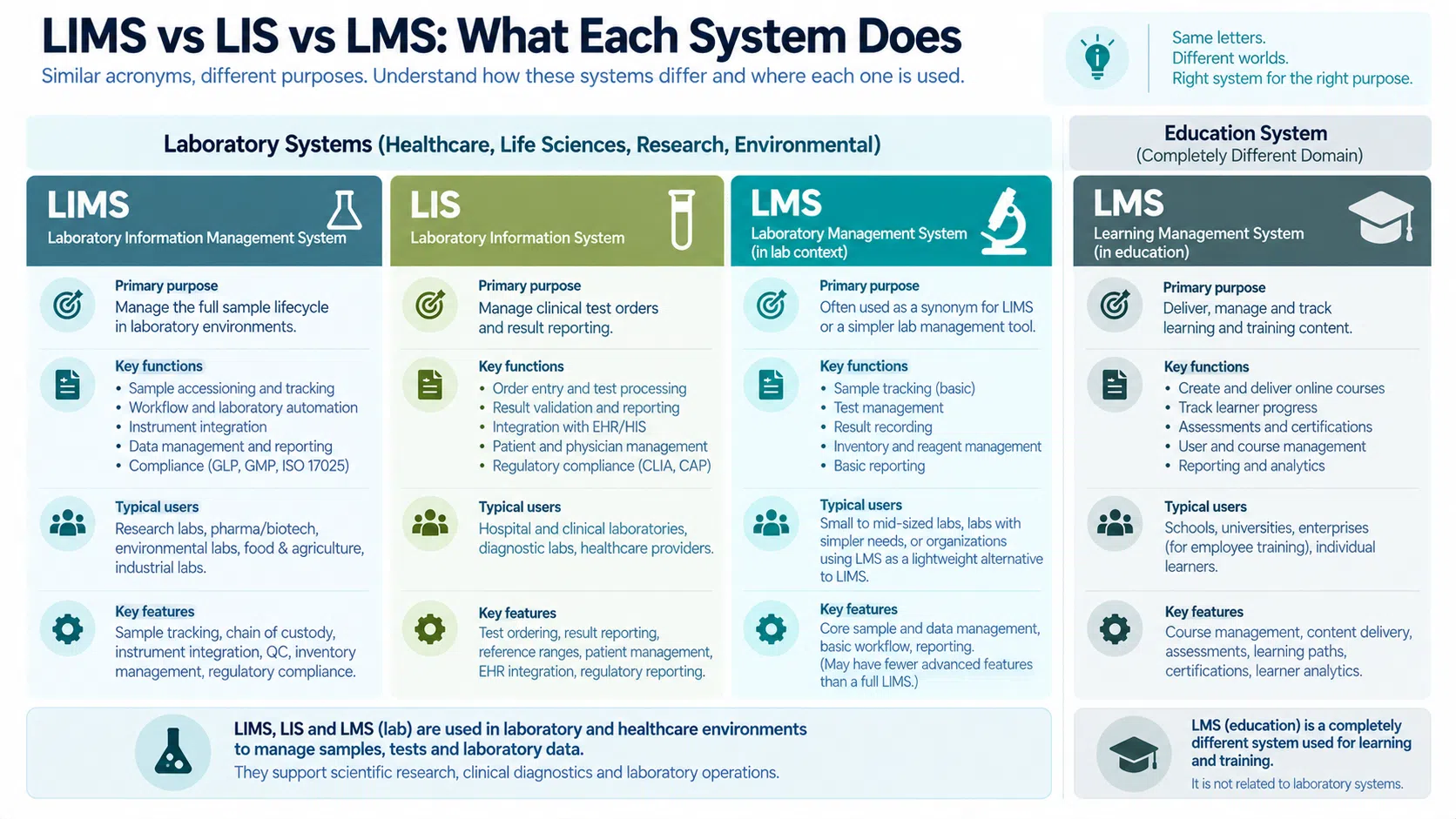
LIMS, LIS, and LMS: what each system does and how they differ in a laboratory context
LMS, LIS, and LIMS are three distinct systems that are frequently confused because their abbreviations overlap and their functions are adjacent. LMS (Laboratory Management System) is a broad term sometimes used interchangeably with LIMS. LIS (Laboratory Information System) is a clinical laboratory system focused on test ordering and result reporting. LIMS (Laboratory Information Management System) is a broader platform covering sample lifecycle, workflow, inventory, and regulatory compliance across laboratory types.
| System | Full name | Primary focus | Typical setting |
| LIMS | Laboratory Information Management System | Full sample lifecycle: accessioning, workflow, instrument integration, inventory, QC, compliance, reporting | Pharmaceutical, biotech, environmental, food safety, clinical research |
| LIS | Laboratory Information System | Test orders from clinical providers, result reporting back to EHR, billing | Hospital clinical laboratories, reference labs |
| LMS (lab context) | Laboratory Management System | Broadly synonymous with LIMS in many vendor contexts; sometimes used for simpler workflow-only tools | Varies by vendor usage |
| LMS (education) | Learning Management System | Training delivery and tracking | Entirely unrelated to laboratory systems; the abbreviation collision is a common source of confusion |
The practical distinction that matters: if the question is about tracking test orders and results in a hospital clinical lab, the relevant system is LIS. If the question is about managing samples, reagents, instruments, QC, and regulatory documentation across a research, pharmaceutical, or environmental laboratory, the relevant system is LIMS. Most large organizations need both, connected by an interface that passes result data from LIMS to LIS.
4. What does a laboratory information system do?
A laboratory information system (LIS) manages the clinical testing workflow in a hospital or reference laboratory: receiving test orders from physicians and EHR systems, routing them to the correct laboratory section, tracking sample processing, and returning results to the ordering provider and patient record.
LIS is purpose-built for the clinical laboratory workflow. A physician orders a complete blood count from an EHR. The order transmits to the LIS via HL7 interface. The LIS creates a work order, assigns a specimen label, and routes the order to the hematology analyzer. The analyzer transmits results back to the LIS via the ASTM interface. The LIS applies reference ranges, flags abnormal values, and routes results for technician review and verification. Verified results transmit back to the EHR and are available to the ordering physician.
LIS and LIMS overlap in some functions (both track specimens and manage results) but are designed for different environments. LIS is designed for the clinical diagnostic laboratory running high-volume standardized tests on patient samples. LIMS is designed for research, pharmaceutical, environmental, and quality control laboratories running varied test panels on complex sample types with extensive regulatory documentation requirements.
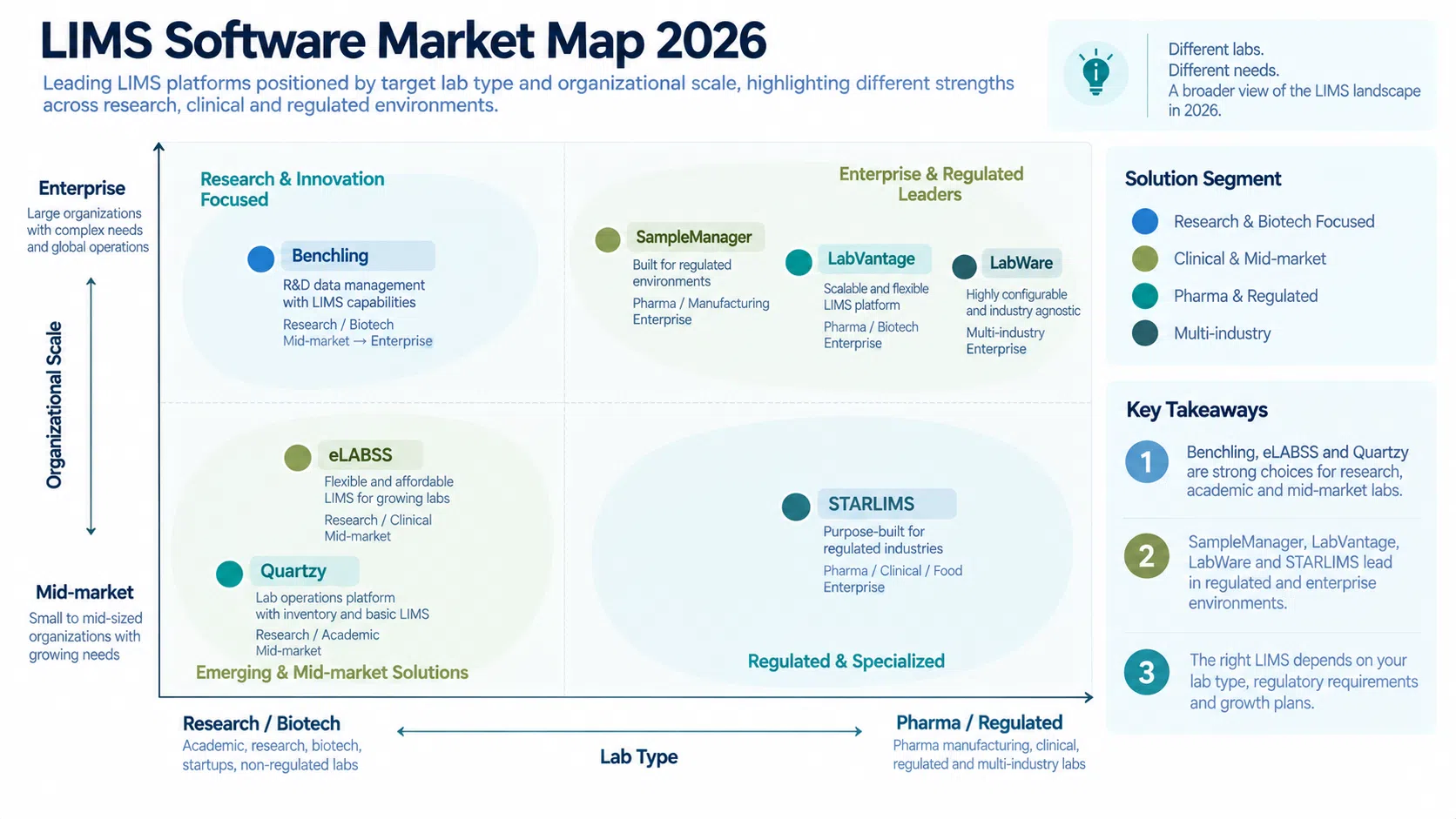
LIMS software platforms in 2026 mapped by laboratory type and organizational scale
5. LIMS software examples: leading platforms in 2026
The LIMS software market spans enterprise platforms for large pharmaceutical and research organizations, mid-market platforms for clinical and environmental labs, and open-source options for research institutions. The most widely deployed platforms in 2026 are LabVantage, LabWare, Benchling, eLABSS, SampleManager (Thermo Fisher), and STARLIMS (Abbott).
LabVantage
EnterprisePharma · Biotech · GMP/GLP
One of the largest enterprise LIMS platforms, widely deployed in pharmaceutical and biotech organizations. Strong regulatory compliance features for 21 CFR Part 11, GMP, and GLP environments. Cloud-native version available as LabVantage OnDemand.
LabWare
EnterpriseHighly configurable · Multi-industry
Among the most configurable enterprise LIMS platforms, with deployments spanning pharmaceutical manufacturing, clinical research, and environmental testing. Known for deep customization capability and large enterprise deployments.
Benchling
R&D focusedBiotech · Early-stage pharma
Life science R&D platform with LIMS as one component alongside electronic lab notebooks and molecular biology tools. Strongest in biotech and early-stage pharmaceutical research.
eLABSS
European marketLife sciences · Clinical research
A European LIMS platform with strong deployment in life sciences and clinical research laboratories. Frequently searched alongside this topic, reflecting active adoption in European markets.
SampleManager (Thermo Fisher Scientific)
EnterprisePharma QC · Manufacturing
Enterprise LIMS with strong instrument integration across Thermo Fisher’s own instrument portfolio. Common in pharmaceutical quality control and manufacturing environments.
STARLIMS (Abbott)
EnterprisePharma · Clinical · Food safety
Enterprise LIMS deployed across pharmaceutical, clinical, and food safety laboratories. Abbott acquired STARLIMS in 2014; it remains one of the most widely deployed platforms in regulated industries.
6. How much does a LIMS typically cost?
LIMS costs range from $10,000 to $500,000 or more for initial implementation depending on platform, laboratory size, number of integrations, and degree of customization. Annual licensing or SaaS subscription costs run from $5,000 for small research labs using entry-level platforms to $100,000 or more for enterprise deployments.
Cost drivers in LIMS implementation are distinct from most software projects because validation is a first-class cost component in regulated environments. A LIMS deployed in a pharmaceutical GMP environment requires Installation Qualification (IQ), Operational Qualification (OQ), and Performance Qualification (PQ) documentation, which can equal or exceed the software implementation cost itself. This is not optional overhead; it is the regulatory requirement for operating in GxP-regulated laboratories.
| Deployment type | Software cost (year 1) | Implementation | Validation | Best for |
| Open-source (SENAITE, openLIMS) | Free (infrastructure costs) | $15,000 – $80,000 | Varies; not pre-validated | Academic research, budget-constrained labs |
| Mid-market SaaS (eLABSS, Quartzy) | $5,000 – $30,000/yr | $10,000 – $50,000 | Limited validation support | Small-to-mid labs, non-GxP environments |
| Enterprise platform (LabVantage, LabWare) | $50,000 – $200,000/yr | $100,000 – $500,000+ | IQ/OQ/PQ packages available | Pharmaceutical, biotech, large clinical labs |
| Custom LIMS development | Build: $80,000 – $300,000 | Included in build | Designed-in from the start | Proprietary workflows, LIMS as a product |
7. Frequently asked questions
Looking for a Trusted Tech Partner That Delivers Your Measurable Values?
Savvycom builds custom healthcare software and clinical systems for health organizations across APAC, Australia, and the US, including laboratory platforms, hospital information systems, and AI-powered clinical tools.
Explore healthcare IT solutions: Healthcare IT Solutions


