Savvycom Healthcare Case Studies: Telemedicine, AI, and Hospital Systems
Healthcare software fails in two predictable places: the integration layer, where new systems meet the clinical and administrative infrastructure that already exists, and the compliance layer, where data architecture decisions made early determine what the system can legally do later. The Savvycom healthcare deployments below were designed around those constraints from the first decision, not the last.
Across telemedicine, AI clinical tools, hospital information systems, and consumer health apps, the pattern is consistent: the technology performs as designed when the architecture is shaped by the operational and regulatory context it will run in. Below are five documented deployments with production outcomes that are measurable.
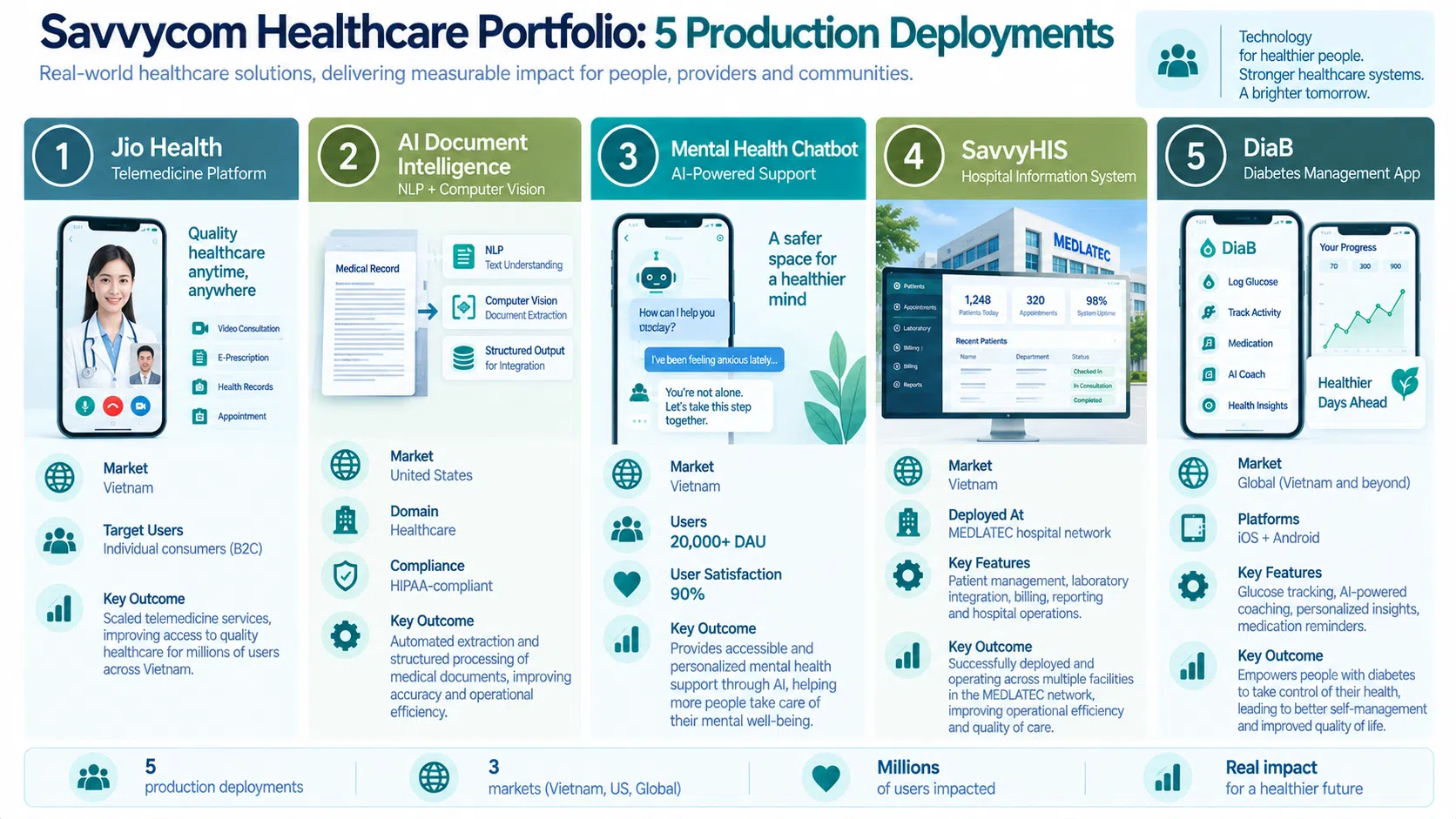
Savvycom’s five documented healthcare deployments across telemedicine, AI, HIS, and consumer health
1. Jio Health: telemedicine at consumer scale in Vietnam
Jio Health is a Vietnamese telemedicine platform built to handle video consultations, appointment management, and electronic prescriptions at a consumer scale. It connects patients with doctors across specialties through a mobile-first experience designed for the Vietnamese healthcare context.
The design challenge was building a telemedicine platform that would work reliably on the mobile infrastructure and connectivity conditions typical of Vietnamese users while handling the clinical workflow requirements of licensed Vietnamese physicians. The data architecture was designed with forward compatibility in mind: as Vietnam’s data protection regulatory framework continues to develop, the system is structured to satisfy strengthening requirements through configuration rather than re-architecture.
Jio Health handles video consultations, appointment scheduling, electronic prescriptions, and patient record access within a single patient-facing app. The platform has operated at consumer scale since launch.
Platform type
Telemedicine (B2C)
Market
Vietnam
Scale
Consumer (production)
Capabilities
Video consultations, scheduling, e-prescriptions, patient records
Full portfolio entry: Jio Health telemedicine.
2. AI document intelligence for US healthcare operations
A US healthcare provider needed to extract and structure clinical and administrative data from unstructured documents: referral letters, insurance forms, lab reports, and discharge summaries arriving in formats that required manual data entry to process. The volume made manual processing a meaningful operational constraint.
The build combined computer vision and NLP to extract and structure document content automatically, feeding downstream clinical and billing workflows. The architecture decision that shaped everything else was HIPAA compliance: de-identification was built into the extraction pipeline from the first design decision, not added at the end. Audit logging, access control, and BAA structure with cloud infrastructure providers were defined before model development began.
The result significantly reduces manual data entry for clinical and administrative workflows. The pipeline is extensible: new document types can be added without re-architecting the compliance layer.
Technology
Computer vision + NLP
Compliance
HIPAA (architecture-first)
Market
United States
Outcome
Significantly reduces manual data entry for clinical and administrative workflows
Full portfolio entry: AI document intelligence for US healthcare.
3. Mental health platform: 20,000+ daily active users
A mental health chatbot platform built for the Vietnamese market achieved over 20,000 daily active users and a 90% user satisfaction rate, demonstrating that AI-assisted mental health tools can achieve consumer-scale adoption in APAC markets where specialist access is limited.
The platform provides conversational support, psychoeducation, and structured intervention protocols through a mobile app. The design challenge was building a tool that felt supportive and clinically grounded without overstating its clinical role or creating dependency patterns that would be counterproductive for users. Clinical governance of the conversation design was a first-class design constraint, not an afterthought.
Scale and satisfaction at these levels in a mental health context reflect both the technology and the clinical design: the tool works because the underlying conversation model was designed by people who understood the clinical context, not just the technical one.
20,000+
Daily active users
90%
User satisfaction rate
Platform type
AI conversational mental health support, psychoeducation, and structured intervention protocols
4. SavvyHIS and DiaB: hospital systems and chronic disease management
SavvyHIS: hospital information system
SavvyHIS is Savvycom’s own hospital information system, developed to meet the specific operational and regulatory requirements of Vietnamese public hospital administration. It handles patient management, clinical documentation, laboratory information, pharmacy, and financial reporting within a single integrated platform.
The system is designed for the constraints of the deployment environment: the Ministry of Health reporting requirements that shape clinical documentation, the Vietnamese social insurance billing model, and the infrastructure typical of hospitals that are not cloud-native by default. It was built outward from local operational reality, not adapted from an international product. The MEDLATEC hospital network is a documented production client.
Full product page: SavvyHIS.
DiaB: diabetes management app
DiaB is a diabetes management app combining blood glucose logging, medication and insulin tracking, meal and carbohydrate recording, and AI-powered coaching. It generates trend reports for sharing with endocrinologists and GPs, bridging self-management and clinical care. The app has maintained an active user base since launch.
Full portfolio entry: DiaB diabetes management app.
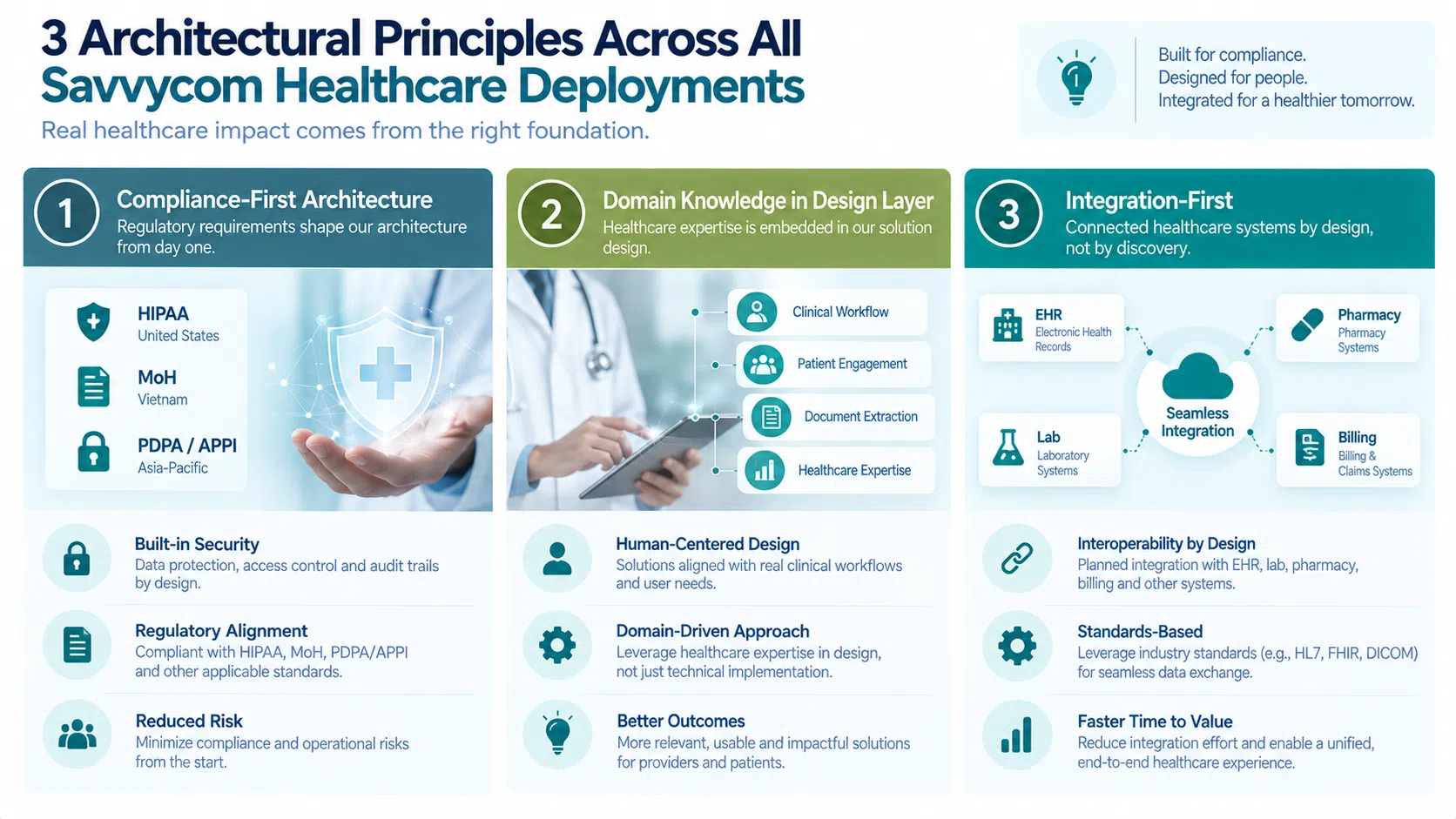
Three architectural principles consistent across all Savvycom healthcare deployments
5. What these deployments have in common
Across these five healthcare engagements, the architectural pattern is consistent: compliance and operational context are the first design inputs, not constraints discovered mid-build. That sequencing is what makes the difference between a system that passes technical review and one that passes regulatory review, clinical governance review, and operational adoption in the environments it was designed for.
Compliance-first architecture
HIPAA for the US healthcare deployment, Vietnamese Ministry of Health requirements for SavvyHIS, and data protection framework compatibility for Jio Health and the mental health platform. Each compliance constraint shaped the architecture before development began.
Domain knowledge in the design layer
Clinical workflow design for SavvyHIS and the mental health platform, patient engagement design for Jio Health and DiaB, and document extraction design for the AI pipeline all required healthcare domain understanding, not just technical execution.
Integration with existing clinical infrastructure
Every deployment connects to the healthcare systems already in place: existing EHR workflows, laboratory systems, pharmacy systems, and billing infrastructure. The integration layer was designed explicitly, not discovered during development.