
Healthcare Coding Systems Explained: ICD, CPT, SNOMED, and HCPCS
Healthcare coding systems are standardized classification frameworks that translate diagnoses, procedures, medications, and clinical findings into codes that healthcare organizations use for billing, documentation, data exchange, and population health analysis. They are not programming languages.
The search query “coding systems like Python” signals a common point of confusion: medical coding and computer programming both use the word “coding,” but they are unrelated fields. Healthcare coding systems are controlled vocabularies and classification schemes maintained by standards bodies such as the WHO, the American Medical Association, and the National Library of Medicine. Their purpose is to create a universal language for healthcare data so that a diagnosis recorded in one country or system can be understood and processed by another.
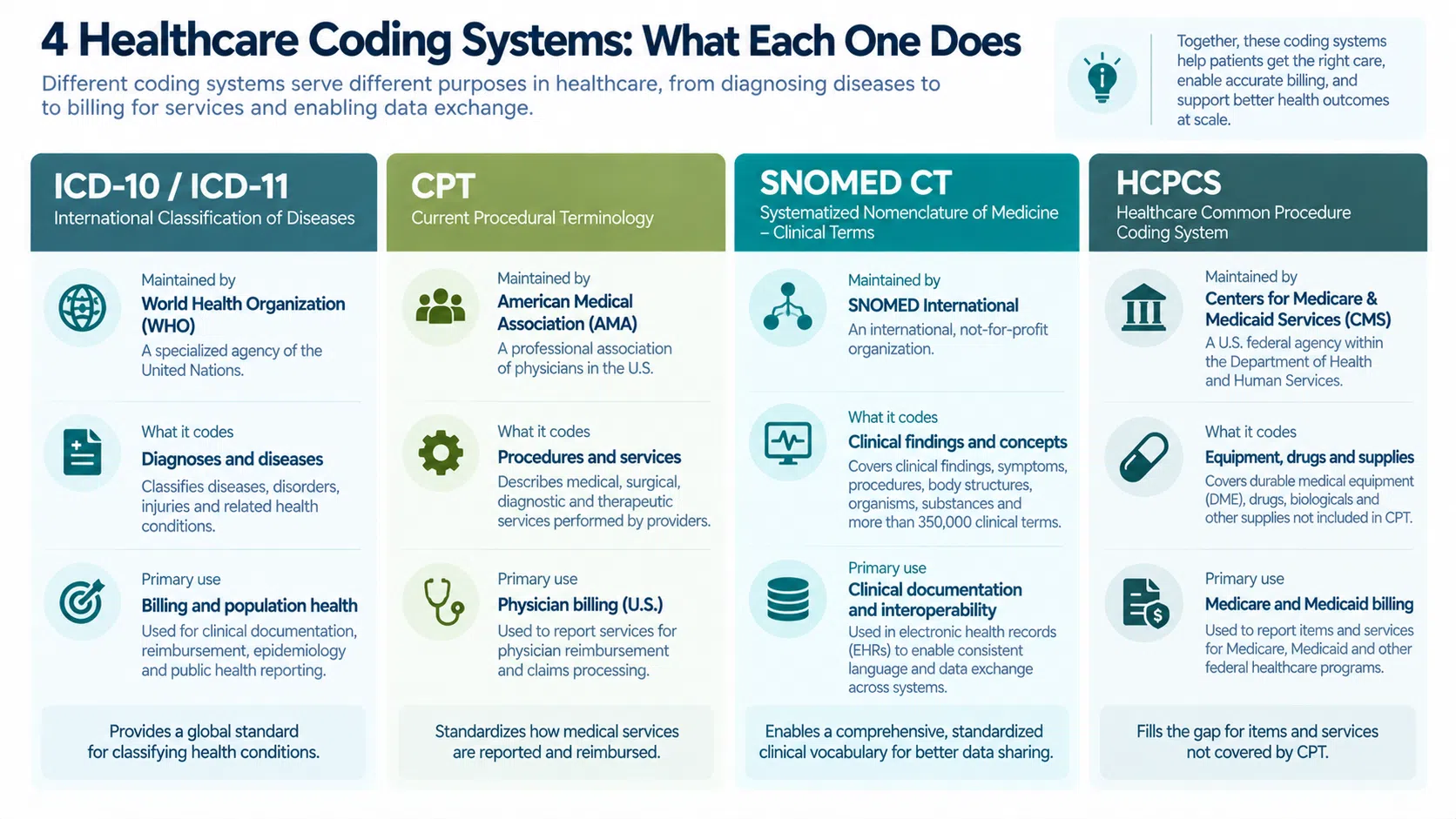
The four primary healthcare coding systems: ICD, CPT, SNOMED CT, and HCPCS — each serving a different function in the healthcare data ecosystem
1. What are the 4 types of medical coding systems?
The four primary healthcare coding systems are ICD (International Classification of Diseases), CPT (Current Procedural Terminology), SNOMED CT (Systematized Nomenclature of Medicine), and HCPCS (Healthcare Common Procedure Coding System). Each serves a different primary purpose in the healthcare data ecosystem.
| System | Maintained by | What it codes | Primary use |
| ICD-10 / ICD-11 | WHO (World Health Organization) | Diagnoses, diseases, causes of death, symptoms | Billing, epidemiology, mortality reporting, population health |
| CPT | American Medical Association (AMA) | Medical, surgical, and diagnostic procedures and services | Physician billing to insurers in the US |
| SNOMED CT | SNOMED International | Clinical findings, diagnoses, procedures, anatomy, drugs | Clinical documentation, EHR data, interoperability |
| HCPCS | CMS (Centers for Medicare & Medicaid Services) | Medical equipment, supplies, drugs, non-physician services | Medicare and Medicaid billing in the US |
2. How the main healthcare coding systems work
Each coding system uses a defined structure to represent clinical concepts as alphanumeric codes, which can then be processed by billing systems, EHRs, and public health databases without ambiguity.
ICD-10 and ICD-11
ICD-10 uses a 3-to-7 character alphanumeric code to classify diseases and health conditions. The first character is a letter indicating the chapter (A for infectious diseases, C for cancer, J for respiratory conditions), followed by numeric characters that specify the condition and its detail. ICD-11, published by WHO in 2019 and adopted progressively by countries since 2022, uses a more flexible structure and covers more clinical detail. Most countries outside the US have migrated or are migrating to ICD-11; the US transitioned from ICD-9 to ICD-10 in 2015, and ICD-11 adoption is under development.
CPT codes
CPT codes are five-digit numeric codes grouped into three categories. Category I codes cover established procedures and services (surgery, medicine, radiology, and pathology). Category II codes are optional performance measurement codes. Category III codes are temporary codes for emerging technologies and services. In US physician billing, the CPT code for a procedure is submitted alongside the ICD diagnosis code to the insurer, which uses both to determine coverage and payment.
SNOMED CT
SNOMED CT is the most comprehensive clinical terminology system, covering over 350,000 active concepts, including clinical findings, procedures, body structures, organisms, substances, and situations. Unlike ICD (designed for statistical classification) and CPT (designed for billing), SNOMED CT was designed for clinical documentation: capturing exactly what a clinician observed, found, or did, in enough detail to support clinical decision support, patient safety rules, and cross-system data exchange. It is the foundation for EHR clinical data in many countries and is required for NHS data in the UK.
HCPCS
HCPCS (pronounced “hick-picks”) has two levels. Level I codes are CPT codes. Level II codes cover items. CPT does not include durable medical equipment (wheelchairs, prosthetics), ambulance services, drugs administered by providers, and certain outpatient procedures. HCPCS Level II codes begin with a letter (A through V) followed by four digits. They are required for Medicare and Medicaid billing in the US and are used by many private payers as well.
3. What are the 3 types of medical coding?
The “3 types of medical coding” framing refers to the three main coding domains used in medical billing: diagnosis coding (ICD), procedure coding (CPT/HCPCS), and medical billing itself (the process of combining diagnosis and procedure codes into a claim). Some sources also use 3-type frameworks that divide by setting: inpatient, outpatient, and physician office.
The distinction between “3 types” and “4 types” reflects different classification frameworks rather than a disagreement about the systems themselves. The four coding systems (ICD, CPT, SNOMED CT, HCPCS) are the most precise taxonomy of the actual systems in use. The 3-type framing is more common in medical billing education, where the focus is on how codes are applied in claims rather than on the underlying systems.
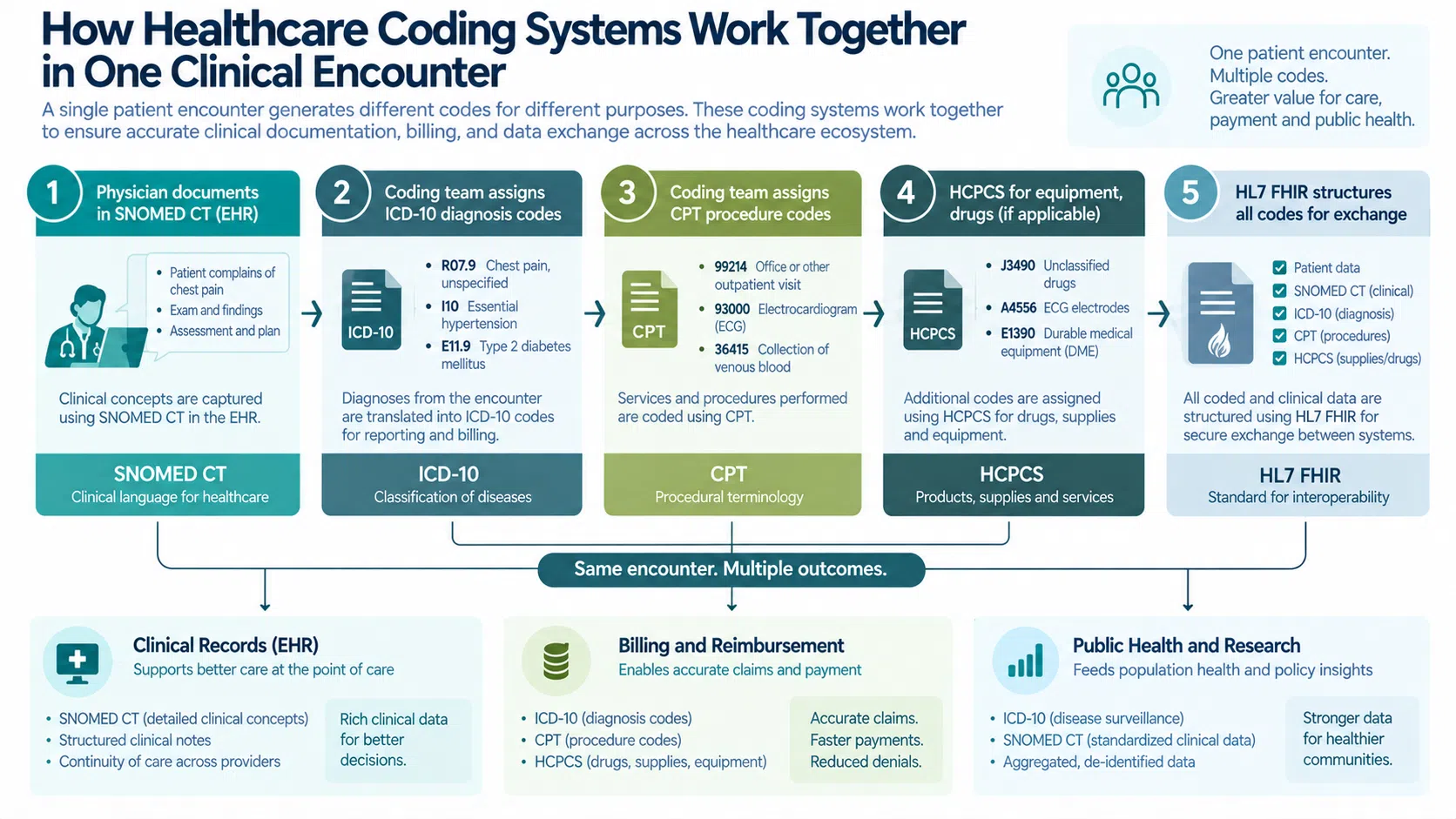
How ICD, CPT, SNOMED CT, and HL7 FHIR work together in a single clinical encounter: from documentation to billing to interoperability
4. How healthcare coding systems connect: interoperability and data exchange
Healthcare coding systems are designed to work together. A single clinical encounter generates ICD diagnosis codes, CPT procedure codes, and SNOMED CT clinical documentation codes simultaneously, each serving a different downstream function.
In a US hospital encounter, the physician documents findings and procedures in SNOMED CT (captured in the EHR). The coding team translates these into ICD-10 diagnosis codes and CPT procedure codes for the claim. The claim is submitted to the insurer with both. The ICD codes feed public health reporting systems. The CPT codes determine reimbursement. The SNOMED CT documentation remains in the EHR for clinical continuity and quality measure calculation.
The HL7 FHIR standard (Fast Healthcare Interoperability Resources) defines how these coded data elements are structured and exchanged between systems. FHIR resources carry ICD, CPT, SNOMED CT, and LOINC codes in defined fields so that a patient record created in one EHR can be interpreted correctly by another system without manual re-coding.
How the systems flow through a single encounter
SNOMED CT: Physician documents clinical findings in the EHR (what was observed and done)
ICD-10: Coding team converts findings to diagnosis codes (for billing and public health)
CPT: Coding team assigns procedure codes (what the insurer is asked to reimburse)
HCPCS: Equipment, drugs, and non-physician services coded for Medicare/Medicaid claims
HL7 FHIR: Structured exchange standard that carries all of the above between systems
5. Medical coding in practice: roles and systems
Medical coders are healthcare professionals who translate clinical documentation into the standardized codes used for billing and data reporting. The primary certification bodies are AHIMA (American Health Information Management Association) and AAPC (American Academy of Professional Coders).
Medical coders work with EHRs, practice management systems, and dedicated encoder software. Encoders are tools that help coders search code sets, apply coding guidelines, and validate code combinations. Major encoder platforms include 3M 360 Encompass, Optum360 EncoderPro, and TruCode. AI-powered coding tools are increasingly entering production in larger health systems, using NLP to extract codes directly from clinical notes, with human coder review for accuracy and compliance.
For context on how healthcare software systems manage clinical data and documentation, see the guide on telemedicine app development.
6. Frequently asked questions
Looking for a Trusted Tech Partner That Delivers Your Measurable Values?
Savvycom builds healthcare IT systems, including EHR integrations, clinical data platforms, and AI-powered healthcare tools for health organizations across APAC, Australia, and the US.
Explore: Healthcare IT Solutions
Related reading:
Telemedicine App Development: A Complete Guide
Benefits of AI in Healthcare
Healthcare IT Solutions


