IT Consulting vs In-House IT: Cost and Trade-offs (2026)
The choice between IT consulting and an in-house IT team is not a question of which is better. It is a question of which model fits the problem you are solving right now, at your current scale, within your timeline.
The range of skills a modern organization needs, spanning cloud architecture, cybersecurity, AI, data engineering, and compliance, has outpaced what most internal teams can cover at depth. That, more than cost, is why a growing share of IT budgets goes to external partners: not because in-house teams are failing, but because no team of three to five people covers every one of those domains at production depth.
This guide compares the two models across the dimensions that actually drive the decision: cost, expertise, speed, risk, and flexibility.
1. What is the real cost difference between IT consulting and in-house IT?
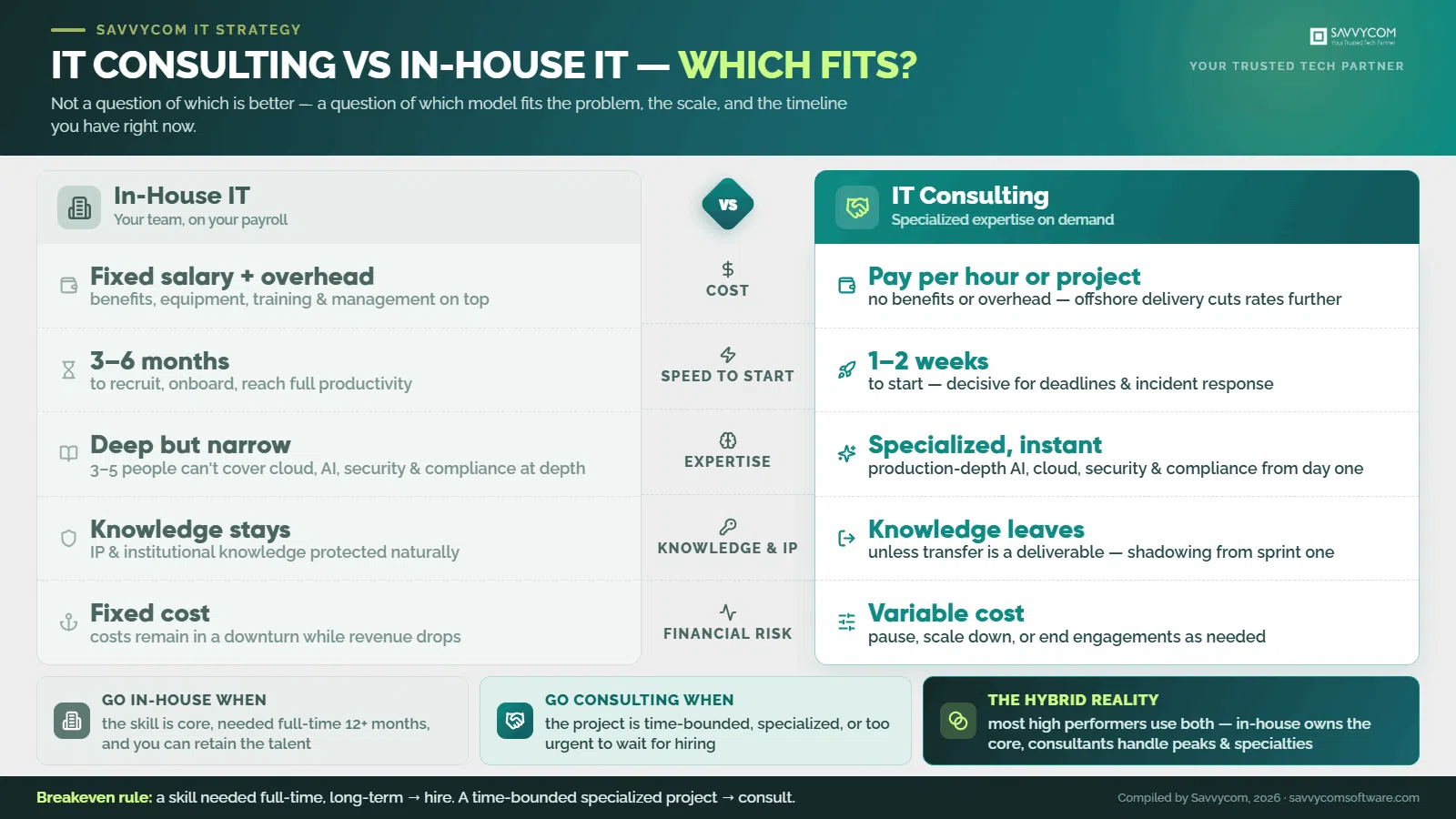
IT consulting typically costs $100 to $250 per hour for general work and $300 to $500 or more per hour for specialized fields like AI and cybersecurity in the US. An in-house IT professional runs roughly $85,000 to $200,000 a year before benefits, overhead, and management cost.
The comparison is not as straightforward as hourly rate versus salary. An in-house hire carries benefits (20 to 30% of salary), equipment, office space, training, and management overhead. A consultant carries none of those but charges a higher hourly rate. The breakeven depends on utilization: if you need 40 hours a week of a specific skill for 12 or more months, in-house is almost always cheaper. If you need that skill for a 3-month project, consulting costs less than hiring, onboarding, and then figuring out what to do with the hire after the project ends.
Two more options change the arithmetic. Managed services cover ongoing IT support at $100 to $300 per user per month, including monitoring, helpdesk, patching, and backup; for organizations without the scale to justify a full internal department, this is often the most cost-effective route. And offshore delivery through Vietnam-based firms runs $25 to $45 per hour, with senior AI and data roles around $55, which moves the breakeven substantially: at those rates, even year-long engagements can cost less than a single fully loaded US hire.
| Cost dimension | In-house IT | IT consulting | Managed services |
|---|---|---|---|
| Cost structure | Fixed (salary + benefits + overhead) | Variable (hourly or project-based) | Predictable monthly (per user) |
| Annual cost (mid-level, US) | $110,000 – $260,000 fully loaded | Project-dependent ($50K – $300K+) | $1,200 – $3,600 per user/year |
| Hidden costs | Recruitment, training, turnover, management | Scope changes, handover, knowledge transfer | Vendor lock-in, customization limits |
| Cost predictability | Low (turnover, raises, unplanned projects) | Medium (fixed-price or T&M) | High (monthly fixed fee) |
2. The expertise and speed trade-off
In-house teams build deep institutional knowledge but often lack specialized depth. Consultants bring specialized expertise immediately but leave when the project ends, taking their knowledge with them.
The practical reality in 2026: the technology skills an organization needs change faster than internal teams can reskill. Cloud architecture, cybersecurity, AI, data engineering, and compliance each require years of experience. No single team of three to five people covers all of them at production depth. This is the primary reason organizations turn to consulting, not because internal teams are weak but because the breadth of required skills has expanded beyond what a small or mid-sized internal team can cover.
Speed is the second factor. An in-house hire takes 3 to 6 months to recruit, onboard, and bring to full productivity. A consulting engagement can begin within 1 to 2 weeks. For time-sensitive projects, such as a compliance deadline, a security incident response, or a competitive window, that speed difference determines whether the project happens at all.
The trade-off: consultants are faster to deploy and deeper in specialty, but they leave. The knowledge they generate must be documented and transferred, or the organization becomes dependent on re-engaging the same firm. The best consulting engagements include explicit knowledge transfer as a deliverable, not as an afterthought.
3. Risk, control, and IP considerations
In-house teams offer more control over priorities, IP ownership, and institutional knowledge. Consulting carries vendor dependency and knowledge-transfer risk but reduces the risk of carrying fixed costs during downturns.
- IP and institutional knowledge: If the work involves proprietary technology, trade secrets, or competitive-advantage systems, in-house development protects IP more naturally. Consultants can work under NDA and IP assignment agreements, but the risk of knowledge leakage increases with each external party involved.
- Vendor dependency: Organizations that rely heavily on a single consulting partner risk dependency. If the partner becomes unavailable, institutional knowledge walks out the door. The mitigation that works in practice, and the one Savvycom structures into hybrid engagements by default, is internal staff shadowing the delivery team from the first sprint, with documentation reviewed at each milestone rather than dumped at handover.
- Financial risk: In-house teams are fixed costs. In a downturn, those costs remain while revenue drops. Consulting is variable: engagements can be paused, scaled down, or ended. For organizations in cyclical industries, this flexibility is a material financial advantage.
4. When should you choose IT consulting over in-house?
Choose IT consulting when you need specialized skills for a defined period, when the timeline does not allow for hiring, or when the project involves technology your team has not worked with before. Choose in-house when the capability is core to your business, when you need it continuously, and when you can attract and retain the talent.
- Choose consulting when: The project is time-bounded (3 to 12 months). The skills required are specialized and not needed permanently (AI, compliance audit, cloud migration, security assessment). The timeline is urgent and does not permit 3 to 6 months of hiring. The work involves a technology or regulatory environment your team has not handled before.
- Choose in-house when: The capability is core to your competitive advantage. You need it continuously, not just for a project. You can realistically attract, pay for, and retain the talent in your market. The work involves deep institutional knowledge that is difficult to transfer.
- The hybrid model: Most organizations that perform well use both. In-house teams own core systems and institutional knowledge. Consultants handle specialized projects, peak-demand periods, and technology areas where the internal team lacks depth. The decision is not binary; it is a portfolio.
5. How the decision changes by company stage and industry
The right balance between consulting and in-house shifts as a company grows and depends heavily on industry-specific factors like regulation, compliance, and the pace of technology change.
- Startups and early-stage companies: Rarely have the budget for a full IT team. Consulting and managed services cover the gaps until the company reaches the scale where in-house hires are justified. Fractional CTO arrangements offer executive technology leadership at a fraction of the cost of a full-time hire.
- Mid-market companies (100 to 1,000 employees): Typically have a small internal IT team for day-to-day operations and use consultants for projects that exceed internal capacity, including cloud migration, ERP implementation, cybersecurity assessments, and AI initiatives.
- Enterprises (1,000+ employees): Maintain large internal IT organizations but increasingly use consulting for specialized transformation, compliance, and innovation projects. The consulting spend is not a substitute for internal capability; it is an extension for areas where the internal team lacks depth or bandwidth.
- Regulated industries (healthcare, BFSI, government): Compliance requirements add a layer that favors consultants with specific regulatory experience. A consultant who has built HIPAA-compliant systems or navigated Basel III requirements delivers faster and with fewer compliance gaps than an internal team encountering those frameworks for the first time.
6. Frequently asked questions
What is the difference between IT services and IT consulting?
IT services deliver ongoing operational support: helpdesk, monitoring, maintenance, and managed infrastructure, typically priced per user per month. IT consulting delivers strategic advice and project-based expertise: architecture design, technology selection, and implementation, priced per hour or per project with defined end dates. Services keep things running; consulting changes how things run.
What is the difference between in-house and outsourcing?
In-house means the work is done by employees on your payroll under your direct management. Outsourcing means an external provider does it, whether onshore, nearshore, or offshore. The trade-off is control versus flexibility: in-house protects IP and institutional knowledge, while outsourcing offers specialized skills on demand and variable rather than fixed cost.
Can you combine in-house IT with consulting?
Yes, and most well-performing organizations do. The standard split: the in-house team owns core systems, daily operations, and institutional knowledge, while consultants handle specialized projects, peak demand, and technologies the internal team has not worked with. The key to making it work is structured knowledge transfer, so each engagement leaves the internal team stronger.
How much does an IT consultant cost in 2026?
In the US, general IT consulting runs $100 to $250 per hour, and specialized fields like AI, cybersecurity, and cloud architecture command $300 to $500 or more. Managed services cost $100 to $300 per user per month. Vietnam-based delivery runs $25 to $45 per hour for equivalent execution work, with senior AI and data roles around $55.
Going deeper: for what a consulting engagement actually includes, how it is structured, and what it should deliver, see the guide on technology consulting services.