Logistics App Development Cost: 2026 Breakdown
Logistics app development costs range from $20,000 for a focused single-function tool to over $300,000 for a full-featured enterprise platform with multi-carrier integration, AI optimization, and real-time IoT connectivity. Most production-ready logistics apps for commercial operators land between $50,000 and $150,000 depending on feature scope and team location.
The cost range is wide because logistics apps cover fundamentally different builds: a driver app with GPS tracking and proof of delivery is a different project from a multi-facility WMS with IoT integration, and neither is the same as a customer-facing shipment tracking portal. Before any estimate means anything, the app type and its integration requirements need to be defined.
This guide breaks down logistics app development cost by type, by scope, by team location (including Vietnam cost comparison), by hidden costs most estimates miss, and by ongoing maintenance. For the broader logistics software context, see the guide on logistics software development.
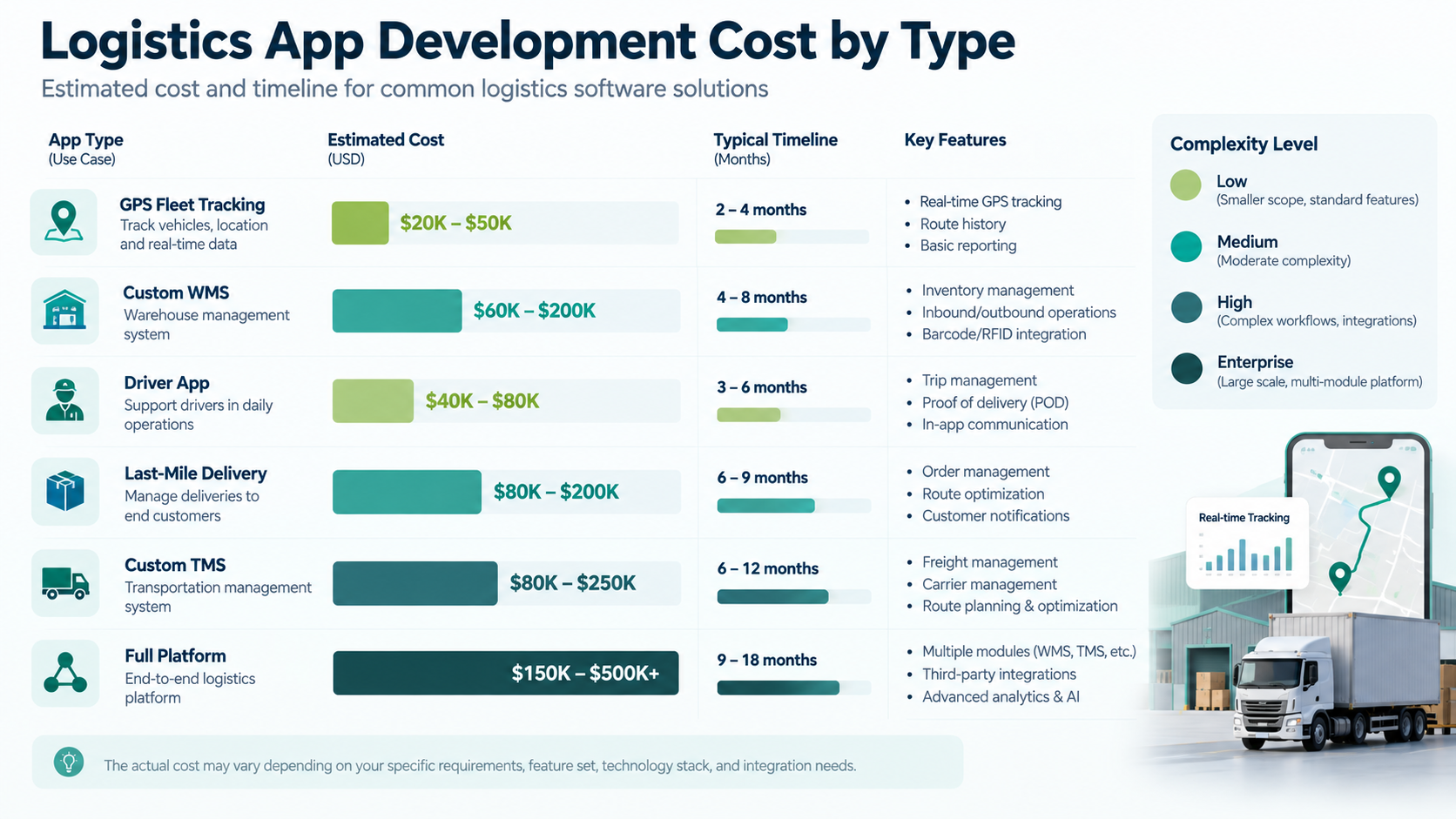
Logistics app development cost by app type: from GPS tracking to full enterprise platform
1. How much does it cost to develop a logistics app?
Logistics app development costs $20,000 to $300,000+ depending on app type, feature scope, integration count, and team location. A GPS tracking app for a small fleet costs $20,000 to $50,000. A driver app with dispatch, POD, and basic route optimization runs $40,000 to $80,000. A full last-mile delivery platform with AI routing, real-time tracking, and customer notifications runs $80,000 to $200,000.
| App type | Cost range | Timeline | Primary cost drivers |
| GPS fleet tracking (basic) | $20,000 – $50,000 | 2 – 4 months | Device integration, map API, real-time updates |
| Driver app (dispatch + POD + routing) | $40,000 – $80,000 | 3 – 5 months | Mobile app (iOS + Android), dispatch backend, carrier API |
| Last-mile delivery platform | $80,000 – $200,000 | 5 – 9 months | AI route optimization, customer notifications, POD, integration |
| Custom TMS | $80,000 – $250,000 | 6 – 12 months | Multi-carrier integration, freight audit, ERP sync, reporting |
| Custom WMS | $60,000 – $200,000 | 5 – 10 months | Inventory management, picking algorithms, RFID/barcode, ERP |
| Full logistics platform (TMS + WMS + visibility) | $150,000 – $500,000+ | 10 – 18 months | All above plus supply chain visibility, analytics, IoT |
2. The five factors that determine logistics app development cost
Five variables account for most of the cost variance in logistics app development: feature complexity, integration count, mobile versus web, AI capability, and team location.
Feature complexity
A basic GPS tracker with a map display costs a fraction of an AI-powered route optimizer that accounts for traffic, delivery windows, vehicle capacity, and driver hours. Real-time features (live tracking, instant notifications) are more expensive than batch or periodic updates because they require different infrastructure.
Integration count
Every external system the app connects to adds cost: ERP (SAP, Oracle), carrier APIs (FedEx, UPS, regional), map providers (Google Maps, HERE), IoT platforms, barcode/RFID scanners, and customs APIs. Integration is consistently the most underestimated cost line. A project briefed with three integrations typically discovers five or seven once data flows are mapped properly.
Mobile, web, or both
A web-only logistics management platform costs less than one that also requires native iOS and Android driver apps. Adding mobile adds 30 to 50% to the development scope. Cross-platform frameworks (React Native, Flutter) reduce mobile cost by 30 to 40% compared to building native apps separately.
AI and optimization
Route optimization, demand forecasting, and predictive maintenance each require ML model development, training data pipelines, and inference infrastructure on top of the core app. This adds $30,000 to $150,000 depending on complexity. Static algorithmic optimization costs less than dynamic AI optimization.
Team location
The same feature set costs significantly different amounts depending on where the team is based. US teams charge $150 to $250 per hour. Western European teams run $100 to $180. Vietnam, Eastern Europe, and India range from $25 to $60 per hour. On a 2,000-hour project, the difference between a US team and a Vietnam team can be $200,000 to $380,000.
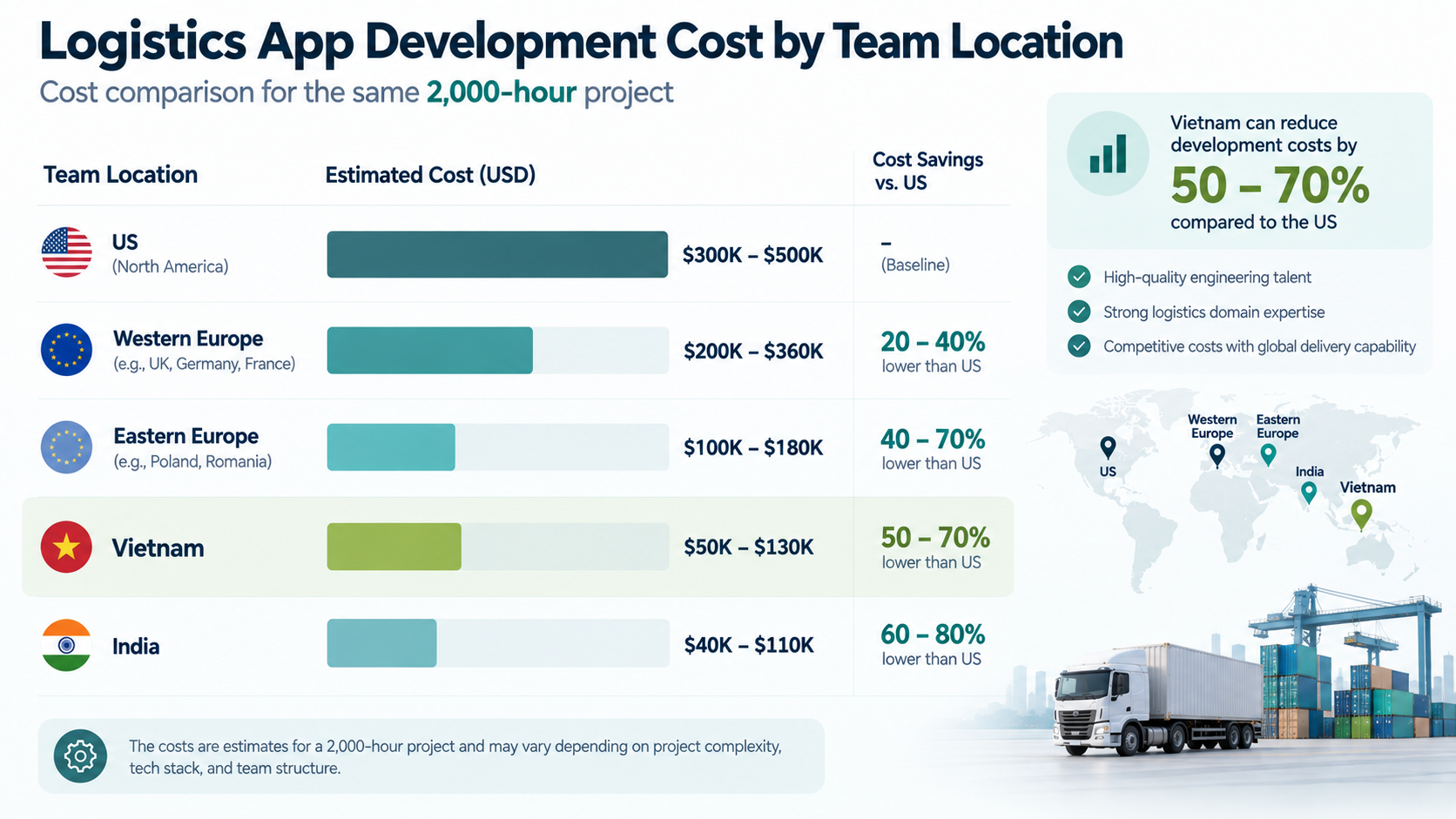
Logistics app development cost comparison by team location: Vietnam delivers 50–70% savings vs US teams
3. Logistics app development cost in Vietnam
Vietnam-based logistics app development typically costs 50 to 70% less than equivalent US or Western European development, with engineering quality for complex logistics systems that has matured significantly over the past decade. A logistics platform that costs $200,000 with a US team costs $60,000 to $100,000 with a well-chosen Vietnam-based team.
The cost savings are most significant for execution-heavy work: custom software development, mobile app development, backend API development, and integration engineering. Strategy, architecture, and programme management benefit less from location arbitrage because the value there is judgment and domain knowledge rather than engineering hours.
Vietnam rates in 2026 for logistics software development run $25 to $45 per hour for mid-level engineers and $40 to $65 for senior engineers with logistics domain experience. Project-based estimates from established Vietnam IT firms for a mid-complexity logistics app (driver app + dispatch backend + basic tracking) typically run $40,000 to $80,000, with timelines of 4 to 8 months.
| Team location | Hourly rate range | Cost for 2,000-hr project | Best for |
| United States | $150 – $250/hr | $300,000 – $500,000 | Senior strategy, architecture, US compliance |
| Western Europe | $100 – $180/hr | $200,000 – $360,000 | European compliance, EU market operators |
| Eastern Europe | $50 – $90/hr | $100,000 – $180,000 | Technical execution, European timezone |
| Vietnam | $25 – $65/hr | $50,000 – $130,000 | Full delivery, APAC domain, best cost-quality ratio |
| India | $20 – $55/hr | $40,000 – $110,000 | Scale, large teams, backend-heavy builds |
4. What hidden costs do most logistics app estimates miss?
Four cost categories consistently surprise organizations that budget based on initial development estimates alone: third-party API fees, app store compliance, change management, and the discovery phase.
Third-party API and licensing fees
Map APIs (Google Maps, HERE) charge by request volume and can cost $10,000 to $50,000 per year for a high-volume logistics operation. Carrier API access may require commercial agreements. SMS/notification infrastructure carries per-message costs that scale with delivery volume. These recurring costs are often excluded from development estimates but are real operational costs.
App store publishing and compliance
Apple App Store and Google Play require annual developer accounts ($99 and $25) and mandate compliance with platform guidelines on data privacy, permissions, and content. App updates require review cycles of 1 to 7 days. For enterprise apps distributed to driver fleets, MDM platforms add further infrastructure cost.
Change management and training
Driver adoption of new dispatch and tracking apps requires structured onboarding. Operations staff need training on the dispatch and reporting platform. Organizations that skip change management investment consistently report lower adoption and worse ROI from their technology investment.
Discovery phase
The most common cause of logistics app budget overruns is committing to a fixed price before the team understands the actual scope. A structured discovery phase (2 to 4 weeks, $5,000 to $15,000) maps workflows, catalogs integrations, and produces a realistic scope document. This investment prevents far more expensive mid-build scope changes.
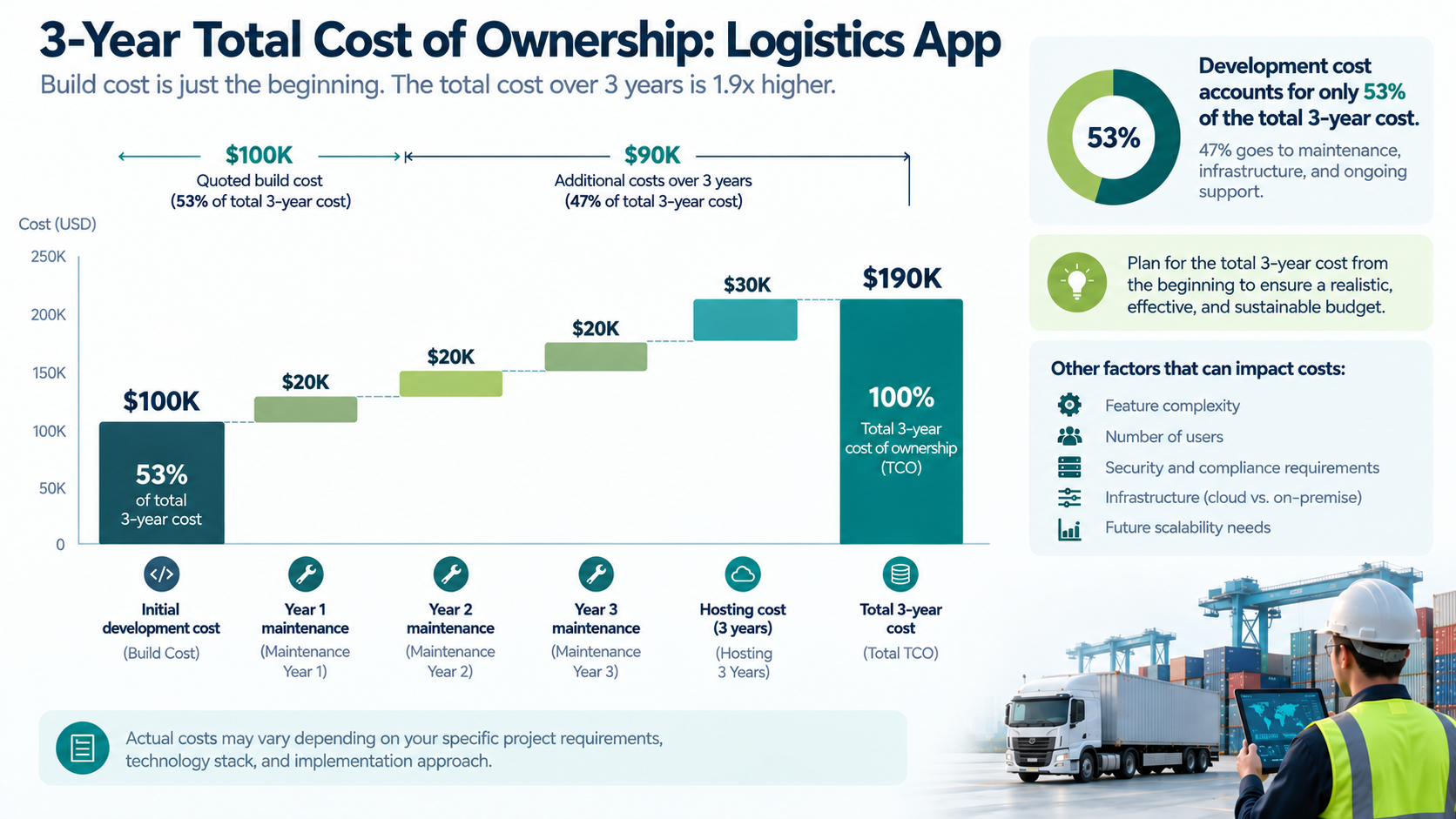
Three-year total cost of ownership for a $100K logistics app: build cost is only 53% of the actual investment
5. Logistics app maintenance cost after launch
Logistics app maintenance typically costs 15 to 25% of the initial development cost per year. For a $100,000 logistics app, annual maintenance runs $15,000 to $25,000. This covers bug fixes, OS and dependency updates, carrier API changes, security patches, and minor feature additions.
The 15 to 25% rule is a general benchmark. Actual maintenance cost depends on the complexity of integrations (carrier APIs change frequently; customs and compliance APIs can change with regulatory updates), the rate of feature development, and the quality of the original build.
What logistics app maintenance covers
OS and dependency updates: iOS and Android release major updates annually, requiring compatibility testing and often code changes. Third-party libraries deprecate features and release security patches that require updating. This is ongoing, non-negotiable maintenance that cannot be deferred without accumulating technical debt.
Carrier and integration API changes: Carrier APIs (FedEx, UPS, and regional carriers) change rate structures, endpoint formats, and authentication methods on their own schedules. Map API providers update SDKs. Each change requires corresponding updates to the integration layer.
Feature updates and improvements: Operational teams identify workflow improvements after go-live. Regulatory changes (ELD compliance in the US, digital tachograph requirements in the EU) may require mandatory feature additions.
Infrastructure and hosting: Cloud hosting (AWS, Azure, Google Cloud) carries monthly costs that scale with user count, data volume, and real-time feature usage. A logistics platform tracking 100 vehicles in real time costs more to operate than a batch-processing order management system.
How to budget for maintenance
Budget maintenance from day one, not as a post-launch discovery. The total cost of ownership over three years is a more relevant number than the build cost alone. A logistics app that costs $100,000 to build, $20,000 per year to maintain, and $30,000 to host over three years has a three-year TCO of $190,000, not $100,000. Proposals that quote build cost only are presenting an incomplete cost picture.
6. How to build an accurate logistics app development budget
An accurate logistics app budget is built from the workstream breakdown upward, not from a single number downward.
Step 1: Define the app type and integration list
Which logistics function does the app serve (fleet tracking, dispatch, last-mile delivery, WMS, or TMS)? Which systems must it connect to (ERP, carrier APIs, IoT devices, customer portal)? This definition determines the scope before any estimate is meaningful.
Step 2: Run a discovery phase
A 2 to 4 week discovery produces a realistic scope document, integration map, and architecture recommendation. The $5,000 to $15,000 cost prevents the far more expensive mid-build scope changes.
Step 3: Get location-adjusted estimates
For the same feature set, compare estimates from US-based, Vietnam-based, and Eastern European teams. The comparison reveals the cost of location premium versus domain-risk trade-off for your specific requirements.
Step 4: Build the 3-year TCO
Add 15 to 25% of build cost per year for maintenance, plus third-party API fees, hosting, and planned feature development. The 3-year TCO is the number that should inform the build-vs-buy decision.
7. Frequently asked questions
Looking for a Trusted Tech Partner That Delivers Your Measurable Values?
Savvycom builds logistics apps and platforms for operators across APAC, Japan, South Korea, Australia, and the US. Every engagement starts with a discovery phase that maps scope and integration requirements before any fixed-price commitment.
Discuss your logistics app requirements: Custom Software Development
Related reading:
Logistics Software Development: A Complete Guide
Logistics Software Development Cost: 2026 Breakdown
Last-Mile Delivery Software: Features and Cost