7 Best Medical Record Apps in 2026 for Personal Health Management
The 7 best personal health record and health management apps in 2026 are Apple Health, Health Connect (Android), CommonHealth, MyChart, Medisafe, HealthEngine, and DiaB. The right app depends on whether you need to aggregate wearable data, access clinical records from health systems, manage medications, or track a specific chronic condition.
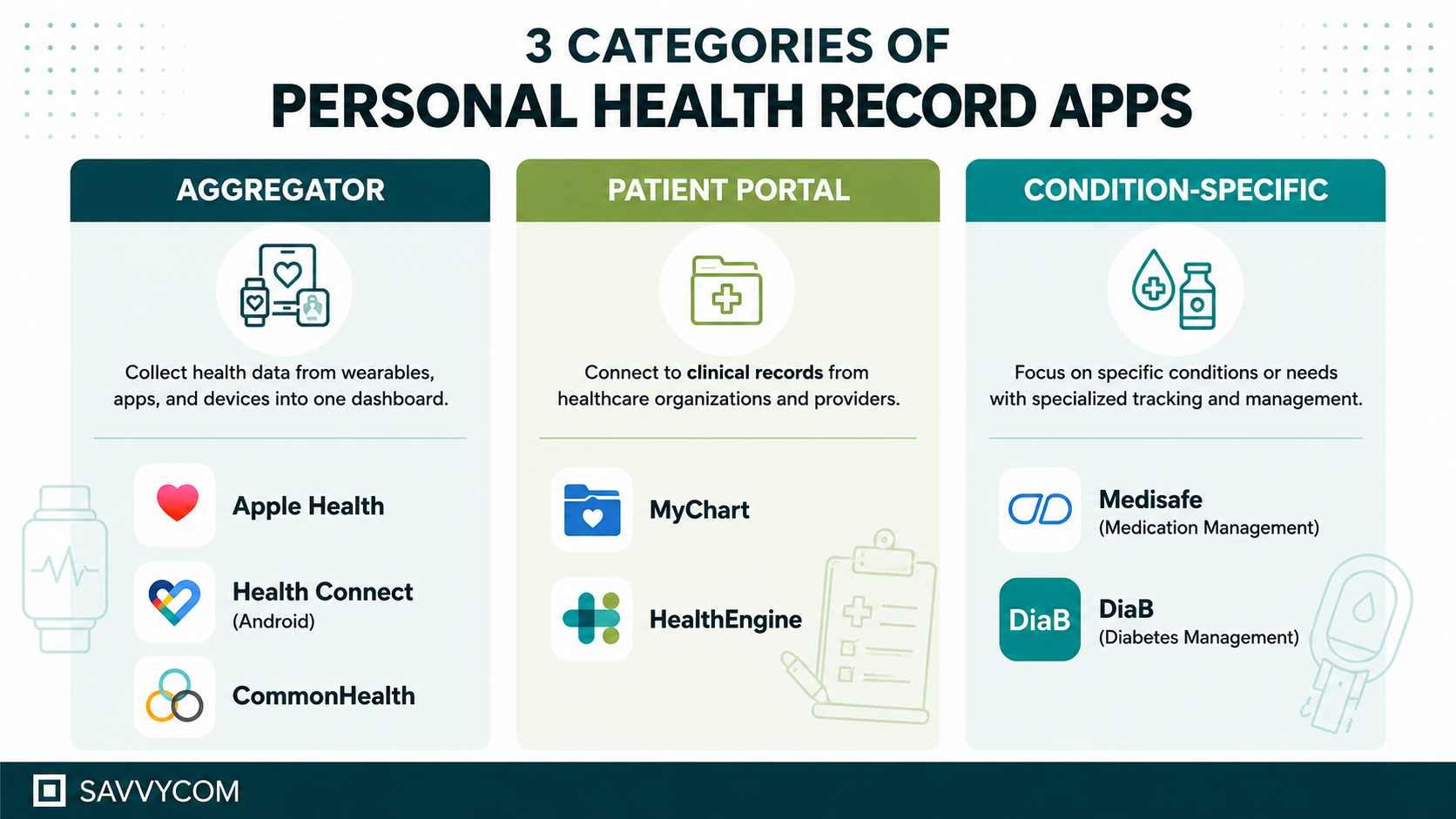
Personal medical record apps fall into three categories. Aggregator apps (Apple Health, Health Connect) collect data from wearables, fitness trackers, and connected apps into one dashboard but depend on users or providers to add clinical records manually or through supported integrations. Patient portal apps (MyChart, HealthEngine) connect to actual clinical records from healthcare organizations but are limited to providers using compatible systems. Condition-specific apps (Medisafe for medications and DiaB for diabetes) offer depth in one health domain alongside record-keeping.
This guide covers each app’s strengths, the free options, and what to look for when choosing a personal health record app. For the broader context of how healthcare organizations build and manage health records digitally, see the guide on healthcare software development.
1. What is the best app for keeping your patient record?
Apple Health (iOS) and CommonHealth (Android) are the best apps for keeping and accessing your patient records in 2026, because both support the FHIR standard that allows direct clinical record download from participating health systems, and both store records on-device rather than in a third-party cloud.
The technical standard that makes personal health records portable is FHIR (Fast Healthcare Interoperability Resources), mandated by the US 21st Century Cures Act. Participating health systems must make patient records available through FHIR APIs, which Apple Health and CommonHealth connect to. If your health system participates, you can pull your actual clinical records, labs, medications, immunizations, and visit summaries directly into the app.
The limitation is participation: not all health systems globally support FHIR API access, particularly outside the US. In markets without FHIR mandate adoption, manual record entry or provider-specific apps (MyChart for Epic-based systems or HealthEngine in Australia) are the practical options.
2. The 7 best medical record apps reviewed
These seven apps cover the primary personal health record use cases in 2026: aggregation, clinical record access, medication management, appointment management, and condition-specific tracking.
Apple Health
AggregatoriOS only · FHIR · Free
Apple Health is one of the most comprehensive personal health data platforms available on iOS. It aggregates data from wearables (Apple Watch, Fitbit, and Garmin), fitness apps, nutrition apps, and connected medical devices (continuous glucose monitors and blood pressure cuffs) into a single dashboard. Through Health Records, it connects to participating health systems via FHIR to pull clinical records: lab results, medications, immunizations, procedures, and clinical notes. All data is stored on-device and encrypted. Available free on all iPhone models.
Best for: iPhone users who want a single repository for health data from multiple sources and who receive care from health systems that support FHIR record access.
Health Connect (Android)
AggregatorAndroid · Wear OS · Free
Health Connect is Android’s unified health data platform, introduced in 2022 and replacing Google Fit as the primary health data hub across the Android ecosystem. It aggregates data from Wear OS wearables, fitness apps, nutrition apps, and connected medical devices, making it accessible to any app with user permission. Google Fit remains available as a front-end tracking app, but Health Connect is the underlying data layer that connects the Android health app ecosystem. Clinical record import (FHIR-based) is available through compatible partner apps on the Health Connect platform rather than natively. Free for all Android users.
Best for: Android users seeking a central hub for wearable and app health data, with data portability across Android health apps.
CommonHealth
Open-sourceAndroid · FHIR · Non-commercial
CommonHealth is the leading FHIR-based patient record app for Android, developed by The Commons Project Foundation (a non-profit). It connects to participating health systems via FHIR API to download clinical records, stores data on-device, and shares with other health apps on the CommonHealth network. It is the Android equivalent of Apple Health Records for clinical data access. Free, open-source, and non-commercial.
Best for: Android users who want clinical record portability from FHIR-participating health systems without a commercial product.
MyChart (Epic)
Patient portalEpic systems · iOS + Android · Free
MyChart is the patient portal for health systems running Epic EHR, one of the largest EHR vendors globally. Patients at Epic-based hospitals and clinics can access their full clinical record through MyChart: test results, visit notes, medications, immunizations, upcoming appointments, and secure messaging with their care team. MyChart is free to patients whose health system uses Epic.
Best for: Patients receiving most of their care from Epic-based health systems, particularly in the US, the Middle East, and large academic medical centers globally.
Limitation: Only works with Epic-based systems. Patients seeing providers on other EHR systems need a separate portal.
Medisafe
Medication management10M+ users · iOS + Android
Medisafe is a medication management app with one of the largest user bases in its category globally, with over 10 million registered users. It tracks medications, reminds patients to take doses, flags drug interactions, and monitors adherence over time. It imports medication lists from pharmacy records and connects to Apple Health and Google Health. A “MedFriend” feature allows a designated family member to receive notifications if a dose is missed. The core app is free; premium features (refill reminders, detailed adherence reports) require a subscription.
Best for: Patients managing multiple medications, chronic conditions, or complex medication regimens who need structured adherence support.
HealthEngine
Appointment + recordsAustralia · 6M+ patients · Free
HealthEngine is one of Australia’s largest health appointment and record management platforms, connecting patients to GPs, specialists, dentists, and allied health providers for online booking, telehealth, and clinical record access. It serves over 6 million Australian patients and integrates with practice management software used by Australian primary care providers. Outside Australia, it has limited relevance, but it is the practical choice for Australian patients seeking a single app for appointment management and record access across primary and specialist care.
Best for: Australian patients managing care across multiple providers who want appointment booking, reminders, and record access in one place.
DiaB
Condition-specificDiabetes · AI coaching · iOS + Android
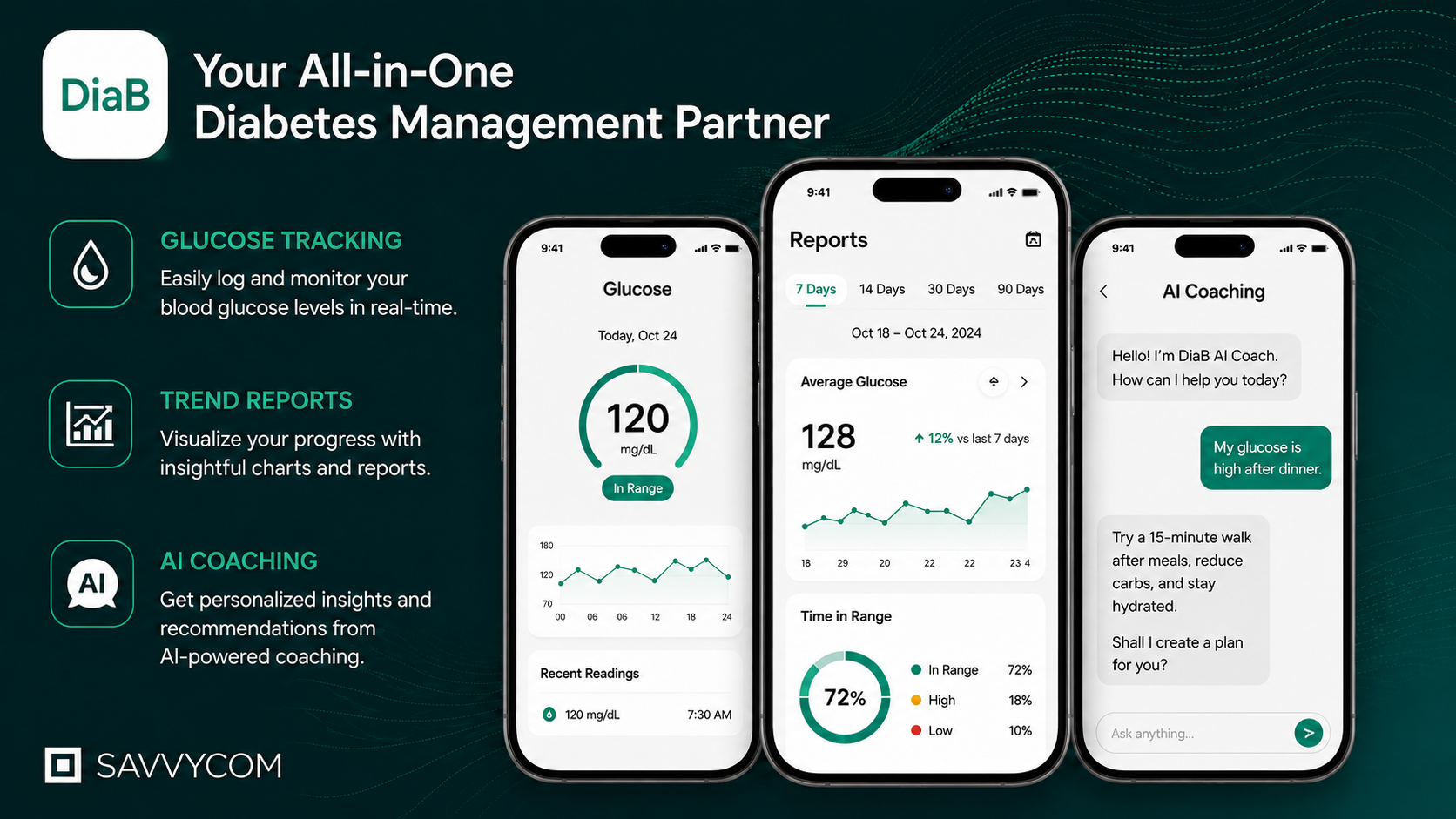
DiaB is a diabetes management app that combines blood glucose logging, medication and insulin tracking, meal and carbohydrate recording, and AI-powered coaching to help people with diabetes manage their condition between clinical appointments. It generates trend reports that patients can share with their endocrinologist or GP, making it a practical bridge between self-management and clinical care.
Built by Savvycom, DiaB is designed for the specific management patterns of Type 1 and Type 2 diabetes, covering the data capture and pattern recognition that general health apps do not handle at sufficient depth for chronic disease management. Where general aggregators like Apple Health collect glucose readings as isolated data points, DiaB correlates glucose trends with meal intake, medication timing, and activity levels to surface patterns that inform treatment adjustments. The AI coaching engine provides contextual recommendations, such as flagging consistently high post-meal readings or identifying insulin timing gaps, that patients can discuss with their clinician at the next visit.
Best for: People living with diabetes who want a structured, condition-specific tool for self-management and clinical record sharing, beyond what general health tracking apps provide.
 3. Which medical record app fits which use case?
The right app depends on whether the primary need is aggregating wearable data, accessing clinical records from health systems, managing medications, or tracking a specific chronic condition.
| App | Primary use case | Clinical record access | Free? | Platform |
| Apple Health | Aggregation + clinical record import | FHIR API | Free | iOS |
| Health Connect | Health data aggregation (Android) | Limited (via partners) | Free | Android |
| CommonHealth | Clinical record portability | FHIR API | Free | Android |
| MyChart | Epic patient portal | Full (Epic systems) | Free | iOS + Android |
| Medisafe | Medication management | Medication list import | Free (premium tier) | iOS + Android |
| HealthEngine | AU appointment + records | AU primary care | Free | iOS + Android (AU) |
| DiaB | Diabetes management | Glucose + medication logs | Contact developer | iOS + Android |
4. What is the best free medical app?
Apple Health (iOS) and CommonHealth (Android) are the best free medical record apps in 2026 for patients who want clinical record portability. Medisafe is the best free option for medication management. Health Connect (Android) is the best free aggregator for Android users outside FHIR-participating markets.
All four are genuinely free for core functionality, with no paywalls on the record-keeping and access features. Apple Health is pre-installed on every iPhone and requires no download or account creation to use basic features. CommonHealth is open-source and non-commercial. Medisafe’s free tier covers the core medication tracking, reminder, and interaction checking features that most users need; the premium tier adds pharmacy integration and advanced reporting.
The free apps that address “best free health tracking app” are the same: Apple Health and Health Connect for wearable-integrated health tracking, and condition-specific apps like DiaB for people who need deeper tracking for a specific diagnosis. Most free health tracking apps monetize through premium features, data partnerships, or insurance integrations, not through direct subscription fees for the core tracking functionality.
5. How to choose a personal medical record app
Four criteria determine the right personal medical record app: which platform your phone runs, which health systems you use and whether they support FHIR record access, whether your primary need is clinical record access or health condition tracking, and your data privacy preferences.
iPhone user, want clinical record import
Apple Health: FHIR record access, on-device storage, and connects to all major wearables.
Android user wants health data hub
Health Connect: Unified Android health data layer, Wear OS integration, app-level permissions.
Android user wants clinical record access
CommonHealth: FHIR-based, open-source, non-commercial, on-device storage.
Patient at an Epic-based health system
MyChart: Full clinical record access, secure messaging, and appointment management.
Managing multiple medications
Medisafe: Drug interaction checking, adherence tracking, and family notifications.
Living with diabetes
DiaB: Glucose-meal-medication correlation, AI coaching, clinical trend reports.
Australian patient (multi-provider)
HealthEngine: 6M+ patients, GP/specialist booking, AU practice management integration.
Data privacy: Apple Health stores data on-device and requires explicit permission for each app to read or write health data. CommonHealth is non-commercial and open-source. Commercial apps (Medisafe, HealthEngine) have privacy policies and data-sharing practices that should be reviewed. Understand whether the app sells or shares health data before entering sensitive information.
6. Frequently asked questions
Going deeper: this guide covered the patient-facing apps and how to choose between them. For the technical side of how healthcare organizations build the systems these apps connect to EHR integration, FHIR implementation, compliance architecture, and development costs read the complete guide: Healthcare Software Development: A Complete Guide for Buyers and Decision-Makers (2026). For telemedicine platform options, see: 8 Best Telemedicine Software Providers in 2026.
Looking for a Trusted Tech Partner That Delivers Your Measurable Values?
Savvycom builds custom healthcare apps and platforms for health systems, clinics, and digital health companies across APAC, Australia, and the US, including telemedicine, chronic disease management, and hospital information systems.
Explore healthcare IT solutions: Healthcare IT Solutions