Enterprise Digital Transformation: A 2026 Guide
Enterprise digital transformation is the coordinated modernization of technology, processes, and operating models across a large, multi-unit organization. It differs from smaller transformations in three structural ways: the scale of coordination across business units, the complexity of decades-old legacy systems, and the need to satisfy multiple regulatory jurisdictions at the same time.
Consider a concrete case. A financial services enterprise in South Korea ran its foreign exchange operations on manual, disconnected processes spread across teams. The constraint was not ambition; it was that any new system had to work within strict South Korean financial data regulations while connecting to settlement infrastructure built years earlier.
Savvycom rebuilt the operation as a multi-agent automation platform on GPT-4o and LangGraph, with five specialized agents handling user management, FX rate, settlement, exchange, and transaction processing. Over a three-month build, processing time dropped 60% and operational efficiency improved 40% against the client’s manual baseline, all within the compliance boundaries a generic cloud architecture would have breached. That project is enterprise transformation in miniature: the technology was the straightforward part, and the coordination, compliance, and integration were where the real work lived.
This guide covers enterprise transformation from the angles that matter at scale: operating models, legacy modernization, multi-BU governance, and the build-versus-partner decision. For the foundational concepts, see the guide on what is digital transformation.
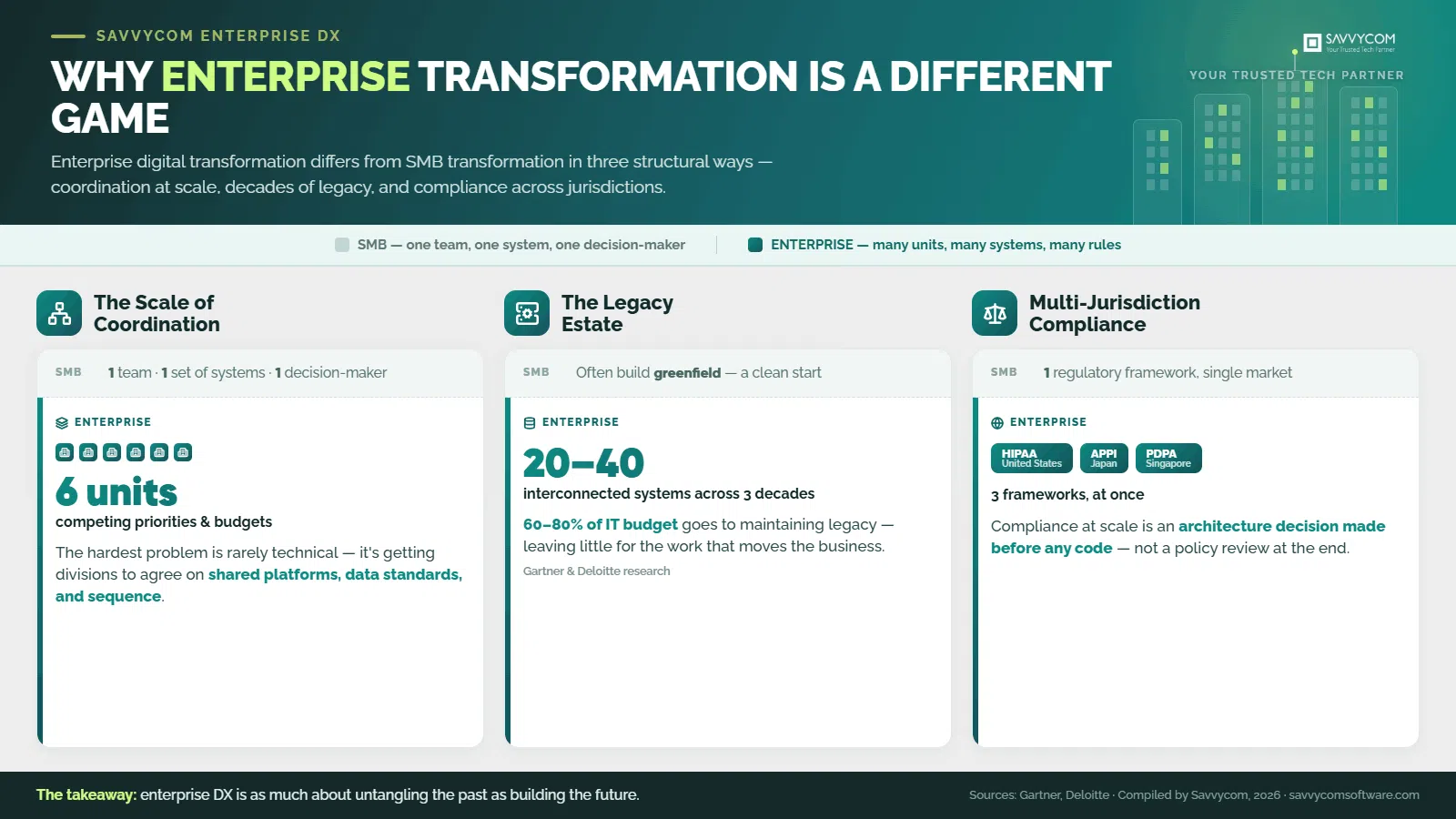
savvycom-enterprise-vs-smb-transformation
1. What makes enterprise digital transformation different from SMB transformation?
The scale of coordination
An SMB transformation involves one team, one set of systems, and one decision-maker. An enterprise transformation involves six business units with competing priorities, each with its own budget, its own legacy systems, and its own definition of what success looks like. The hardest problem is rarely technical. It is getting the divisions to agree on shared platforms, shared data standards, and a shared sequence when each one wants to be first.
The legacy estate
SMBs often build greenfield. Enterprises modernize an estate of 20 to 40 interconnected systems built across three decades. Gartner and Deloitte research consistently show enterprises spend 60 to 80% of their IT budget maintaining legacy systems, leaving little for the work that moves the business. The transformation is as much about untangling the past as building the future.
Multi-jurisdiction compliance
A single-market company complies with one regulatory framework. An enterprise operating across the US, Japan, and Singapore operates under HIPAA, APPI, and PDPA at once, each with different consent, storage, and cross-border transfer rules. Compliance at enterprise scale is an architecture decision made before any code is written, not a policy review at the end.
2. The enterprise transformation operating model
Centralized, hub-and-spoke, or decentralized
The operating model determines who decides what. The three dominant structures each carry different trade-offs at enterprise scale:
|
Operating model |
How it works |
Best for |
Trade-off |
|
Centralized |
A single transformation office owns strategy, architecture, platform decisions, and execution |
Highly regulated enterprises needing consistency and control across all units |
Slower to respond to unit-specific needs; can feel imposed |
|
Hub-and-spoke |
The central office sets standards, architecture, and shared platforms; business units execute within those guardrails |
Most large multi-BU enterprises balancing consistency with unit autonomy |
Requires mature governance to prevent drift between hub and spokes |
|
Decentralized |
Each business unit runs its own transformation with minimal central coordination |
Conglomerates with genuinely independent divisions and no shared systems |
Creates duplicate platforms and data silos; hardest to keep coherent |
Not sure which model fits your organization? The interactive selector below scores your situation across six questions and points to a starting model.
Indicative only. Operating-model choice should be validated in a structured discovery phase against your actual unit structure and regulatory map.
The transformation office and executive sponsorship
Every successful enterprise transformation has a named owner with decision authority, increasingly a chief transformation officer. Bain research shows organizations with a dedicated transformation-officer role capture 24% more of their planned transformation value. The role exists because transformation crosses every business unit, and without an owner who reports to the CEO, it becomes a set of disconnected IT projects.
Funding models
Annual budget cycles do not fit a multi-year transformation. Leading enterprises are replacing them with product and platform funding models that allocate continuously based on outcomes, so funding follows what is working rather than what was forecast a year earlier.
3. Legacy system modernization at enterprise scale
The modernization patterns: the 7 Rs
There is no single “modernize” button. Mature enterprises apply one of seven approaches per system, not uniformly across the portfolio:
A practical rule from enterprise practice: rehost or replatform to stop the bleeding quickly, then refactor or rearchitect only the systems that are genuine competitive differentiators.
The integration layer is the bottleneck
In enterprise deployments, the integration layer is consistently underestimated. Connecting new capabilities to systems running HL7 v2, proprietary APIs, and SOAP web services alongside modern REST endpoints is harder than building the new capability itself. A business that believes it has one integration point typically discovers seven once it starts cataloguing actual dependencies.
Anti-pattern: big-bang replacement
The most expensive enterprise modernization mistake is rip-and-replace. Gartner recommends continuous modernization over big-bang replacement, and McKinsey research on insurance core replacements found they routinely run more than 50% over budget. The alternative, a phased strangler-fig migration that incrementally replaces the old system while it keeps running, reaches positive ROI far sooner than a full rewrite. The VA electronic health record modernization, which ballooned from $10 billion to $37 billion, is the cautionary example of what big-bang scope does at enterprise scale.
4. How do enterprises govern transformation across multiple business units?
The standards-versus-autonomy balance
The central question in multi-BU governance is what the center controls and what the units decide. The pattern that works: the center owns architecture standards, security, identity, and shared data platforms, the things that must be consistent to avoid silos. Business units own execution, prioritization, and unit-specific workflows, which should adapt to local needs. Getting this line wrong in either direction stalls the program.
Cross-BU platform decisions
Some decisions cannot be made per business unit. Shared data platforms, identity and access management, and security architecture must be enterprise-wide, or the organization ends up with six incompatible data lakes and no single view of the customer. These are the decisions the central transformation office must own, even when individual units would prefer their own tools.
Managing competing priorities
Every business unit wants to be first. Sequencing is a governance decision, not a technical one. The most effective approach front-loads the units where data is ready and business impact is measurable within 90 days, then uses those early wins to build momentum and credibility for the harder units. Attempting to transform all units simultaneously is the fastest route to a stalled program.
5. Change management is the primary enterprise risk
Why enterprise change management is harder
The scale of the workforce is the key multiplier. Changing how 50 people work is a project. Changing how 15,000 people work across six business units and four countries, each with its own culture, language, and entrenched processes, is the actual transformation. Organizations that follow a structured change-management framework are consistently more likely to hit their goals than those that treat adoption as an afterthought. For the practices that separate the two, see our guide on the keys to successful digital transformation.
The adoption measurement gap
Most enterprises measure whether a system was deployed, not whether it is used. The metric that matters is the ratio of active users to licensed users, tracked by department, weekly, for the first six months. Adoption variance between departments reveals where change management is working and where it is not, and lets leadership intervene before a rollout fails quietly.
Distributed change ownership
At enterprise scale, change cannot be driven from the center alone. It requires change champions embedded within each department: people who understand the local context, handle questions in real time, and surface resistance early. When change management is underfunded and treated as an afterthought, adoption stalls and the software investment fails to return, regardless of how good the technology is.
6. Enterprise transformation in regulated APAC markets
Multi-market compliance architecture
An enterprise running analytics across facilities in Japan, South Korea, and Singapore cannot default to a single cloud region. APPI restricts cross-border transfers from Japan; PIPA governs South Korean data; PDPA covers Singapore and Thailand. The architecture must be designed for the strictest applicable framework and account for where each jurisdiction requires data to physically reside, a constraint that shapes platform selection before the first line of code.
Case study: enterprise operations digitization in South Korea
The foreign exchange platform introduced at the start of this guide is worth returning to in technical detail. The core challenge was regulatory: South Korean financial data rules meant the system could not simply run on a default cloud region. Savvycom built the multi-agent platform on GPT-4o and LangGraph, with five specialized agents across user management, FX rate handling, settlement, exchange, and transaction processing, each operating inside the compliance perimeter.
The architectural lesson is the transferable part: the compliance boundary shaped the design from the first decision, not the last.
Data sovereignty and geopatriation
Data sovereignty pressure is reshaping where enterprises place workloads, moving data from global public clouds toward sovereign or regional infrastructure. For APAC enterprises, the same pressure applies. Confidential computing, which processes encrypted data without exposing it, is becoming the enabling technology for compliant cross-border analytics where data residency rules would otherwise prevent combining datasets.
7. Build, buy, or partner: the enterprise sourcing decision
When to build in-house
Building makes sense when the capability is core competitive IP, the requirements are stable enough to justify permanent investment, and the organization already has engineering talent at the required depth. The risk is the timeline: hiring and ramping an enterprise-grade team takes 12 to 18 months, during which competitors who partnered are already in production.
When to partner
Partnering makes sense when speed matters, when the organization needs specialized compliance experience it does not have internally, or when the use case is complex enough that getting it wrong costs more than the engagement. The value a partner brings is rarely better technology; it is the change-management and integration experience that determines whether a deployment actually scales past the pilot. For how Savvycom structures that delivery, see how we deliver digital transformation.
Evaluating enterprise transformation partners
When the decision is to partner, the objective criteria that separate partners who deliver from those who present well are documented production references at a similar scale and regulatory complexity, a structured discovery phase that produces a realistic budget before any fixed price, demonstrated integration experience with legacy environments like yours, and post-launch support scoped as a standard deliverable rather than an add-on. Certifications such as ISO 27001 and ISO 9001 are baseline signals, not proof of domain competence.
8. Frequently asked questions
What are the four types of digital transformation?
The four types are process transformation, business model transformation, domain transformation, and cultural or organizational transformation. Process transformation modernizes internal workflows. Business model transformation changes how the company creates and delivers value. Domain transformation expands into new technology-enabled markets. Cultural transformation shifts how the organization works and makes decisions. Enterprise programs typically run all four in parallel, which is what makes them harder to coordinate than single-focus SMB transformations.
What is enterprise data transformation?
Enterprise data transformation is the process of restructuring how a large organization collects, stores, governs, and uses data, moving from fragmented systems into a unified, governed data architecture that supports analytics and AI. It is a core component of digital transformation, not a separate initiative. At enterprise scale, the challenge is consolidating data spread across dozens of legacy systems with inconsistent formats while satisfying data-residency requirements across jurisdictions such as GDPR, APPI, and PDPA.
What is an enterprise digital platform?
An enterprise digital platform is a shared technology foundation combining data infrastructure, integration services, identity management, and application-development tools that multiple business units build on rather than creating separate systems. The platform model is what lets large organizations avoid duplicate tools and data silos across divisions. It centralizes the components that must stay consistent, such as security and data standards, while giving units flexibility to build unit-specific applications on top.
How much does enterprise digital transformation cost?
Enterprise transformation programs run from several hundred thousand to tens of millions of dollars, delivered over 2 to 5 years in phases. The largest cost drivers are legacy system integration, multi-market compliance architecture, and change management, which should receive a dedicated budget rather than a residual allocation. Full-scale enterprise modernization alone typically runs $2 million to over $10 million.
Related reading
- What Is Digital Transformation? A Complete Guide
- Digital Transformation Checklist: 6 Phases
- Top Digital Transformation Trends in 2026
Looking for a Trusted Tech Partner That Delivers Your Measurable Values?
Savvycom delivers enterprise transformation programs across BFSI, healthcare, logistics, and retail in APAC, Japan, South Korea, Australia, and the US, from discovery and architecture through legacy modernization, integration, and post-launch optimization.
Explore the engagement model: Digital Transformation Solutions