Logistics Software Development: A Complete 2026 Guide
By the Head of Logistics & Supply Chain Tech, Savvycom
The hardest part of a logistics software project is almost never the algorithm. On a container yard automation build our team delivered in 2024, the computer vision model that read container IDs off camera feeds was working within weeks. What took the rest of the engagement was everything around it: matching those reads against shipping manifests, reconciling them with customs documents, and getting the result into the client’s existing systems fast enough to be worth having.
That gap between the smart part and the shipped part is what this guide is about. Logistics software development is the design and engineering of digital systems that automate and optimize how goods move, sit in storage, and get tracked across a supply chain: warehouse management, transportation management, fleet, order, and supply chain visibility platforms.
The market has grown accordingly. Global logistics software is worth roughly $17.6 billion in 2026, expanding at about 7.8% annually, with Asia-Pacific the fastest-growing region at roughly 11% CAGR. One caveat worth knowing before you cite any of those numbers in a board deck: market definitions vary enormously. The same analysts who size “logistics software” at $17.6 billion size supply chain management software at $36.4 billion, and digital logistics higher still. They are counting different things. Check the scope before you compare.
1. What is logistics software development?
Custom, off-the-shelf, or platform-based
Most enterprises end up hybrid: a commercial core, extended and integrated with custom components. That is not a compromise, it is usually the correct answer. Building a warehouse inventory engine from scratch when twenty vendors sell one is rarely defensible. Building the exception-handling logic your operation runs on, when no vendor models it, often is.
Where logistics software sits in the tech stack
Logistics software rarely operates alone. It sits between the ERP system (finance, procurement) and the physical operation (warehouses, vehicles, devices), exchanging data with CRM, e-commerce platforms, carrier systems, and customs authorities. Being connected to that many systems, internal and external, is what makes logistics software integration-heavy by nature.
Why logistics software differs from general enterprise software
Three characteristics set it apart. It is real-time: a delayed shipment status is a business problem, not a reporting inconvenience. It is high-volume: large operators process hundreds of thousands of events per day. And it is multi-party: data flows across carriers, ports, customs, suppliers, and customers, none of whom share a single system. These constraints shape every architecture decision that follows.
2. What software is used in logistics?
|
System |
Primary job |
Who lives in it daily |
Go deeper |
|---|---|---|---|
| WMS | System of record for what is in the warehouse and where | Warehouse supervisors, pickers | WMS guide |
| TMS | Plans and executes physical movement between locations | Transport planners, freight desk | Transportation tech |
| Fleet | Tracks vehicles, fuel, driver behavior, maintenance | Fleet managers, compliance | – |
| OMS | Decides which location fulfills which order | Order desk, e-commerce ops | Inventory tools |
| Visibility | Single view of goods in transit across all parties | Control tower, customer service | Supply chain visualization |
| Last-mile | Final leg routing, proof of delivery, returns | Dispatchers, drivers | – |
Warehouse management systems (WMS)
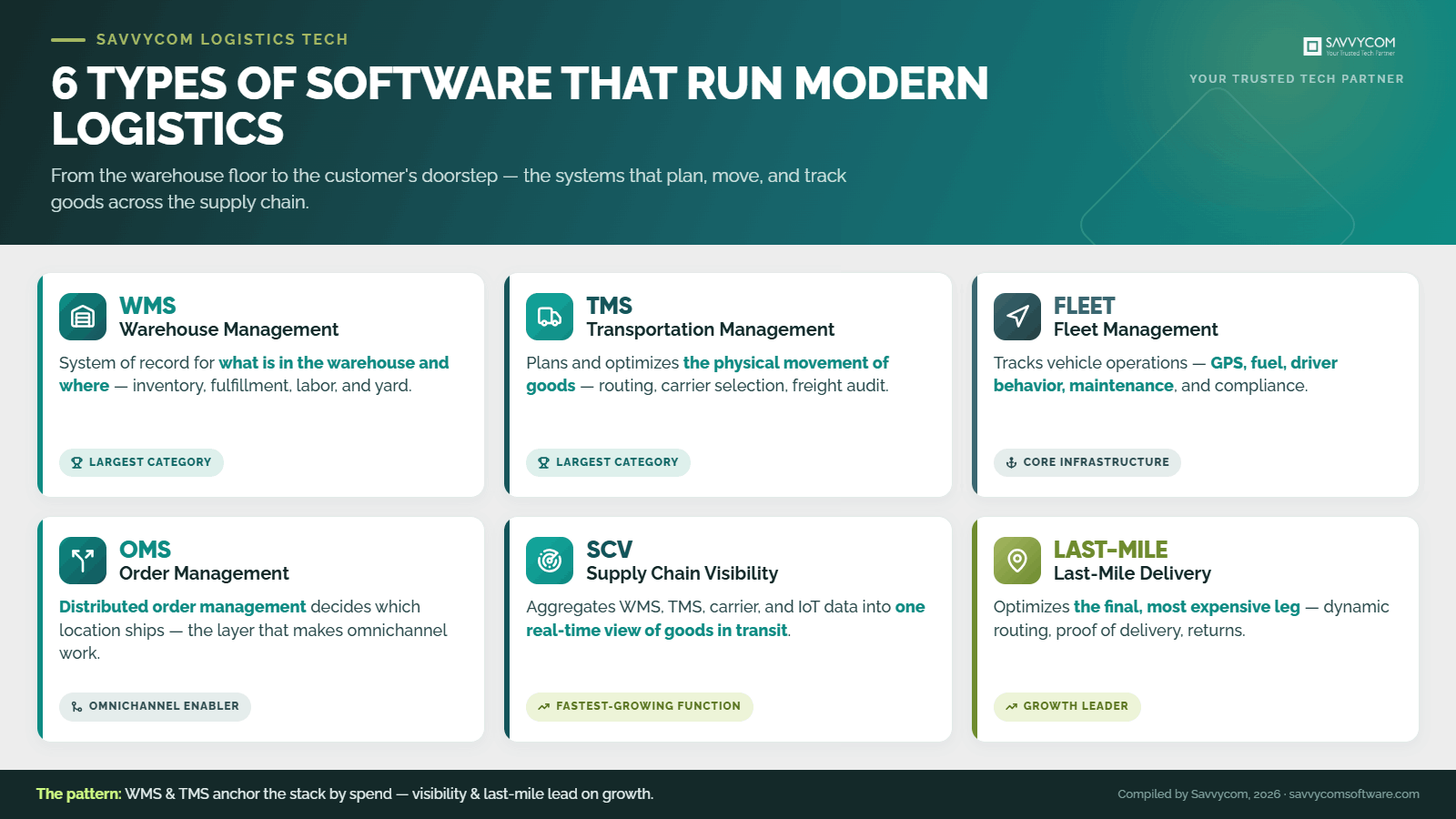
A WMS optimizes warehouse operations: inventory tracking, order fulfillment, labor management, and yard management. It is the system of record for what is in the warehouse and where. WMS and TMS are consistently the two largest software categories in logistics, with WMS driven by e-commerce and retail fulfillment volume.
Transportation management systems (TMS)
A TMS plans, executes, and optimizes the physical movement of goods: route optimization, carrier selection, freight audit, and shipment tracking. Growth here tracks e-commerce volume and the complexity of cross-border trade. If your freight spend is significant and your carrier mix is more than two or three, a TMS usually pays for itself on freight audit alone.
savvycom-logistics-software-6-types
Fleet management software
Fleet management software tracks and optimizes vehicle operations: GPS tracking, fuel management, driver behavior monitoring, maintenance scheduling, and compliance. For operators running their own vehicles rather than relying solely on carriers, this is core infrastructure rather than an add-on.
Order management systems (OMS)
An OMS manages the order lifecycle from creation to fulfillment across multiple channels and warehouses. It is the layer connecting e-commerce and sales channels to warehouse and transportation execution.
The distinguishing capability of a modern OMS is distributed order management. When an order arrives, the system decides which warehouse, store, or fulfillment center should ship it, weighing inventory location against shipping cost and delivery speed. This is what makes omnichannel retail work: buy online, pick up in store, ship from store. A basic e-commerce platform cannot coordinate that on its own.
Supply chain visibility and tracking platforms
Visibility platforms aggregate data across WMS, TMS, carrier systems, and IoT devices to provide a single real-time view of goods in transit. Of the functional categories, this is the one growing fastest, pushed by the need for end-to-end tracking across supply chains that keep getting longer and less predictable.
Last-mile delivery software
Last-mile delivery software optimizes the final and most expensive leg: dynamic routing, proof of delivery, real-time customer tracking, and reverse logistics for returns. Among application-level categories it is the growth leader, propelled by same-day and next-day delivery expectations that most networks were never designed to meet.
3. What are the core features of modern logistics software?
Warehouse automation is where the gap between demo and production is widest. A barcode upgrade is a project; adding vision-based picking or broader logistics automation is a change-management program that happens to involve software. On the analytics side, the cheapest early win is usually not a forecasting model at all but RPA on the repetitive back-office work surrounding it, which pays back in months rather than quarters.
4. How does the logistics software development process work?
5. Technology stack for logistics software
Cloud and deployment models
Cloud accounts for roughly 62% of the logistics software market in 2026, driven by scalability and real-time data access. Large enterprises with data residency or heavy customization requirements still retain on-premise or hybrid models, and in cross-border operations that is often a compliance decision rather than a preference. But the direction is clear.
Real-time data streaming and IoT
Real-time logistics runs on streaming infrastructure. Apache Kafka handles high-throughput event streams from GPS trackers, IoT sensors, and scanning devices. This is what lets a visibility platform show goods moving in near real time rather than in overnight batches.
Computer vision and OCR for automation
Computer vision automates what used to require manual scanning. Models like YOLOv8 for object detection and PaddleOCR for text extraction read container IDs, license plates, and shipping labels from camera feeds. It is one of the highest-impact applications of AI in logistics operations, and the pattern generalizes well beyond containers, as our work on AI-powered document processing shows.
Integration middleware and EDI standards
The supply chain runs on EDI. EDIFACT (international) and ANSI X12 (North America) govern how logistics data is exchanged between trading partners, and neither is going anywhere. Modern middleware bridges those standards with REST APIs so new software can talk to legacy partner systems and modern platforms at the same time.
6. How much does logistics software development cost?
|
Scope |
Typical cost |
Timeline |
Example |
|---|---|---|---|
| Single-function tool | $50,000–$120,000 | 3–6 months | Route optimization module, proof-of-delivery app |
| Mid-scope module | $120,000–$300,000 | 6–12 months | Custom WMS or TMS for a single operation |
| Multi-module platform | $300,000–$500,000+ | 9–18 months | Integrated WMS + TMS + visibility across a network |
| Enterprise transformation | $500,000+ | 18+ months | Full logistics platform with multi-party integration |
What actually drives the number
Ranked by how much they typically move a logistics software budget, heaviest first:
The ordering matters more than precise percentages. Most budget overruns in logistics projects come from the top two lines being scoped as if they were the bottom two.
The hidden costs
The build cost is rarely the whole cost. Integration with existing systems, data migration from legacy platforms, and change management for warehouse and transport staff are consistently underestimated. Integration alone can equal or exceed the cost of the core software when many external systems are involved. Budget for it explicitly, or it will come out of your contingency in month four.
Build, buy, or customize
The ROI calculation depends on fit. If a commercial platform covers 80% of the workflow, buying and extending it is usually cheaper than building. If the operation depends on workflows no commercial product handles, which is common for specialized 3PLs and cross-border operators, custom development pays back through efficiency the off-the-shelf product could not deliver.
7. What makes logistics software integration so difficult?
EDI and API integration across the supply chain
A single shipment can touch a dozen systems, and each may use a different standard:
Building integration that reliably exchanges data across all of them, in real time, is the core engineering challenge of logistics software. Every hop is a place where a format mismatch or a silent timeout can strand a shipment status.
Legacy system integration
Most logistics operators run systems built over decades. Connecting a modern visibility platform to a 15-year-old WMS on an older EDI version is routine work in this field, and it is where timelines most often slip. Planning for it upfront is the difference between a project that ships and one that stalls in UAT.
Cross-border data compliance
Logistics is inherently cross-border, which means logistics data crosses jurisdictions. Operators moving goods across Asia-Pacific handle customs data requirements alongside several separate data protection regimes:
|
Market |
Framework |
Practical architecture impact |
|---|---|---|
| Singapore | PDPA | Consent and transfer limitation on partner data sharing |
| Thailand | PDPA | Local processing records; transfer safeguards |
| Japan | APPI | Restrictions on onward transfer to third parties |
| South Korea | PIPA | Among the stricter consent and localization regimes in the region |
For operations spanning multiple markets, this shapes where data is stored and how partner integrations are designed. It is an architecture consideration, not a legal afterthought.
8. A real-world logistics software deployment
The operation had four compounding problems. Containers were hard to locate, so yard moves stalled. There was no specialized yard management system, so records were kept manually and drifted out of sync. Internal container movements went untracked entirely, which meant misplacement with no audit trail. And daily container volume was high enough that all three problems reinforced each other into a bottleneck.
Savvycom built a real-time yard management system with four components:
The lesson generalizes. In logistics software the intelligence is rarely the hard part. The real-time data pipeline connecting sensors and cameras to operational decisions is where the engineering difficulty and the business value both concentrate.
9. How do you choose a logistics software development approach?
Score your operation against the seven conditions below. The more that apply, the further you should move toward custom.
|
Condition |
Applies to you? |
|---|---|
| Core workflows differ meaningfully from standard warehousing or shipping practice | Yes / No |
| An off-the-shelf platform would need significant workarounds to fit | Yes / No |
| You need deep integration with proprietary or heavily customized internal systems | Yes / No |
| Real-time operational data is a competitive advantage, not just reporting | Yes / No |
| You run cross-border flows with customs or multi-jurisdiction data requirements | Yes / No |
| You plan to offer this software to customers or partners externally | Yes / No |
| You have budget and appetite for an engagement of 9 months or longer | Yes / No |
When off-the-shelf works
For standard operations, meaning conventional warehousing, common shipping lanes, and typical order flows, a commercial WMS or TMS extended through configuration is usually the fastest and lowest-risk path. If a commercial product covers most of your workflow, building from scratch rarely justifies the cost or the time.
When custom development is justified
Custom development earns its place when off-the-shelf options require significant workarounds, when you need deep integration with proprietary systems, when you are building a product to sell externally, or when your operational model is itself a competitive differentiator no commercial product supports.
Evaluating a development partner
When the decision is to build with a partner, the criteria that actually matter are documented logistics domain experience, production references at similar scale and complexity, demonstrated EDI and legacy integration capability, a structured discovery phase that produces a realistic budget, and post-launch support scoped as standard rather than sold later. Certifications like ISO 27001 are baseline signals, not proof of logistics competence.
10. Frequently asked questions
What software is used in logistics?
The main software used in logistics is warehouse management systems (WMS), transportation management systems (TMS), fleet management software, order management systems (OMS), supply chain visibility platforms, and last-mile delivery software. Most operations run several of these together, integrated with an ERP system that handles finance and procurement.
Is logistics part of ERP?
Logistics connects to ERP but is not the same thing. ERP manages finance, HR, and procurement, and many suites include basic logistics modules. Dedicated systems like WMS and TMS go far deeper, which is why most enterprises integrate specialized logistics software with their ERP rather than relying on ERP alone.
Should you build custom logistics software or buy an off-the-shelf platform?
Buy when a commercial platform covers roughly 80% of your workflow, which is the common case for conventional warehousing and standard shipping lanes. Build when your operating model is itself a differentiator, when integration with proprietary systems runs deep, or when you intend to sell the software externally.
How long does it take to develop logistics software?
A focused single-function tool takes 3 to 6 months. A custom multi-module platform integrating WMS, TMS, and real-time tracking runs 9 to 18 months. The largest timeline variable is integration scope: how many internal and external systems must connect via EDI and APIs, and how modern those systems are.
Looking for a Trusted Tech Partner That Delivers Your Measurable Values?
Savvycom builds logistics and supply chain software: warehouse, transportation, visibility, and computer-vision automation systems for operators across Asia-Pacific and the US.
Explore the engagement model: Custom Software Development