What Is Digital Transformation? Complete Business Guide
Reviewed by Tue Nguyen, Chief AI Officer at Savvycom
Enterprises are spending more on digital transformation than ever before. McKinsey's research finds that roughly 70% of those programs don't reach their goals. The gap between investment and outcome is not a technology problem. Technology has never been more affordable or accessible.
The gap is a strategy and execution problem. Organizations invest in tools before knowing what problem they're solving. They underestimate how much their existing processes, data quality, and company culture will push back on change. And they measure success by activity (systems deployed, users trained, APIs connected) rather than by the business outcomes those activities were meant to produce.
This guide covers what digital transformation actually means, why most programs stall, how to build one that works, and what it looks like across banking, healthcare, logistics, and manufacturing.
1. What does "digital transformation" actually mean?
Digital transformation means changing the way your business works from the ground up, not just buying better tools. Digitization moves paper processes online. Digitalization uses digital tools to speed up those processes. DX goes further: it changes how the business creates and delivers value in the first place.
The distinction matters because most organizations are doing digitization or digitalization and calling it transformation. Scanning paper invoices is digitization. Routing those invoices through an automated approval workflow is digitalization. Rebuilding how your company pays suppliers, using live financial data and AI to flag problems automatically, is digital transformation. Not faster invoicing. A different way of working entirely.
Three concrete signs tell you whether a change is real digital transformation:
- Value is created in a new way, not just faster. A bank that builds a mobile version of its branch experience has digitized. A bank that redesigns its loan approval process so decisions happen in minutes using live transaction data, instead of weeks using old paperwork, has transformed.
- The change is hard to reverse. You can usually go back to a manual process if a digital tool breaks. You cannot easily reverse a transformation, because the old process no longer exists. The business now works differently at its core.
- The change keeps improving over time. Digital tools get faster as more people use them. Transformed businesses get smarter as more data comes in. More customer interactions means better fraud detection. More production cycles tracked means better maintenance predictions.
Across programs we have delivered in banking and healthcare across Southeast Asia, the most common mistake is thinking that buying a better tool makes a transformation. It rarely does. The tool is the last decision, not the first.
2. Why do most digital transformation projects fail?
McKinsey estimates around 70% of digital transformation programs fail to reach their goals. The failure is almost never the technology. The three root causes are: choosing technology before defining outcomes, underestimating the complexity of existing processes, and having no clear decision-making structure when the plan changes.
Each cause has a specific fix. For a full breakdown of how to handle each one in a running program, see our guide on digital transformation challenges and how to overcome them.
1. Choosing technology before defining outcomes
A leadership team approves a platform investment (an ERP upgrade, a cloud move, an AI pilot) before anyone defines what business result it should produce. The program runs for 18 months, delivers something, and then tries to build a case for what was built. The case is always optimistic. The results are always harder to measure than the activity.
The fix is simple but uncomfortable: define the outcome first, then work backward to the technology. "Reduce insurance claims processing time by 40% for motor policies" is an outcome. It tells you what data you need, what process must change, and what success looks like. "Modernize our claims system" is an activity. It tells you none of those things.
2. Hidden process complexity
Organizations almost always underestimate how complicated their current operations actually are. Not just in the technology, but in the workarounds, exception steps, and informal data flows that have built up over years. These don't show up in any requirements document because the people running them have stopped noticing them. They show up when a new system is deployed and suddenly nothing works the way it used to.
The fix is a real process audit before picking any technology. Not a documentation exercise. An observation exercise: what does this process actually look like on a Tuesday when three things go wrong at once?
3. No clear decision-making structure
Things go wrong in every program. A vendor is late. A regulatory requirement changes. A technical tradeoff has to be made quickly. If every decision like this needs to go up to the C-suite, the program moves too slowly to stay on track. If there is no clear authority at all, every team makes its own call and the gaps add up into tech debt that is very expensive to fix later.
3. What are the core pillars of digital transformation?
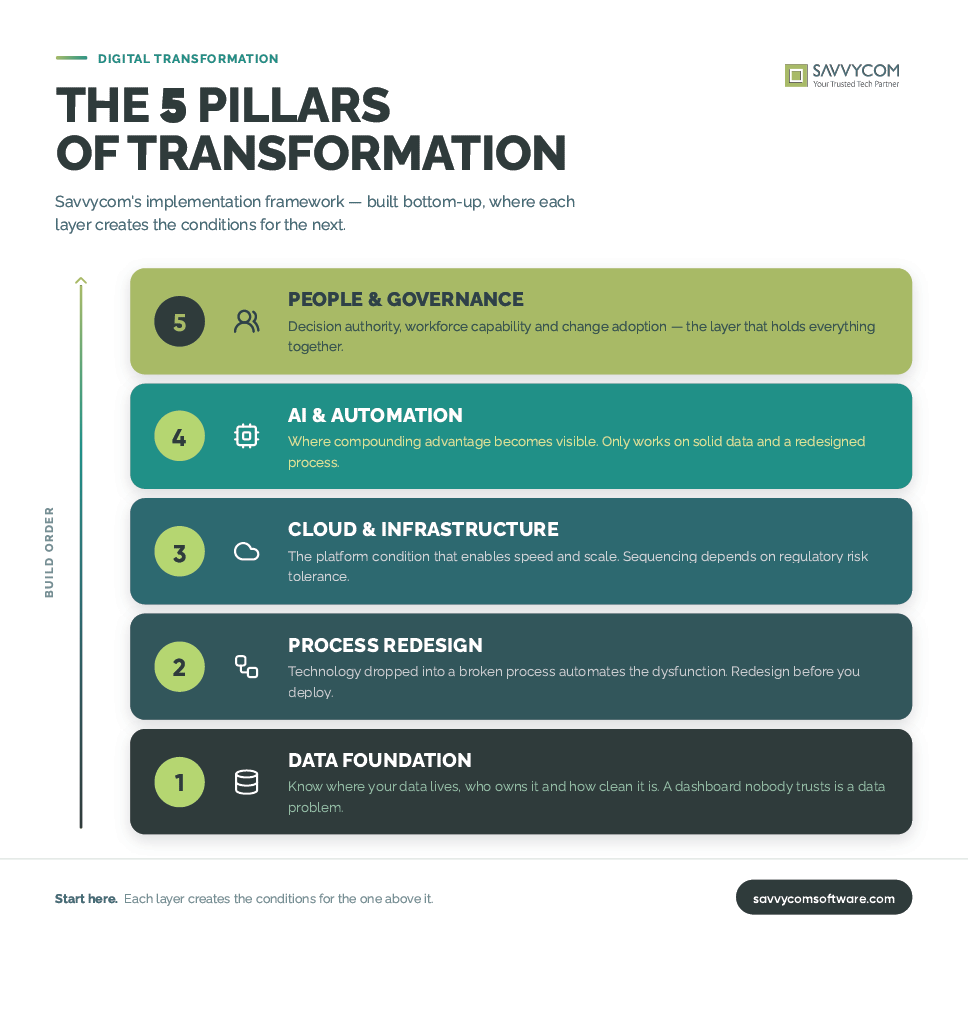
Digital transformation is built on five layers, in this order: data foundation, process redesign, cloud and infrastructure, AI and automation, and people and governance. The order matters. Each layer makes the next one possible. Skipping a layer (deploying AI without clean data, or new infrastructure without fixing the process) is the most common way programs waste money.
1. Data foundation
This is the layer most companies underinvest in, and the one that causes the most problems later on. A solid data foundation means knowing where your data lives, who is responsible for it, and how accurate it is. It does not mean a data warehouse or a fancy analytics platform right away. It means having a clear picture of what you actually have before you build anything on top of it. If your team does not trust the dashboards, that is a data foundation problem, not a visualization problem.
2. Process redesign
Technology built on a broken process just automates the problems inside it. Before picking any tool for a process, you need to understand what the process is actually supposed to do, where it breaks down, and what it would look like if it worked correctly. In our logistics and manufacturing work, we consistently find that 20 to 30% of process steps exist only because of limitations in older systems. When the process is redesigned with modern technology in mind, those steps disappear. For a practical guide on how to approach this, see our breakdown of business process redesign steps.
3. Cloud and infrastructure
Cloud migration is not a goal in itself. It is the platform that lets the layers above it work at speed and scale. The key question here is sequencing: move everything to the cloud first (faster clean break, more short-term disruption), or build new capabilities alongside your existing systems (less disruption, more complexity long-term). Both approaches work depending on your situation and risk tolerance. For a detailed breakdown of how to sequence this, see our guide on cloud migration as part of digital transformation.
4. AI and automation
This is where the real payoff from transformation starts to show up. But it only works when the layers below are solid. AI models are only as good as the data they learn from. Automation only holds up when the process underneath it is clean. The organizations that get this layer right plan their AI requirements during the data and process phases, not after. The questions to answer before any model is built: Which decisions should AI improve? What data quality does it need? Who reviews the AI's output? Getting these wrong upfront costs far more to fix later.
5. People and governance
This is the layer that determines whether the other four hold together. It covers three things: team capability (do your people have the skills to work in the new environment?), adoption (were the people who will use the systems involved in designing them?), and decision governance (who can make calls when the plan changes?). In regulated industries like banking and healthcare, governance is not paperwork. It is a hard delivery requirement. Programs that treat it as optional almost always regret it.
In the banking programs we have run, the most underfunded layer is almost always data foundation. The most skipped layer is process redesign. Both are fixable, but far more expensive to fix after the infrastructure and AI layers are already running.
4. What does digital transformation look like by industry?
Digital transformation looks different in every industry because the core challenge is different. In banking, it is the limits of legacy core systems and compliance requirements. In healthcare, it is getting clinical teams to adopt new systems and making those systems work together. In logistics, it is having real-time visibility across a supply chain run by many different parties. In manufacturing, it is connecting factory floor data to business decisions. The technology follows from those challenges, not the other way around.
Banking and financial services
The core challenge: Most commercial banks run on core systems built for overnight batch processing, not real-time operations. Every digital initiative (mobile banking, instant lending, real-time fraud detection) runs against what that core can actually do.
Programs that work start by mapping exactly what the core can and cannot do. Then they design the digital layer around those limits. In practice, this often means building specific capabilities as separate services that connect to the core through controlled interfaces, rather than replacing the core entirely. A full core replacement is possible, but it is a multi-year program with real execution risk. It is not necessary for most digital goals.
What this looks like in practice: A leading Cambodian commercial bank revamped its mobile banking platform across 192 branches. Instead of replacing the core system, the team built a modern layer on top of it, migrating over 300,000 customer records in the process. The result was a digital-first banking experience with a technical foundation built to support future products without starting from scratch again. See our guide on digital transformation in banking for more on this approach.
Healthcare
The core challenge: Clinical adoption. Systems are often built based on IT requirements, with clinical staff trained at the end. By that point, the system has been configured around assumptions that do not match how care is actually delivered. The result is a technically working system that clinical teams find ways to work around.
Programs that succeed bring clinical teams into the design process early, not just for training. This adds time upfront. It removes a lot more time and cost during rollout.
What this looks like in practice: Jio Health, a telemedicine platform we built for the Vietnamese market, launched on iOS and Android with remote consultation and e-prescription workflows built directly with licensed physicians. The clinical design work happened before engineering began. That sequencing is why the platform reached adoption rates that most telehealth deployments take 18 months to achieve. For more detail, see our healthcare digital transformation guide.
Logistics and supply chain
The core challenge: Visibility. A supply chain involves many parties (shippers, carriers, warehouse teams, customs agents, last-mile providers), each running their own systems at their own pace. Without a way to see across all of them in real time, delays and mistakes are inevitable.
The technical challenge is connecting systems that were never designed to work together, and making the data available fast enough to actually influence decisions. A status update that arrives six hours after the decision it was meant to support has no value.
What this looks like in practice: For a leading South Korean logistics company, we built an AI-powered contract review platform. The system read through contracts automatically and flagged the clauses that needed human attention. The legal team stopped spending time reading 50-page documents and focused on the calls that actually needed their judgment. Result: 50% less time on contract reviews, 95% accuracy in identifying critical clauses, and a volume of over 1,000 contracts reviewed per month. See our guide on digital transformation in logistics for more.
Manufacturing
The core challenge: Most manufacturers know their overall equipment effectiveness (OEE) score but cannot explain what is driving it. Is downtime coming from maintenance issues, quality problems, or slow changeovers? Does it vary by shift, line, or product? Without that level of detail, any improvement effort is guesswork.
The data foundation for manufacturing transformation is usually IoT: sensors on equipment feeding a shared data model that connects production, quality, and maintenance data. For more on how IoT fits into this, see our guide on IoT and digital transformation. Once that is in place, predictive maintenance, real-time quality checks, and production optimization can run on real signal rather than end-of-day reports.
What this looks like in practice: SCG, Thailand's largest industrial group, built an IoT Smart Living platform connecting device management, monitoring, and analytics across their manufacturing and property operations. With an 11-engineer team integrated into SCG's product organization, the program cut AWS infrastructure costs by 20% and delivered a platform built to scale across multiple SCG business units. See our guide on digital transformation in manufacturing for a full breakdown.
5. What are the stages of a digital transformation journey?
A digital transformation moves through four stages: Assess, Pilot, Scale, and Sustain. Each stage has a clear output that must be done before the next stage starts. Programs that skip Assess, or move to Scale before the Pilot has produced a clear result, almost always run over time and over budget.
- Assess. The output is a prioritized list of initiatives with ROI estimates, a realistic picture of where you are starting from, and a named owner for each initiative. You are done with Assess when all three of those things exist and have been checked by the people who will actually run the programs. If the list exists but the baseline assessment does not, you are not done.
- Pilot. One or two initiatives run in a controlled environment with clear success criteria. The output is a decision: scale, adjust, or stop. The discipline here is not letting the pilot run indefinitely. A pilot with no agreed decision point becomes a permanent proof of concept that costs money and teaches nothing.
- Scale. Successful pilot patterns roll out across the business. The main risk at this stage is that the conditions that made the pilot work (focused team, tight scope, engaged stakeholders) do not automatically exist at full scale. Managing this requires real investment in change management and governance before the rollout begins, not during it.
- Sustain. The new way of working is running, and the organization has the internal skills to keep improving it without external support. This is where many programs quietly fail. The program ends, the external team leaves, and the organization drifts back to old habits because no one built the internal capability to maintain what was delivered.
For a step-by-step framework on running each stage, with ownership templates and decision checkpoints, see our digital transformation roadmap guide. If you are still building the business case, our digital transformation strategy guide covers how to structure the strategy before the roadmap begins.
Where are you in your DX journey?
5 questions. Under 2 minutes. Find your stage.
6. How does Savvycom deliver digital transformation for enterprises?
Savvycom starts every engagement with a structured discovery sprint before any engineering work begins. The sprint produces three things: a clear map of the client's current data and systems, a prioritized list of initiatives with effort and ROI estimates, and a governance model that sets out who makes decisions and when.
"Most enterprises we work with have already made significant technology investments," says Tue Nguyen, Savvycom's Chief Technology Innovation Officer. "What they often lack is a layer connecting those investments to each other and to real business outcomes. We start every engagement by mapping what exists and where the gaps are, not by recommending new platforms."
The delivery model reflects Savvycom's position as an AI-native software company. AI is designed into the architecture from day one. This matters because adding AI to a system that was not built for it typically means restructuring the data model and revisiting governance decisions that were made without AI in scope. That rework costs significantly more than building it right the first time.
Savvycom's programs run across four areas where we have the deepest delivery experience:
- Core banking and fintech modernization: clients across Southeast Asia, South Korea, and Australia
- Healthcare data and clinical workflow transformation: digital health platforms and providers in Vietnam and the US
- Logistics visibility and supply chain automation: high-volume operations across multiple markets
- Manufacturing IoT and OEE analytics: industrial companies in Thailand and the broader APAC region
To learn more about how we structure digital transformation engagements, visit our digital transformation solutions page. For context on delivery in the region, see our overview of digital transformation in Vietnam.
Frequently Asked Questions
What are the 5 pillars of digital transformation?
The five pillars are data foundation, process redesign, cloud and infrastructure, AI and automation, and people and governance. Each layer creates the conditions for the one above it. Deploying AI without clean data, or new infrastructure without fixing the process, is one of the most common ways DX programs waste budget.
Why do most digital transformation projects fail?
McKinsey estimates around 70% of DX programs fail to reach their goals. The three main causes are: technology chosen before outcomes are defined, hidden process complexity that only appears during implementation, and no clear decision-making structure when things change. None of these are primarily technology problems.
How long does a digital transformation take?
A full digital transformation typically takes three to five years. A well-structured program should show measurable results within six to nine months through focused pilots. Programs that claim full transformation in under 12 months are usually describing digitalization (process improvement), not a fundamental change to how the business works.
What is an example of digital transformation in banking?
A leading Cambodian commercial bank rebuilt its mobile banking platform across 192 branches, migrating over 300,000 customer records while keeping all services running. The program moved the bank from a branch-first model to a digital-first one, with a platform built to support future products without needing another full rebuild.